Thirty-Day High-Grade Aortic Valve Block Post-Transcatheter Aortic Valve Replacement in Patients Discharged on Heart Rhythm Monitor
Mohamad S. Alabdaljabar, Mohamed Elhadi, Rajiv Gulati, Charanjit S. Rihal, Paul A. Friedman, Yong-Mei Cha, Mackram F. Eleid

TL;DR
This study examines the risk and incidence of high-grade aortic valve block after a heart procedure called TAVR, using a monitoring protocol to identify patients at risk.
Contribution
A 3-group risk stratification algorithm for predicting high-grade aortic valve block post-TAVR with high negative predictive value is validated.
Findings
7.8% of patients developed high-grade aortic valve block, with 68% being asymptomatic.
80% of high-grade aortic valve block events occurred within the first 2 weeks post-TAVR.
Male sex, baseline right bundle branch block, and post-TAVR QRS >150 ms were significant risk factors.
Abstract
Conduction disease is an important and common complication post-transcatheter aortic valve replacement (TAVR). Previously, we developed a conduction disease risk stratification and management protocol post-TAVR. This study aims to evaluate high-grade aortic valve block (HAVB) incidence and risk factors in a large cohort undergoing ambulatory cardiac monitoring post-TAVR according to conduction risk grouping. This single-center, retrospective study evaluated all patients discharged on ambulatory cardiac monitoring between 2016 and 2021 and stratified them into 3 groups based on electrocardiogram predictors of HAVB risk (group 1 [low], group 2 [intermediate], and group 3 [high]). HAVB was defined as ≥2 consecutive nonconducted P waves in sinus rhythm or bradycardia <50 beats/minute with a fixed rate for atrial fibrillation/flutter. Descriptive statistics were used to show the incidence…
Genes, proteins, chemicals, diseases, species, mutations and cell lines named across the full text — each resolved to its canonical identifier and authoritative record.
Click any figure to enlarge with its caption.
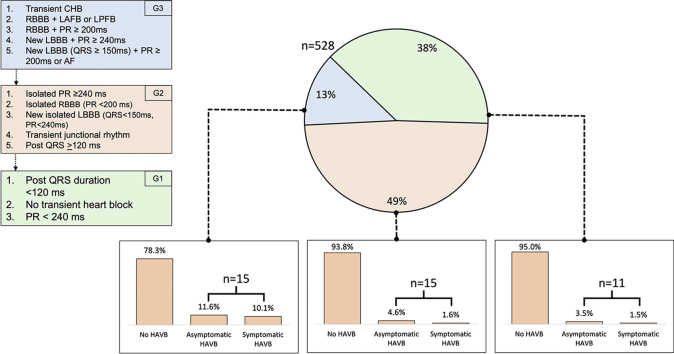 Figure 1
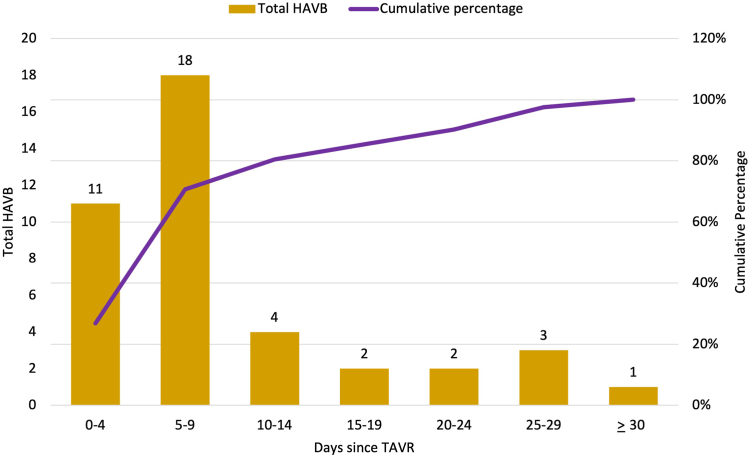 Figure 2
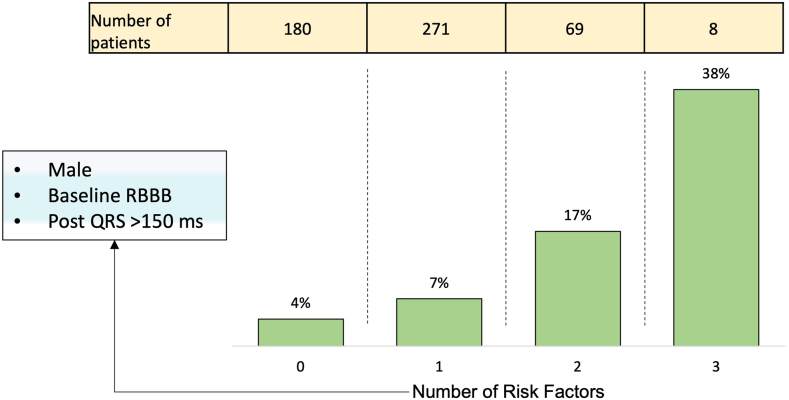 Figure 3
Peer Reviews
No public reviews on file for this paper yet. If you reviewed it on a platform where reviews are public (OpenReview, ICLR, NeurIPS, ICML), you can paste yours below so the community can read it here.
Videos
No videos yet. Explain this paper in a talk, walkthrough, or lecture? Add one.
Taxonomy
TopicsCardiac Valve Diseases and Treatments · Cardiac pacing and defibrillation studies · Cardiac Arrhythmias and Treatments