A case of giant ovarian cyst during pregnancy
Imen Ben Farhat, Haifa Bergaoui

TL;DR
This paper presents a case of a large ovarian cyst during pregnancy that required surgical intervention due to complications.
Contribution
The paper contributes a clinical case highlighting the management of a giant ovarian cyst during pregnancy.
Findings
Ovarian cysts during pregnancy can grow significantly and cause complications like previa obstruction.
Surgical cystectomy can be safely performed alongside a caesarean section when necessary.
Ultrasound is essential for monitoring ovarian cysts during pregnancy.
Abstract
The incidence of ovarian cysts in pregnancy has risen considerably since ultrasound was first routinely performed in pregnant women. This incidence is between 0.3% and 5.4%. The main risk of complication of ovarian cysts during pregnancy is adnexal torsion, estimated at around 8%. Ultrasound remains the gold standard for identifying ovarian tumors during pregnancy. A part from complications, expectant management is recommended during pregnancy in view of the maternal-fetal risk of surgery. When surgery is indicated, laparoscopy is the preferred approach during the 1st and 2nd trimesters. The ovarian tumor should not affect the delivery procedure, except in the case of a complication of suspected malignancy or a previa obstruction, as in the case of our patient. We present a 30-year-old patient with no pathological medical history who underwent surgery for a benign ovarian cyst 10 years…
Genes, proteins, chemicals, diseases, species, mutations and cell lines named across the full text — each resolved to its canonical identifier and authoritative record.
Click any figure to enlarge with its caption.
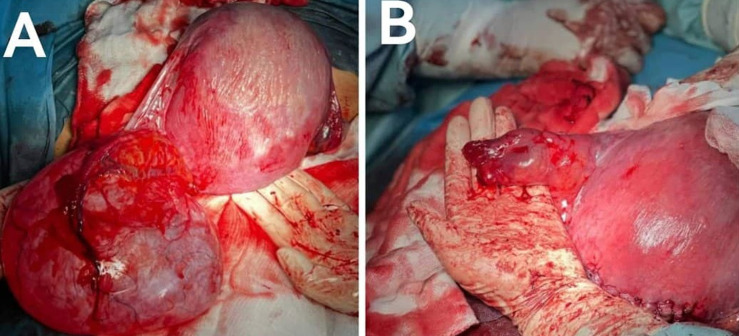 Figure 1
Peer Reviews
No public reviews on file for this paper yet. If you reviewed it on a platform where reviews are public (OpenReview, ICLR, NeurIPS, ICML), you can paste yours below so the community can read it here.
Videos
No videos yet. Explain this paper in a talk, walkthrough, or lecture? Add one.
Taxonomy
TopicsRetinal and Macular Surgery · Intraocular Surgery and Lenses · Drug-Induced Ocular Toxicity
Image en médecine
L´incidence des kystes ovariens au cours de la grossesse a considérablement augmenté depuis la pratique systématique de l´échographie chez la femme enceinte. Cette fréquence est comprise entre 0,3 et 5,4%. Le principal risque de complication des kystes ovariens durant la grossesse est la torsion annexielle, évaluée autour de 8%. L´échographie reste l´examen de référence pour caractériser une tumeur ovarienne durant la grossesse. En dehors des complications, l´expectative est recommandée au cours de la grossesse vue le risque maternofoetal de la chirurgie. Lorsqu´un acte chirurgical est indiqué, la cœlioscopie est la voie d´abord de choix au cours du 1^er^ et du 2^e^ trimestres. Les modalités de l´accouchement ne doivent pas être modifiées par la tumeur ovarienne, excepté en cas de complication de suspicion de malignité ou d´obstacle prævia comme le cas de notre patiente. Nous présentons le cas d´une patiente âgée de 34 ans sans antécédents médicaux pathologique opérée pour un kyste ovarien bénin il y 10 ans, G3P3, utérus sain qui nous consulte à 38 SA pour suivi de la grossesse. Par ailleurs, une seule consultation prénatale a été faite au cours de suivi avec à l´échographie de premier trimestre. Un kyste ovarien de 5cm. Nous avons relevé lors de la réalisation de l´échographie obstétricale la présence d´une image kystique uniloculaire anéchogène pure à paroi régulière faisant un obstacle prævia. Une césarienne prophylactique a été décidée avec kystectomie en même temps passées sans incidents.
A) aspect per opératoire du kyste de l’ovaire de 13cm réalisant un obstacle prævia ; B) aspect après kystectomie