Pubic pediculosis under the armpits of a homosexual male
Huilin Zhi, Zehu Liu, Xiujiao Xia

Abstract
Genes, proteins, chemicals, diseases, species, mutations and cell lines named across the full text — each resolved to its canonical identifier and authoritative record.
Click any figure to enlarge with its caption.
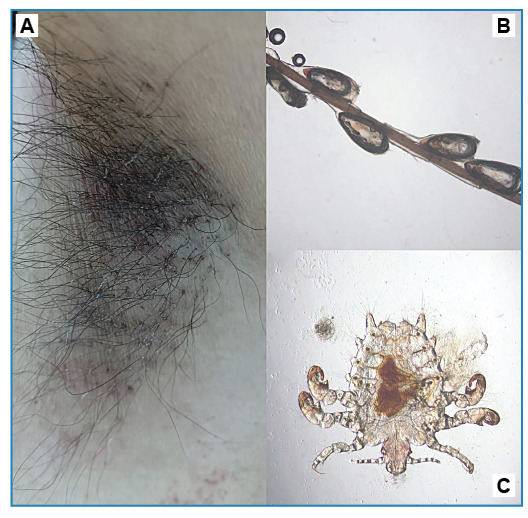 Figure 1
- —Hangzhou Municipal Science and Technology Bureau
Peer Reviews
No public reviews on file for this paper yet. If you reviewed it on a platform where reviews are public (OpenReview, ICLR, NeurIPS, ICML), you can paste yours below so the community can read it here.
Videos
No videos yet. Explain this paper in a talk, walkthrough, or lecture? Add one.
Taxonomy
TopicsDermatological diseases and infestations · Genital Health and Disease · Bartonella species infections research
A 55-year-old man who identified as homosexual visited our dermatology clinic and reported a persistent and severe itching sensation in the inguinal area and armpits over the past three months. He disclosed a history of homosexual contact and had received a diagnosis of perianal condyloma acuminatum one month prior. Physical examination revealed redness and black spots in both the groin and armpit areas, along with whitish concretions attached to the hair shafts (Figure 1A) and slow-moving parasites. Microscopy and dermoscopy revealed numerous nits glued to the hair on the armpit areas (Figure 1B), and direct microscopic examination of the armpit scraps revealed crab-like parasites (Figure 1C). We treated the patient and the sexual partner with a compound sulfur cream and instructed them to disinfect their clothes. One week after the treatment, the itching had resolved, and no lice were observed upon a follow-up examination at two weeks.
FIGURE 1:Clinical appearance of pubic lice infestation on the armpit area (A). Numerous nits attached to hair shaft from the armpit area, visualized under microscopy (×20 magnification) (B). Pubic lice morphology (×10 magnification) (C).
Lice are obligate parasites that feed only on the blood of infested hosts1. There are more than 3000 species of lice. Among them, only Pediculus humanus and Phthirus pubis (pubic lice) require humans as hosts. While pubic lice usually inhabit the hair of the pubic area, they can occasionally infest various hairy regions of the body, including under the armpits, in the beard or mustache, and on the eyebrows and eyelashes2. It is important to note that pubic lice are usually transmitted sexually and often coexist with other sexually transmitted diseases3, as in our case.
The reference list from the paper itself. Each links out to its DOI / PubMed record.
- 1Veracx A Rivet R Mc Coy KD Brouqui P Raoult D Evidence that head and body lice on homeless persons have the same genotype P Lo S One 201279 e 459032304988910.1371/journal.pone.0045903 PMC 3458819 · doi ↗ · pubmed ↗
- 2Badiaga S Brouqui P Human louse-transmitted infectious diseases Clin Microbiol Infect 20121843323372236038610.1111/j.1469-0691.2012.03778.x · doi ↗ · pubmed ↗
- 3Chosidow O Scabies and pediculosis Lancet 20003558198261071193910.1016/s 0140-6736(99)09458-1 · doi ↗ · pubmed ↗