BAR502/fibrate conjugates: synthesis, biological evaluation and metabolic profile
Claudia Finamore, Simona De Marino, Chiara Cassiano, Giuliano Napolitano, Pasquale Rapacciuolo, Silvia Marchianò, Michele Biagioli, Rosalinda Roselli, Cristina Di Giorgio, Carmen Festa, Stefano Fiorucci, Angela Zampella

TL;DR
Scientists combined a bile acid analog with fibrates to create new compounds that may help treat cholestasis and NASH by activating specific receptors.
Contribution
The paper introduces a novel library of BAR502-fibrate conjugates with promising pharmacological properties.
Findings
Compound 1 showed the highest activity among the conjugates tested.
Compound 1 is hydrolyzed in mice to release clofibric acid and BAR505, which retain dual FXR/GPBAR1 activity.
Compound 1 demonstrated good stability and cell permeation.
Abstract
BAR502, a bile acid analogue, is active as dual FXR/GPBAR1 agonist and represents a promising lead for the treatment of cholestasis and NASH. In this paper we report the synthesis and the biological evaluation of a library of hybrid compounds prepared by combining, through high-yield condensation reaction, some fibrates with BAR502.The activity of the new conjugates was evaluated towards FXR, GPBAR1 and PPARα receptors, employing transactivation or cofactor recruitment assays. Compound 1 resulted as the most promising of the series and was subjected to further pharmacological investigation, together with stability evaluation and cell permeation assessment. We have proved by LCMS analysis that compound 1 is hydrolyzed in mice releasing clofibric acid and BAR505, the oxidized metabolite of BAR502, endowed with retained dual FXR/GPBAR1 activity.
Genes, proteins, chemicals, diseases, species, mutations and cell lines named across the full text — each resolved to its canonical identifier and authoritative record.
Click any figure to enlarge with its caption.
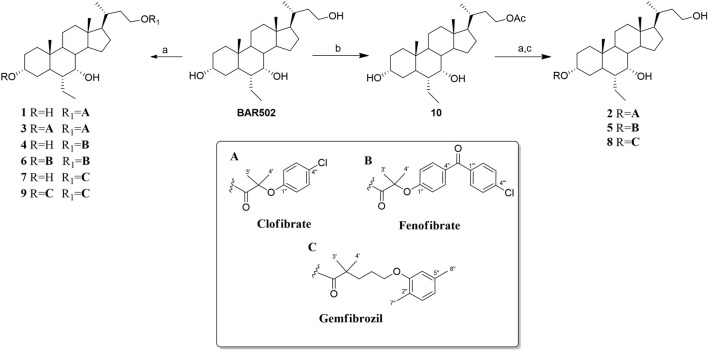 Figure 1
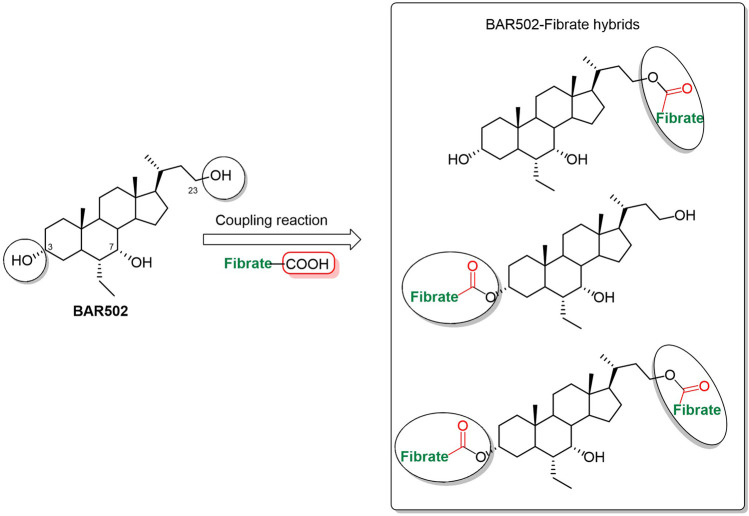 Figure 2
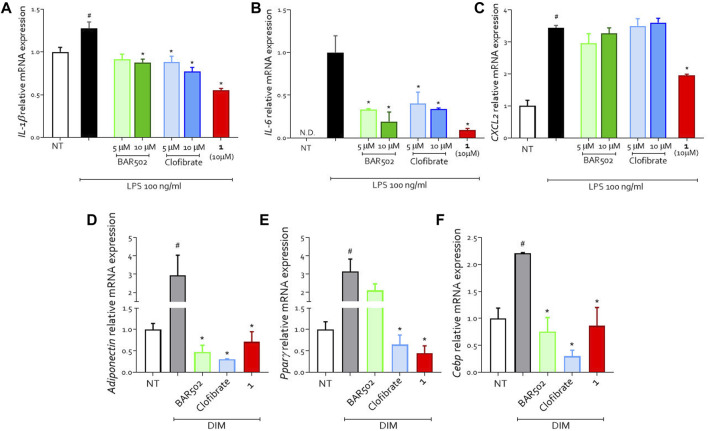 Figure 3
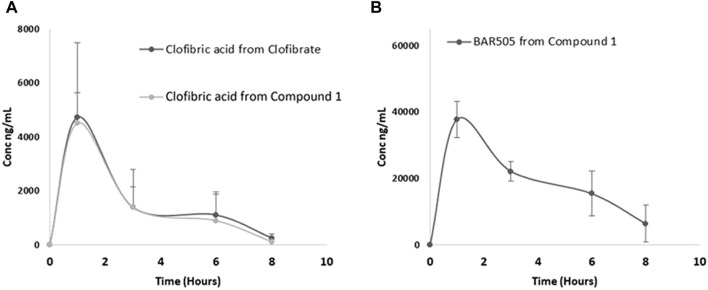 Figure 4
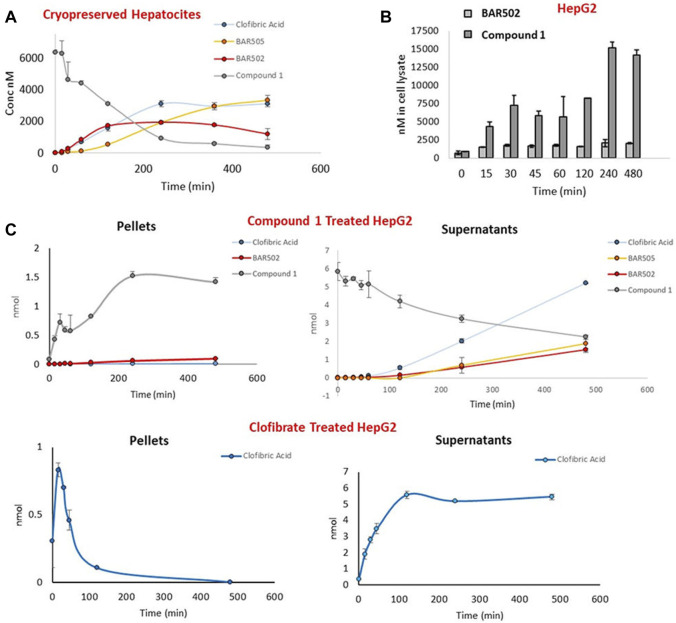 Figure 5
Peer Reviews
No public reviews on file for this paper yet. If you reviewed it on a platform where reviews are public (OpenReview, ICLR, NeurIPS, ICML), you can paste yours below so the community can read it here.
Videos
No videos yet. Explain this paper in a talk, walkthrough, or lecture? Add one.
Taxonomy
TopicsDrug Transport and Resistance Mechanisms · Pediatric Hepatobiliary Diseases and Treatments · RNA Interference and Gene Delivery