Collimonas rhizosphaerae sp. nov., a novel species isolated from the beech rhizosphere
Stephane Uroz, Ségolène Bouche, Emmanuelle Morin, Mathilde Bocquart, Ravi Kumar, Michael W. Rey, Jonathan Pham, Fidel Akum, Johan H. J. Leveau

TL;DR
Scientists discovered a new bacterial species, Collimonas rhizosphaerae, from soil near beech trees in France.
Contribution
A novel bacterial species, Collimonas rhizosphaerae, is described based on genomic, phylogenetic, and phenotypic analyses.
Findings
The strain H4R21T shows high similarity to other Collimonas species but is distinct enough to be a new species.
Phylogenomic and DNA-DNA hybridization data confirm H4R21T as a novel species within the genus Collimonas.
The new species has unique fatty acid and quinone profiles and a DNA G+C content of 59.5 mol%.
Abstract
Bacterial strain H4R21T was isolated from beech rhizosphere soil sampled in the forest experimental site of Montiers (Meuse, France). It effectively weathers minerals, hydrolyses chitin and produces quorum sensing signal molecules. The strain is aerobic and Gram-stain-negative. Phylogenetic analysis based on its 16S rRNA gene sequence indicated that strain H4R21T belongs to the genus Collimonas with high sequence similarity to C. arenae Ter10T (99.38 %), C. fungivorans Ter6T(98.97 %), C. pratensis Ter91T (98.76 %), C. humicola RLT1W51T (98.46 %) and C. silvisoli RXD178 T (98.46 %), but less than 98 % similarity to other strains of the genus Collimonas. The predominant quinone in H4R21T is ubiquinone-8 (Q8). The major polar lipids are diphosphatidylglycerol, phosphatidylethanolamine, diphosphatidylglycerol, phosphatidylglycerol and lipid. The major fatty acids identified were C12 : 0,…
Genes, proteins, chemicals, diseases, species, mutations and cell lines named across the full text — each resolved to its canonical identifier and authoritative record.
Click any figure to enlarge with its caption.
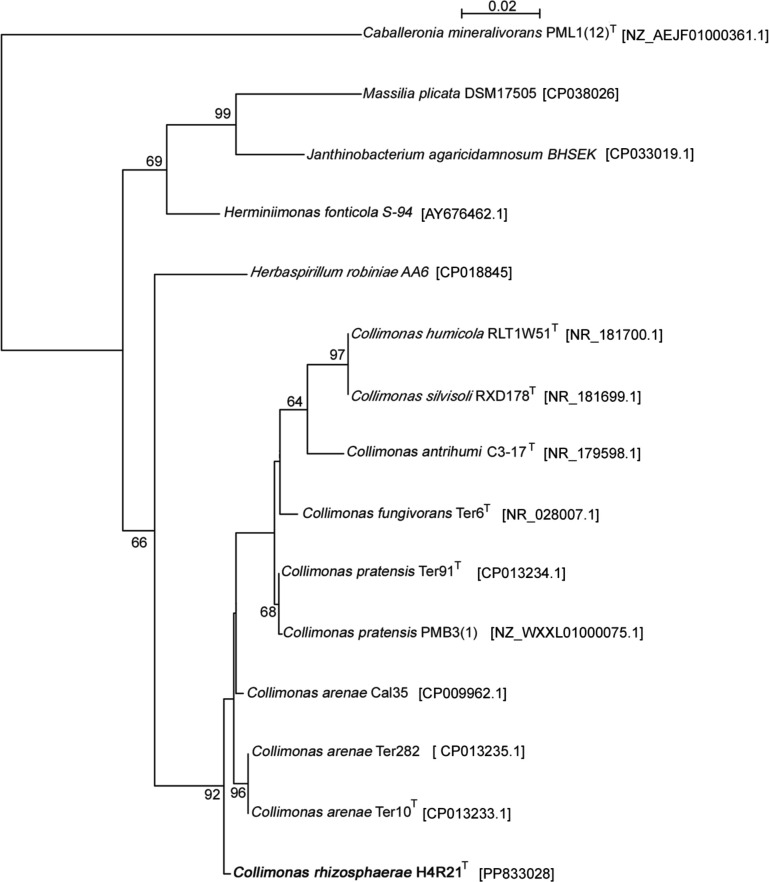 Figure 1
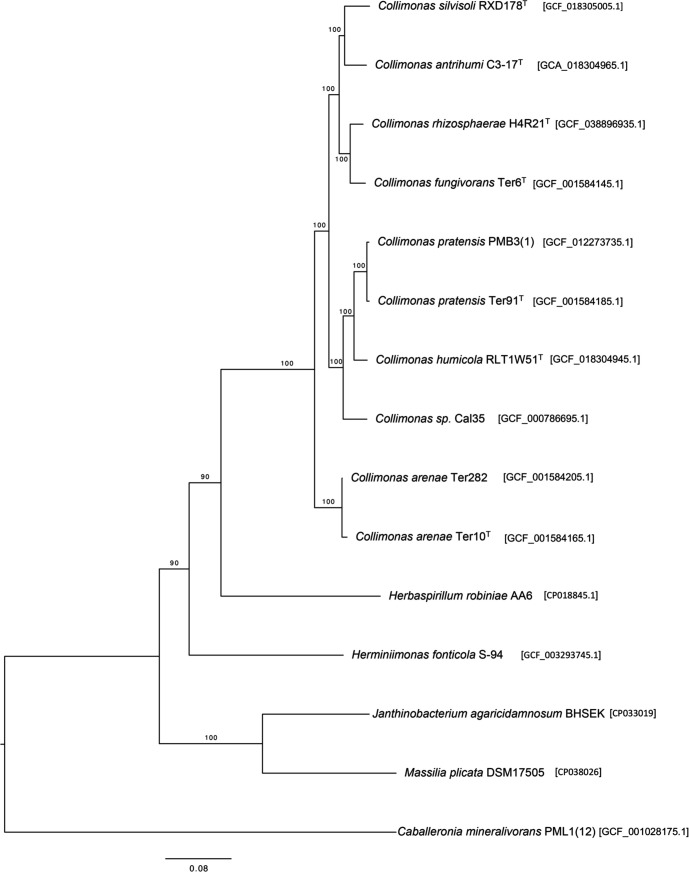 Figure 2
Peer Reviews
No public reviews on file for this paper yet. If you reviewed it on a platform where reviews are public (OpenReview, ICLR, NeurIPS, ICML), you can paste yours below so the community can read it here.
Videos
No videos yet. Explain this paper in a talk, walkthrough, or lecture? Add one.
Taxonomy
TopicsMicrobial Community Ecology and Physiology · Genomics and Phylogenetic Studies · Protist diversity and phylogeny