Attraction by pairwise coherence explains the emergence of ideological sorting
Federico Zimmerman, Lucía Pedraza, Joaquín Navajas, Pablo Balenzuela

TL;DR
This paper explores how political polarization leads to ideological sorting by showing that people are drawn to those with coherent opinions, not just similar ones.
Contribution
The study introduces pairwise-coherence favoritism as a novel mechanism explaining ideological sorting in political systems.
Findings
Ideological sorting only emerges when pairwise-coherence favoritism is included in the model.
Pairwise-coherence favoritism is significantly present in political attitude datasets but absent in non-political topics.
The model's outcomes align with empirical data from 24,035 opinions across 67 topics.
Abstract
Political polarization has become a growing concern in democratic societies, as it drives tribal alignments and erodes civic deliberation among citizens. Given its prevalence across different countries, previous research has sought to understand under which conditions people tend to endorse extreme opinions. However, in polarized contexts, citizens not only adopt more extreme views but also become correlated across issues that are, a priori, seemingly unrelated. This phenomenon, known as “ideological sorting”, has been receiving greater attention in recent years but the micro-level mechanisms underlying its emergence remain poorly understood. Here, we study the conditions under which a social dynamic system is expected to become ideologically sorted as a function of the mechanisms of interaction between its individuals. To this end, we developed and analyzed a multidimensional…
Genes, proteins, chemicals, diseases, species, mutations and cell lines named across the full text — each resolved to its canonical identifier and authoritative record.
Click any figure to enlarge with its caption.
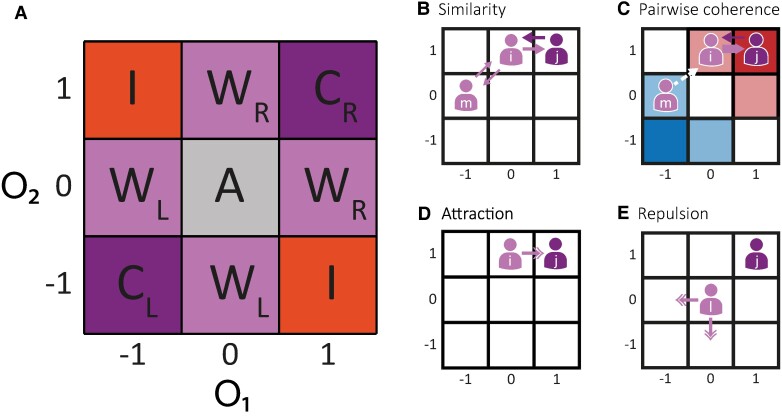 Figure 1
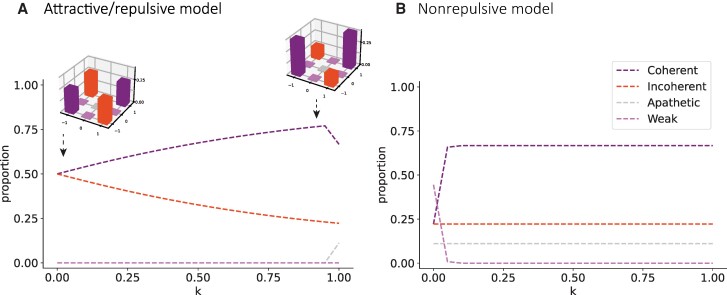 Figure 2
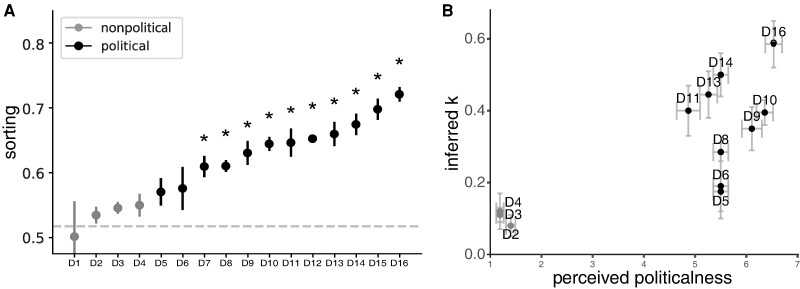 Figure 3
Peer Reviews
No public reviews on file for this paper yet. If you reviewed it on a platform where reviews are public (OpenReview, ICLR, NeurIPS, ICML), you can paste yours below so the community can read it here.
Videos
No videos yet. Explain this paper in a talk, walkthrough, or lecture? Add one.
Taxonomy
TopicsOpinion Dynamics and Social Influence · Complex Network Analysis Techniques · Evolutionary Game Theory and Cooperation