Antiandrogen Withdrawal Syndrome After Discontinuation of Enzalutamide in Patients With Metastatic Castration-Resistant Prostate Cancer: A Report of Two Clinical Cases and a Literature Review
Patrícia R Rodrigues, Cátia Faustino, Joaquina Maurício, Filipa Carneiro

TL;DR
This paper reports two cases where stopping enzalutamide in prostate cancer patients led to improved outcomes, a phenomenon called antiandrogen withdrawal syndrome.
Contribution
The paper presents two new clinical cases of antiandrogen withdrawal after enzalutamide discontinuation and explores possible contributing factors.
Findings
Discontinuation of enzalutamide led to a decrease in PSA levels in both patients.
Antiandrogen withdrawal syndrome may result in clinical or imaging improvements after drug cessation.
The underlying mechanism and frequency of this phenomenon remain unclear.
Abstract
Metastatic prostate cancer treatment is based on androgen deprivation, with pharmacological or surgical castration. This treatment may be complemented with the addition of antiandrogenic drugs. In the setting of prostate-specific antigen (PSA) progression and subsequent suspension of the antiandrogenic drug, there might occur a phenomenon of antiandrogen withdrawal, leading to a decrease in PSA and/or improvement in imaging or clinical outcomes after discontinuation of the antiandrogenic agent. Although there are some descriptions of withdrawal after the cessation of enzalutamide, the physiological mechanism behind it, as well as its frequency and impact on patient survival, remain unknown. We present two clinical cases of antiandrogenic withdrawal after enzalutamide discontinuation and discuss potential contributing factors to this phenomenon.
Genes, proteins, chemicals, diseases, species, mutations and cell lines named across the full text — each resolved to its canonical identifier and authoritative record.
Click any figure to enlarge with its caption.
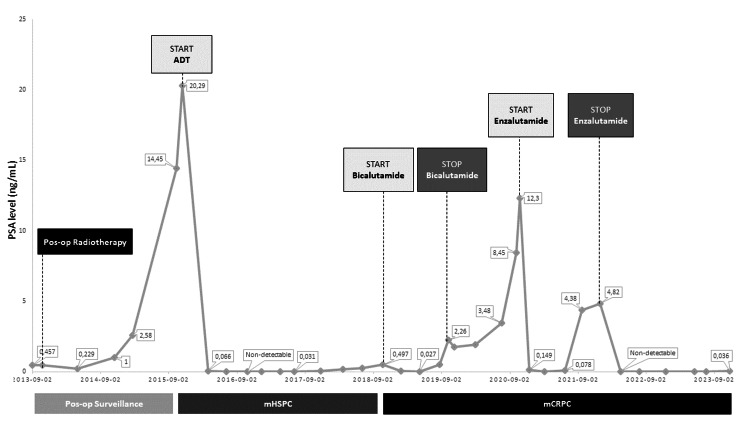 Figure 1
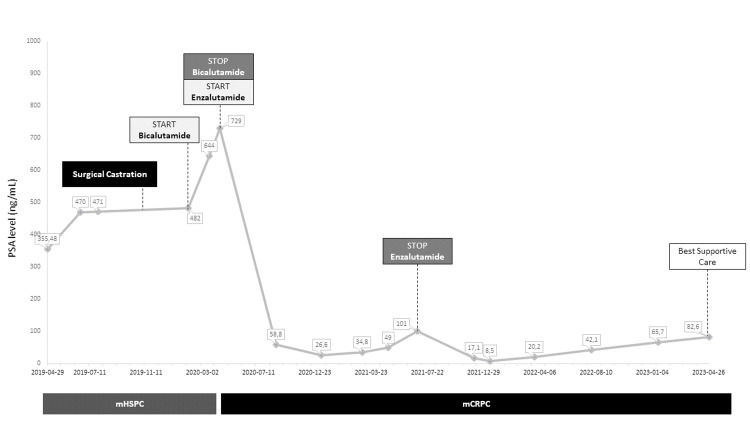 Figure 2
Peer Reviews
No public reviews on file for this paper yet. If you reviewed it on a platform where reviews are public (OpenReview, ICLR, NeurIPS, ICML), you can paste yours below so the community can read it here.
Videos
No videos yet. Explain this paper in a talk, walkthrough, or lecture? Add one.
Taxonomy
TopicsProstate Cancer Treatment and Research · Hormonal and reproductive studies · Cancer Treatment and Pharmacology