Coefficient bounds for starlike functions involving q− Hurwitz-Lerch Zeta operator in conic region
K. Uma, K. Vijaya

TL;DR
This paper introduces a new family of analytic functions based on the q-Hurwitz-Lerch Zeta function and explores their properties in conic regions.
Contribution
The paper introduces a novel family of analytic functions and derives new coefficient bounds for starlike functions in conic domains.
Findings
Coefficient estimates for Janowski starlike functions are derived.
Subordination results are established for functions in symmetric conic domains.
Contraction coefficient inequalities are discussed for the new function family.
Abstract
In this paper, we generalize a family of q-Hurwitz-Lerch Zeta function by means of constructing and investigating a new family of analytic functions. Some novel findings are discussed like contraction coefficient inequality and other important concepts, some of which are: partial sums, coefficient estimates, subordination results for Janowski starlike functions related with symmetric conic domains.
Genes, proteins, chemicals, diseases, species, mutations and cell lines named across the full text — each resolved to its canonical identifier and authoritative record.
Click any figure to enlarge with its caption.
 Figure 1
 Figure 2
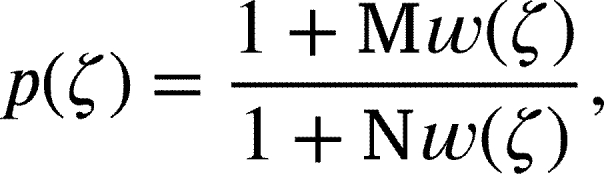 Figure 3
 Figure 4
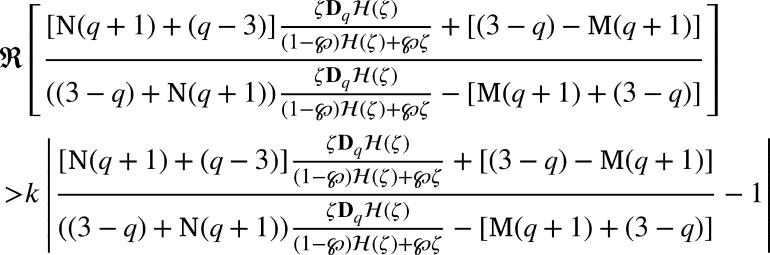 Figure 5
 Figure 6
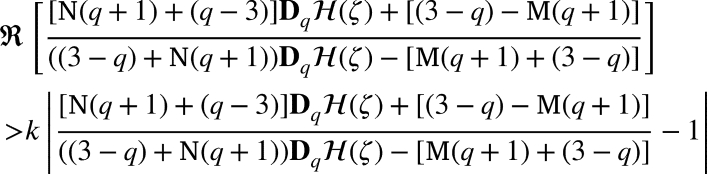 Figure 7
 Figure 8
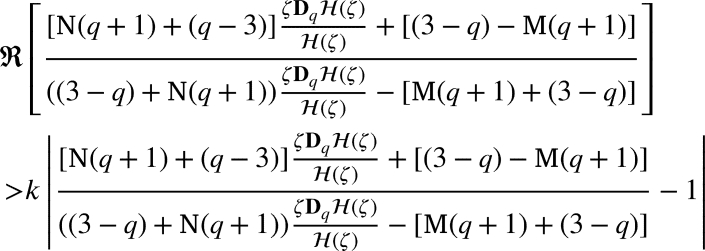 Figure 9
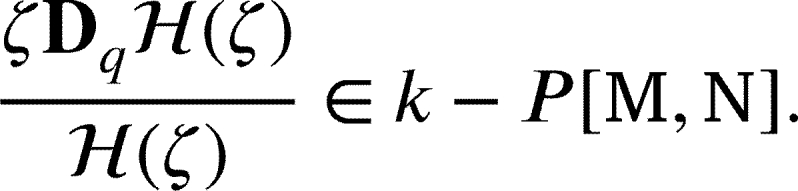 Figure 10
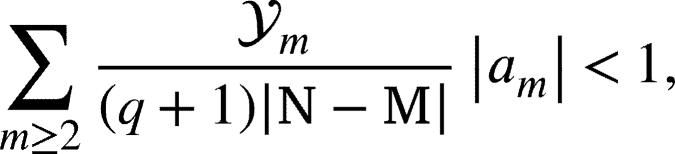 Figure 11
 Figure 12
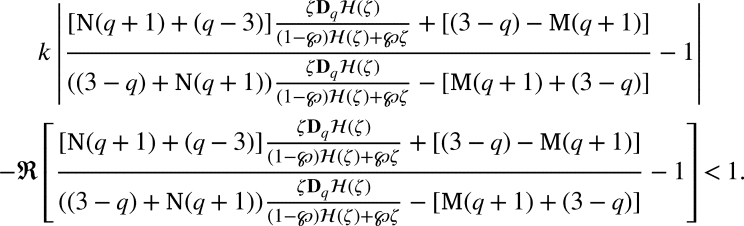 Figure 13
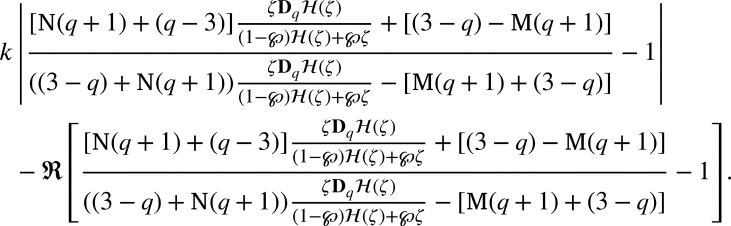 Figure 14
 Figure 15
 Figure 16
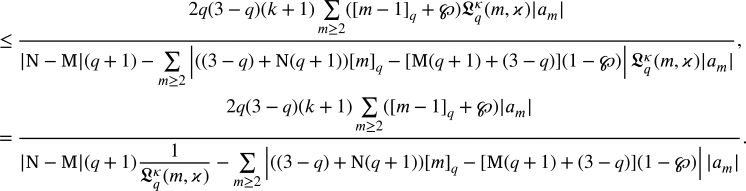 Figure 17
 Figure 18
 Figure 19
 Figure 20
 Figure 21
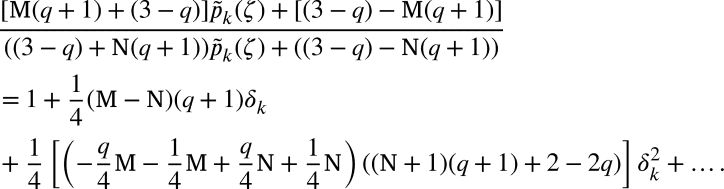 Figure 22
 Figure 23
 Figure 24
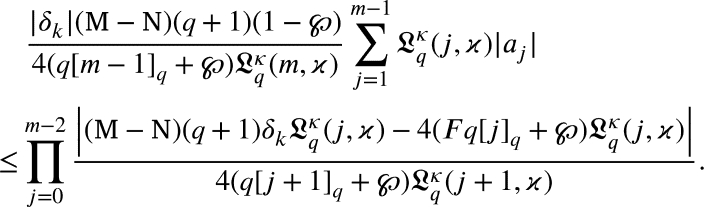 Figure 25
 Figure 26
 Figure 27
 Figure 28
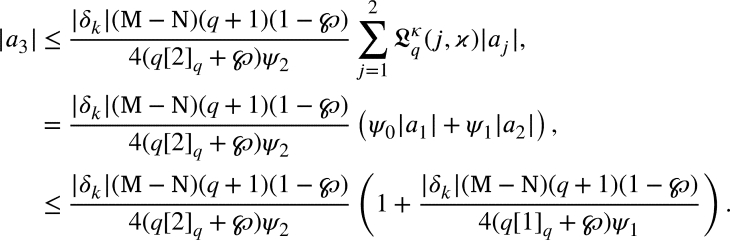 Figure 29
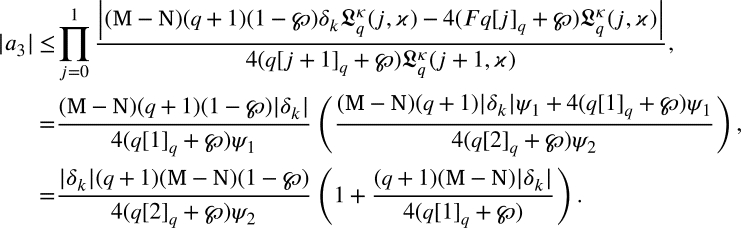 Figure 30
 Figure 31
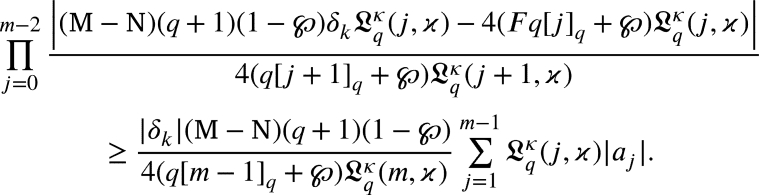 Figure 32
 Figure 33
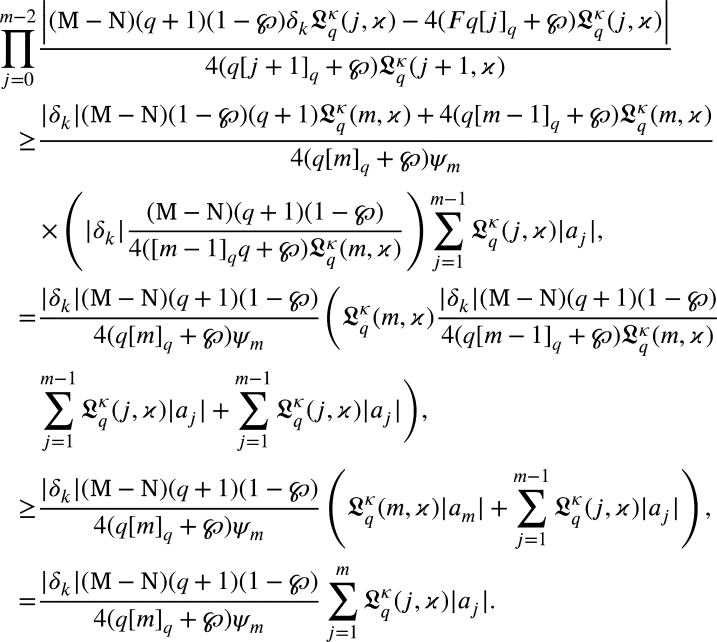 Figure 34
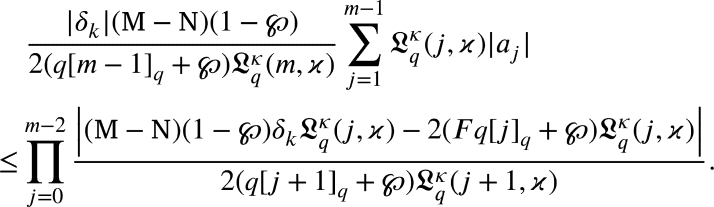 Figure 35
 Figure 36
 Figure 37
Peer Reviews
No public reviews on file for this paper yet. If you reviewed it on a platform where reviews are public (OpenReview, ICLR, NeurIPS, ICML), you can paste yours below so the community can read it here.
Videos
No videos yet. Explain this paper in a talk, walkthrough, or lecture? Add one.
Taxonomy
TopicsSocial and Educational Sciences · Library Science and Administration
Introduction
1
Suppose that the set of all analytic or holomorphic functions Ξ in the open unit disc and that has the series representation as
We denote the basic subclass of analytic functions Ξ as
- (1)
- (2)
- (3) starlike functions of order ϱand
- (4) convex functions of order ϱ.
Let and be holomorphic function and with in U so that . We consider is subordinated by signified mathematically as . If is univalent, then ⇔ and .
For two holomorphic function
the Hadamard (convolution) product is assumed as
We include a some notation of q-calculus exploited from the article [16], [17]. The q-analogue of m as
and
The q-factorial, as below
Moreover the q-derivative operator of as given as
Consider
and
Jackson first used the idea of q-calculus [16], [17]. With remarkable way, he first proposed the q-integral and the well-known q-derivative. Subsequently, the geometric features of q-analysis have been mostly examined and discussed in terms of quantum groups [13], with a notable beginning in the early 1980s. In [3], [4], [5], the q-analogue of the well-known Baskakov Durrmeyer operator was presented based on the q-beta function. Two other important q-speculations regarding complex operators are the q-Picard integral operator and the q-Gauss-Weierstrass integral operator (see [6], [9], [14], [29]). The geometric features of these operators were scrutinized in detail. As demonstrated by [1], a number of operators are now being studied in [19], [24], [40] provides an explanation of the q-symmetric derivative operator and its numerous uses.
Numerous intriguing properties and characteristics of the Hurwitz-Lerch Zeta function have been revealed by recent investigations by Kiryakova [25], Lin and Srivastava [26], Choi et al. [8], Garg et al. [12], Ferreira and Lopez [10], Lin et al. [27] and others. Additionally, in 2007 by Srivastava [45], Srivastava and Attiya [44] (also see Raducanu and Srivastava [36], and Prajapat and Goyal [35]) as well as the references cited therein, have investigated and studied various subclasses of Ξ.
The following we recall a general q− analogue of Hurwitz-Lerch Zeta function (q-HLZ), defined in [39], given by
where
and as usual, , .
Recently in [31], [39]introduced and discussed the linear operator:
specified, with respect to the Hadamard product (or convolution), by
where,
and for different perspective of study on analytic and harmonic functions.
For u of the form (1.1), it is simple to note from (1.2) and (1.3) that we have
where
(and throughout this paper unless otherwise mentioned) the parameters ϰ are constrained as follows:
For and
and various choices of κ the q-HLZ includes the integral operators as listed below (see also [34], [44], [45]. Remark 1.1
note that if , it closely related to some multiplier transformation studied by Fleet [11]. Special functions are extremely important in many areas of applied mathematics and sciences. Numerous researchers have studied the geometric properties of very unique special functions, as several studies have demonstrated (see [2], [33], [41]). After a thorough examination of relevant literature, it was discovered that the Ruscheweyh derivative operator [38], which is a differential operator that is well-known and frequently quoted, first appeared in the publication [42], [43], [46], [47], [48], [49], [50].
For Image 1 we denote by Image 2 and by Image 3 the class of Janowski starlike functions and Janowski convex functions, defined by
and
respectively (See [18] for a thorough analysis of the Janowski function class). Denote by the family of functions analytic in the U and Image 6 if and only if
where Image 1 and is the Schwarz function. Geometrically, Image 8 if and only if and lies inside an open disc centered with center Image 9 on the real axis having radius Image 10 with diameter end points Image 11. On observing that for , we have Image 12 if and only if for some
The conic domain , plays the role of an extremal functions and is given by
where and t is chosen such that , with is Legendre's complete elliptic integral of the first kind and is complementary integral of . According to [21], [22], the function provides the picture of U as a conic region that expresses symmetrically about the horizontal axis. Based on the equation , [20] shows that, using (1.7), one may have
Motivated by aforementioned works on the study of conic regions impacted by Janowski function involving q-derivative was dealt in detail by Srivastava et al. [42], [43], [46], [47], [48], [49], [50] also see [28], [7], [30], [31], [32], [41], [52], [53] and references cited therein we defined a broad class of functions related to the q-Hurwitz-Lerch Zeta (q-HLZ) function, which is connected to the symmetric conic area that Janowski functions [23], [15] describe and denote by Image 14 as in below Definition 1.2 and discussed certain characteristic properties.
Definition 1.2For defined in Image 15, if and only if
or equivalently
where as in (1.4). The new class that has not yet been explored is based on the (q-HLZ) function connected to the symmetric conic area that Janowski functions as follows, with the fixed parameters (and ). Definition 1.3For we let a new class Image 18, if it holds
or equivalently
Definition 1.4For and Image 21, by fixing , we deduce a new class Image 22, if it satify
or equivalently
We find the well-known results, such as the coefficient bounds, partial sums results bounds and subordination results for this recently established function class in the following sections:
Coefficients bounds
2
To prove our result we recall the Rogosinski. Lemma 2.1[37]Let be subordinate to is univalent inU*, then*
In the following assertion, we prove a precondition for the functions that become part of Image 14. Theorem 2.2A function and has the form described in equation(1.1)will be class underImage 25*, provided that it fulfills the following condition*
where
where as assumed in(1.5). ProofSupposing that (2.2) holds true, it is sufficient to show that
For our convenient, let we write that
Substituting for and and upon simplification we get
If the above inequality bounded above by 1, we get
Thus the proof is complete. □
Corollary 2.3 For any given in (1.1) and Image 34 , if it fulfills the criterion
Theorem 2.4 Let Image 36 , Image 37 as in (1.1) , then
where is defined in (1.5) .
ProofBy the definition of Image 39, we have
where
If , then
Now, if , then by (2.1) and (2.6), we arrived
Now, from (2.5), we arrived
and using with , we arrived
by simple computation we have
Using the Cauchy product, we arrived
Equating like coefficients of , we have
which yields
By (2.7), we have
Now, we prove that
By the induction method we can proceed to this proof. For , from (2.8), we arrived
it becomes to
From (2.4)
substituting , from (2.8), we arrived
From (2.4), we have
Suppose that for the hypothesis holds. From (2.8), we get
From (2.4), we get
Using induction principle
Multiplying both the sides by
we arrived
That is,
Thus, the outcome is true for . Consequently, the induction principle concludes that for any ., (2.4) is true. □
Bounds of the partial sums
3
After reviewing the findings of Silvia [40] and Silverman [41], we examine how a function represented by (1.1) may be divided into its component parts using a sequence of cumulative partial terms
and
Numerous authors have studied partial sums for various subclasses (see [30], [32], [39], [46], [47], [48] and references therein). For the functions of the class Image 14, we analyze the lower bounds for , , and . Theorem 3.1For anyImage 36*, then*
where is stated by(2.3)andImage 56*. The function*
provides the sharp result. ProofAssume that
which reduces to
Using this, one may have
Now,
if
It suffices to prove that the upper bound of , on the left side of (3.2), if
which leads to the expression
To verify the sharpness, of (3.1) when .
□
Theorem 3.2 For any Image 36 , then
where is as in (2.3) and Image 56 . The bound (3.3) is sharp for function given in (3.1) .
ProofAgain let us assume
Now we get
Thus we have
which simplifies that
Now,
if
Proving the upper bound of , on the left side of (3.4) is appropriate if
which tends to
That is,
Hence, equality posses for , as given in (3.1). □
Theorem 3.3 For any Image 36 , then
where is as in (2.3) and Image 56 . The bound (3.5) is sharp for function given in (3.1) .
ProofLet us take a function ,
It reduces us to
which tends to
Now,
if
It is adequate to prove that the upper bound of , on the left side of (3.6), if
which tends to the below form
□ Theorem 3.4 If Image 36 , then
where is as in (2.3) and Image 56 . The result (3.7) is sharp for function given in (3.1) .
ProofLet us consider a function as below
that is,
This yield us to
That is
Now,
if
The left part of (3.8) as bounded above by , if
which reduced as
thus we have
Therefore,
□
Subordination results
4
Now due to Wilf [51], we state subordinating factor sequence which are more essential for our discussion.
Definition 4.1*(Subordinating Factor Sequence)*[51]: A sequence of complex numbers is said to be a subordinating sequence if, given by (1.1) is holomorphic, univalent and convex in U, then
Lemma 4.2The sequence is a subordinating factor sequence if and only if
Theorem 4.3LetImage 57and then
where
and is from(1.5).
The constant factor in(4.1)*cannot be substituted by a greater number.*ProofSince Image 59 and assume that . Then
Therefore, by Definition 4.1, the subordination result holds if
is a subordinating factor sequence, with . In sight of Lemma 4.2, this is equal to the subsequent inequality
For we note that is increasing function and in particular
therefore, for , we have
by the assertion (2.2) of Theorem 2.2. This clearly proves (4.3) and hence (4.1).By fixing
inequality (4.2) follows from (4.1). Subsequently we consider the function
For this function (4.1) becomes
It is easily verified that
This proves that the constant cannot be substituted by a greater number. □Conclusion: Our research introduces and investigates a novel family of analytic functions based on the convolution characterized by a q-HLZ function. Through rigorous analysis, we unveil several key findings, including coefficient inequalities and other noteworthy characteristics within this function class. Our approach allowed us to analyze the intriguing aspects of this subclass. Furthermore, we delve into the determination of partial sums, starlikeness radii, and coefficient estimates for the class of Janowski starlike functions in the context of symmetric conic domains. By fixing the values of parameter ℘ as mentioned in Definition 1.3, Definition 1.4 we can derive analogues results given in Theorem 2.2, Theorem 4.3. Moreover specializing the parameters as in Remark 1.1, new subclasses can be defined and discussed for the results given in Theorem 2.2, Theorem 4.3. This exploration not only contributes to the theoretical framework of analytical functions but also provides valuable insights into the properties and behavior of the q-HLZ function and its associated subclasses. Our findings not only advance the understanding of these mathematical structures but also pave the way for potential applications in diverse scientific and engineering disciplines moreover inspired to develop this concept to the classes of bi-univalent functions, meromorphic functions, etc.
Ethical approval
This article does not contain any studies with human participants or animals performed by any of the authors.
Funding statement
The research did not receive any funding.
CRediT authorship contribution statement
K. Uma: Writing – original draft, Methodology, Investigation, Formal analysis. K. Vijaya: Writing – review & editing, Validation, Supervision, Methodology, Investigation, Conceptualization.
Declaration of Competing Interest
The authors declare that they have no known competing financial interests or personal relationships that could have appeared to influence the work reported in this paper.
The reference list from the paper itself. Each links out to its DOI / PubMed record.
- 1Aldweby H.Darus M.Some subordination results on q-analogue of Ruscheweyh differential operator Abstr. Appl. Anal.20142014958563
- 2Anastassiou G.A.Gal S.G.Geometric and approximation properties of some singular integrals in the unit disk J. Inequal. Appl.2006200617231
- 3Aral A.Gupta V.On q-Baskakov type operators Demonstr. Math.422009109122
- 4Aral A.Gupta V.On the Durrmeyer type modification of the q-Baskakov type operators Nonlinear Anal., Theory Methods Appl.72201011711180
- 5Aral A.Gupta V.Generalized q-Baskakov operators Math. Slovaca 612011619634
- 6Aral A.On the generalized Picard and Gauss Weierstrass singular integrals J. Comput. Anal. Appl.82006249261
- 7Breaz D.Murugusundaramoorthy G.CotîrlǎL.I.Geometric properties for a new class of analytic functions defined by a certain operator Symmetry 142022262410.3390/sym 14122624 · doi ↗
- 8Choi J.Srivastava H.M.Certain families of series associated with the Hurwitz-Lerch Zeta function Appl. Math. Comput.1702005399409