Detraining’s Effects on Cardiorespiratory Fitness and Maximal and Explosive Strength in Army Soldiers: Does Age Matter?
Alexis Arce-Álvarez, Ángelo Zaio, Camila Salazar-Ardiles, Cristian Álvarez, Pablo Merino-Muñoz, Manuel Vasquez-Muñoz, Mikel Izquierdo, Mauricio Castro, David C. Andrade

TL;DR
This study found that four weeks of detraining reduces aerobic fitness and leg strength in army soldiers, with some age-related differences in muscle performance.
Contribution
The study provides new insights into how age influences the effects of detraining on cardiorespiratory and muscular performance in tactical athletes.
Findings
Detraining reduced maximum time and speed at VO2max in both age groups.
Flight time and maximum height during CMJ decreased in the non-dominant leg for both age groups.
Dominant leg concentric impulse decreased only in the 30–40 age group.
Abstract
Purpose: This study investigated the impact of four weeks of age-dependent detraining on army soldiers’ cardiorespiratory fitness and maximal and explosive strength. Methods: Fourteen volunteer tactical athletes participated, divided into two age groups (20 to 29 and 30 to 40 years). Before and after the detraining period, we assessed their anthropometric measurements (weight, height, body mass index, fat mass, and fat-free mass), cardiorespiratory fitness (maximal oxygen uptake [VO2max] and ventilatory thresholds [VT1 and VT2]), and kinematic properties during a single-leg counter-moving jump (CMJ) test for both the dominant and non-dominant legs. Two-way ANOVA followed by the Holm–Sidak post hoc test was used. Results: The anthropometric and cardiovascular variables did not show significant differences between the groups. However, both groups exhibited a significantly reduced maximum…
Genes, proteins, chemicals, diseases, species, mutations and cell lines named across the full text — each resolved to its canonical identifier and authoritative record.
Click any figure to enlarge with its caption.
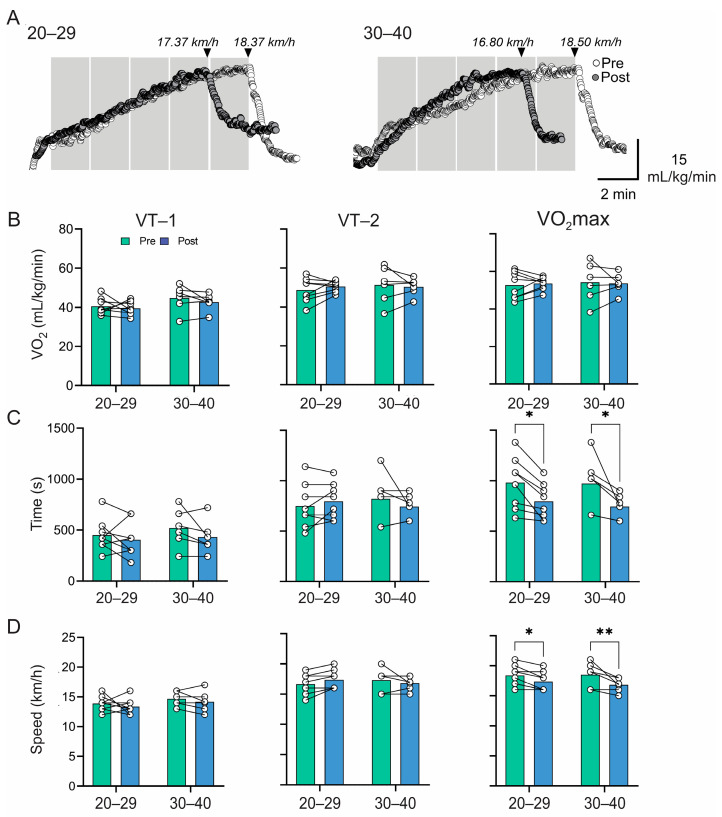 Figure 1
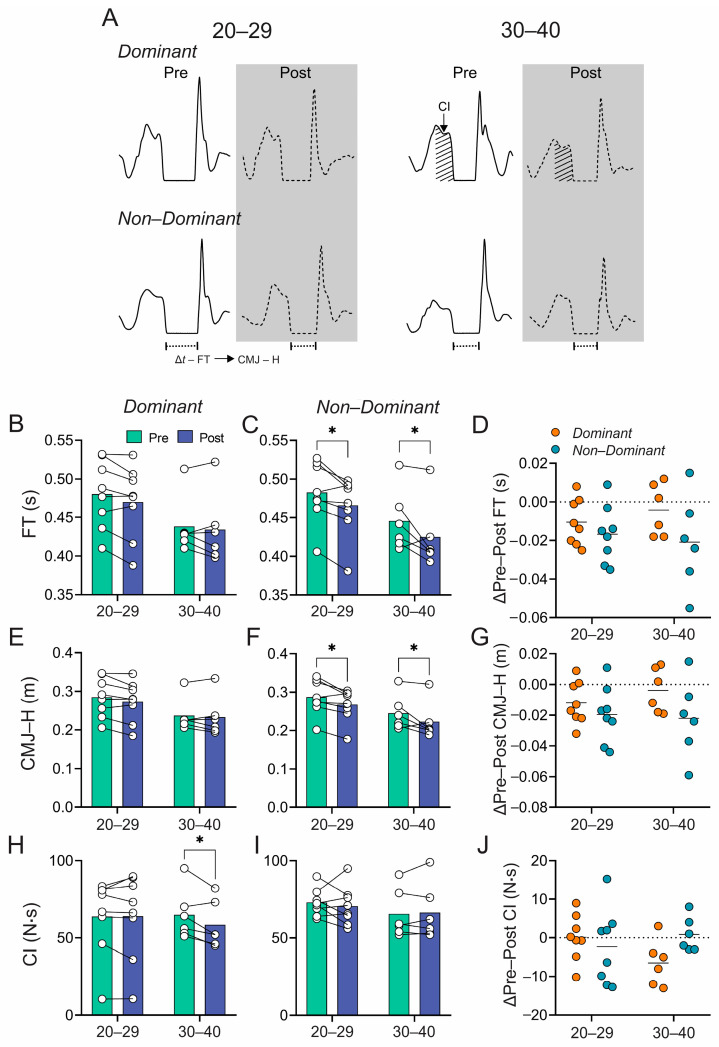 Figure 2
Peer Reviews
No public reviews on file for this paper yet. If you reviewed it on a platform where reviews are public (OpenReview, ICLR, NeurIPS, ICML), you can paste yours below so the community can read it here.
Videos
No videos yet. Explain this paper in a talk, walkthrough, or lecture? Add one.
Taxonomy
TopicsOccupational Health and Performance · Sports Performance and Training · Cardiovascular and exercise physiology