A convenient five-segment cassette procedure for DNA insertions coding for novel peptides
Jonathan Filley, Dhana Govind Gorasia, Dhana Govind Gorasia, Dhana Govind Gorasia

TL;DR
This paper introduces a cost-effective DNA cassette method for creating and testing new peptides in E. coli using short oligomers and GFP fusions.
Contribution
A novel five-segment DNA cassette method with three nicks for efficient peptide insertion and rapid prototyping.
Findings
The five-segment cassettes with 20 nt overlaps can code for 20 amino acid peptides using 40 nt oligomers.
Cassettes with more than three nicks fail to insert into plasmid DNA successfully.
Peptides are isolated as C-terminal fusions with GFP, enabling easy mutation and analysis of solubility and IMAC retention.
Abstract
A DNA cassette assembly method is described which utilizes inexpensive oligomers no longer than 40 nt in length. The five-segment cassettes have 20 nt overlaps which give an effective length of 80 nt, making it possible to code for peptides up to 20 amino acids long. The cassettes have three phosphate free nicks, which can be successfully inserted into plasmid DNA and used to transform E. coli. The nicks are repaired in vivo by an unknown mechanism. Insertions are not successful for cassettes with greater than three nicks. A procedure is provided for rapid turnaround from DNA design to peptides, which are easily isolated as C-terminal fusions with GFP. The technique generally gives the expected sequence, with errors which occur about 1% of the time. Several representative DNA inserts are described which illustrate the method, as well as chemical details on the new peptides coded for.…
Genes, proteins, chemicals, diseases, species, mutations and cell lines named across the full text — each resolved to its canonical identifier and authoritative record.
Click any figure to enlarge with its caption.
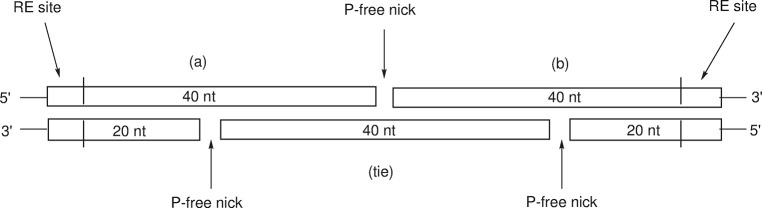 Figure 1
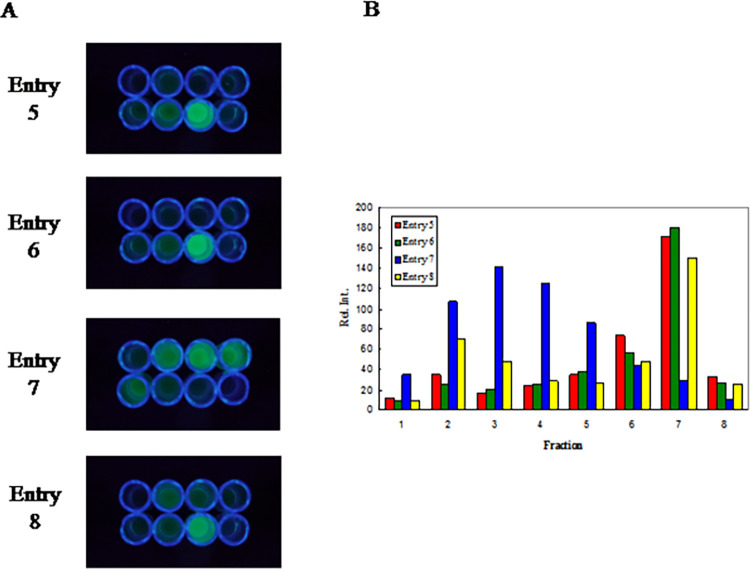 Figure 2
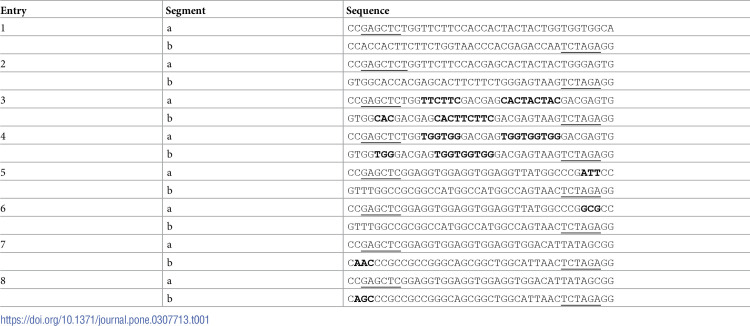 Figure 3
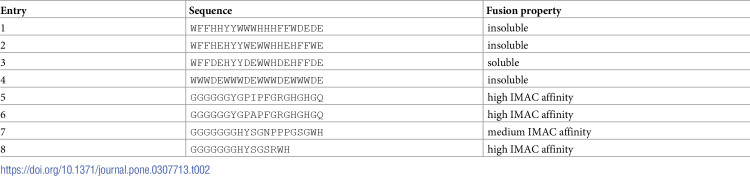 Figure 4
 Figure 5
Peer Reviews
No public reviews on file for this paper yet. If you reviewed it on a platform where reviews are public (OpenReview, ICLR, NeurIPS, ICML), you can paste yours below so the community can read it here.
Videos
No videos yet. Explain this paper in a talk, walkthrough, or lecture? Add one.
Taxonomy
TopicsRNA and protein synthesis mechanisms · Advanced biosensing and bioanalysis techniques · RNA Interference and Gene Delivery