Insight into the Binding Interaction between PEDCs and hERRγ Utilizing Molecular Docking and Molecular Dynamics Simulations
Fanqiang Bu, Lin Chen, Ying Sun, Bing Zhao, Ruige Wang

TL;DR
This study explores how certain environmental chemicals interact with a human receptor at the molecular level, revealing key binding patterns and energy contributions.
Contribution
The study identifies specific amino acid residues and binding energy contributors in the interaction between PEDCs and hERRγ, with a novel focus on methoxide groups reducing binding energy.
Findings
Residues Leu271, Leu309, Leu345, and Phe435 are crucial for PEDC binding to hERRγ.
CH-π, π-π, and hydrogen bonds are the main contributors to the binding energy of PEDCs with hERRγ.
Methoxide groups in BP(2,2)(Me) reduce the binding energy of PEDCs with hERRγ.
Abstract
Phenolic environmental endocrine-disrupting chemicals (PEDCs) are persistent EDCs that are widely found in food packaging materials and environmental media and seriously threaten human health and ecological security. Human estrogen-related receptor γ (hERRγ) has been proposed as a mediator for the low-dose effects of many environmental PEDCs; however, the atomic-level descriptions of dynamical structural features and interactions of hERRγ and PEDCs are still unclarified. Herein, how three PEDCs, 4-(1-methylpropyl)phenol (4-sec-butylphenol), 5,6,7,8-tetrahydro-2-naphthol (tetrahydro-2-napthol), and 2,2-bis(4-hydroxy-3,5-dimethoxyphenyl)propane (BP(2,2)(Me)), interact with hERRγ to produce its estrogenic disruption effects was studied. Molecular docking and multiple molecular dynamics (MD) simulations were first conducted to distinguish the detailed interaction pattern of hERRγ with…
Genes, proteins, chemicals, diseases, species, mutations and cell lines named across the full text — each resolved to its canonical identifier and authoritative record.
Click any figure to enlarge with its caption.
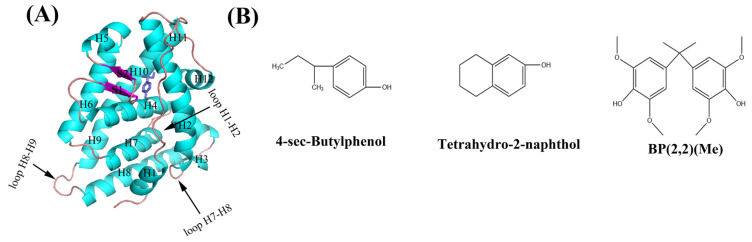 Figure 1
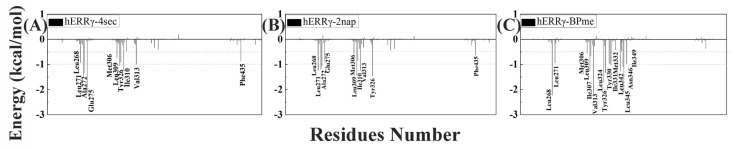 Figure 2
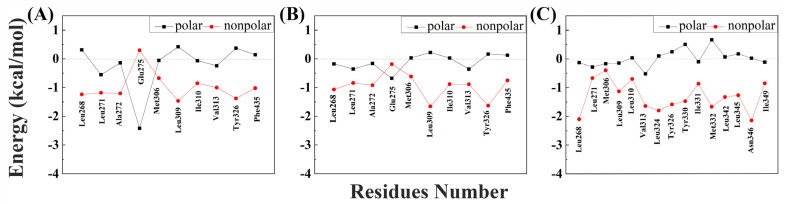 Figure 3
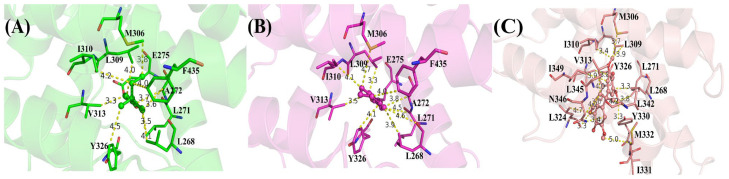 Figure 4
Peer Reviews
No public reviews on file for this paper yet. If you reviewed it on a platform where reviews are public (OpenReview, ICLR, NeurIPS, ICML), you can paste yours below so the community can read it here.
Videos
No videos yet. Explain this paper in a talk, walkthrough, or lecture? Add one.
Taxonomy
TopicsEffects and risks of endocrine disrupting chemicals · Estrogen and related hormone effects · Computational Drug Discovery Methods