Narcotic Nitrogen Effects Persist after a Simulated Deep Dive
Sven Dreyer, Johannes Schneppendahl, Martin Hoffmanns, Thomas Muth, Jochen D. Schipke

TL;DR
Breathing pure oxygen during decompression reduces nitrogen narcosis effects in divers after a deep dive.
Contribution
Breathing 100% oxygen during decompression reduces postdive nitrogen narcosis effects.
Findings
The air group showed increased vestibular impairment after the dive, as measured by the Sharpened Romberg test.
The O2 group maintained consistent vestibular function and improved performance on the modified tweezers test.
Breathing O2 during decompression appears to reduce postdive inert gas narcosis.
Abstract
Background and Objectives: Scuba divers often experience persistent inert gas narcosis (IGN) even after surfacing. This study aimed to test the hypothesis that breathing oxygen (O2) before surfacing can reduce postdive IGN. Materials and Methods: A group of 58 experienced divers underwent a 5 min dive at a depth of 50 m in a multi-place hyperbaric chamber. They were decompressed using air (air group). Another group of 28 divers (O2 group) breathed 100% O2 during the end of decompression. Prior to and after the dive, all participants performed the Sharpened Romberg test (SRT) and a modified tweezers test. Results: In the air group, the number of positive SRT results increased postdive (47% vs. 67%), indicating a greater impairment in the vestibular system (Cohen’s d = 0.41). In the O2 group, the percentage of positive SRT results remained constant at 68% both before and after the dive.…
Genes, proteins, chemicals, diseases, species, mutations and cell lines named across the full text — each resolved to its canonical identifier and authoritative record.
Click any figure to enlarge with its caption.
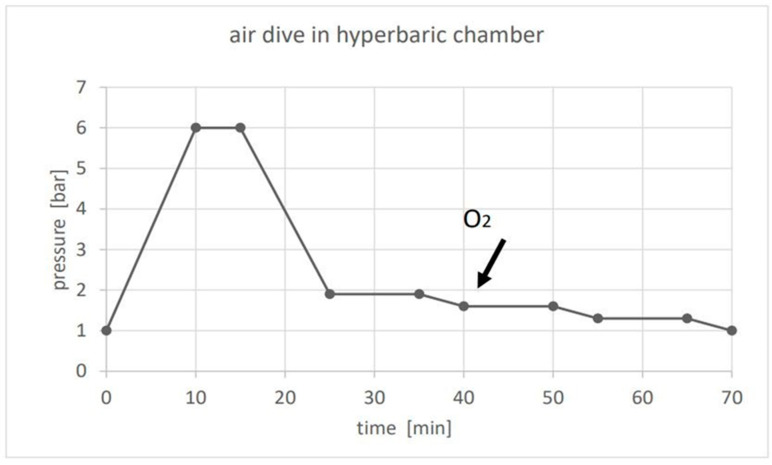 Figure 1
Peer Reviews
No public reviews on file for this paper yet. If you reviewed it on a platform where reviews are public (OpenReview, ICLR, NeurIPS, ICML), you can paste yours below so the community can read it here.
Videos
No videos yet. Explain this paper in a talk, walkthrough, or lecture? Add one.
Taxonomy
TopicsCardiovascular and Diving-Related Complications · Neuroscience of respiration and sleep · Restraint-Related Deaths