Visible-Light-Mediated Ring-Opening Geminal Dibromination of Alkenes via Alkoxy Radicals Enabled by Electron Donor–Acceptor Complex
Rong Wei, Yuan Wang, Juantao Zhang, Chunsheng Wu, Zhenhua Zhang, Duo Zhang

TL;DR
A new method uses visible light and a special complex to convert alkenes into geminal dibromides through alkoxy radicals and hydroxybromination.
Contribution
A visible-light-mediated ring-opening geminal dibromination of alkenes via alkoxy radicals is introduced.
Findings
An electron donor–acceptor complex generates alkoxy radicals from alcohols under mild visible light conditions.
The process enables deconstructive functionalization of alkenes to produce geminal dibromides.
Mechanistic studies suggest hypervalent iodine (III) compounds are intermediates in the reaction.
Abstract
An electron donor–acceptor complex was utilized to generate alkoxy radicals from alcohols under mild conditions using visible light. This approach was combined with a hydroxybromination process to achieve the deconstructive functionalization of alkenes, leading to the production of geminal dibromides. Mechanistic investigations indicated the intermediacy of hypervalent iodine (III) compounds.
Genes, proteins, chemicals, diseases, species, mutations and cell lines named across the full text — each resolved to its canonical identifier and authoritative record.
Click any figure to enlarge with its caption.
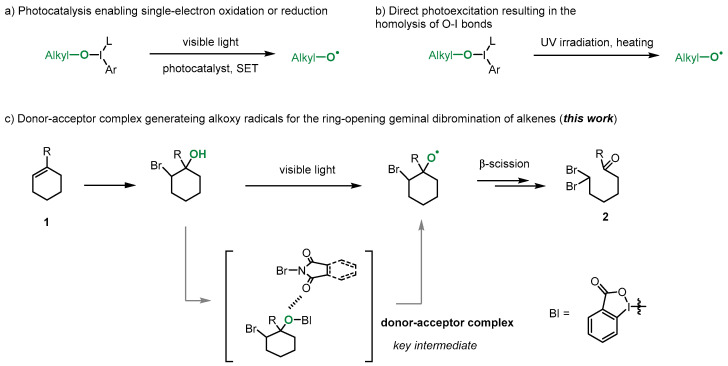 Figure 1
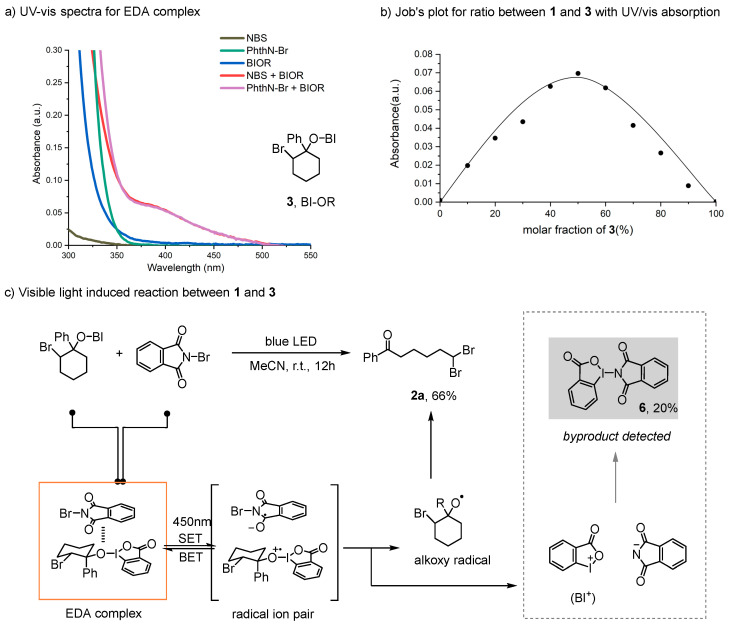 Figure 2
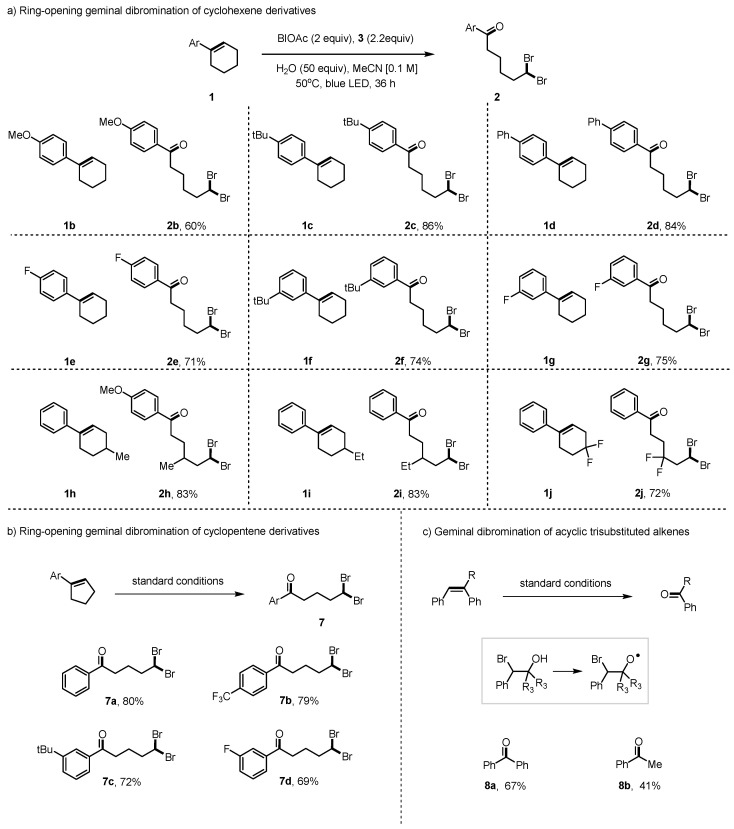 Figure 3
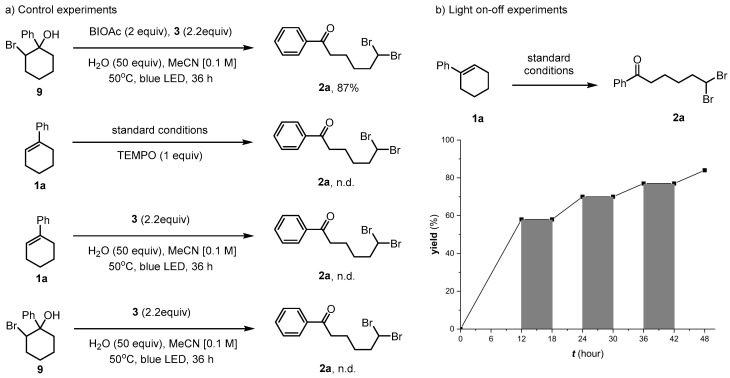 Figure 4
 Figure 5
Peer Reviews
No public reviews on file for this paper yet. If you reviewed it on a platform where reviews are public (OpenReview, ICLR, NeurIPS, ICML), you can paste yours below so the community can read it here.
Videos
No videos yet. Explain this paper in a talk, walkthrough, or lecture? Add one.
Taxonomy
TopicsRadical Photochemical Reactions · Oxidative Organic Chemistry Reactions · Catalytic C–H Functionalization Methods