Erythema Migrans in Patients with Post-Traumatic Splenectomy
Vera Maraspin, Katarina Ogrinc, Petra Bogovič, Tereza Rojko, Eva Ružić-Sabljić, Gary P. Wormser, Franc Strle

TL;DR
This study found that patients without a spleen due to trauma have different symptoms and higher treatment failure rates for Lyme disease-related erythema migrans compared to those with a spleen.
Contribution
The study is the first to compare clinical features and treatment outcomes of erythema migrans in splenectomized versus non-splenectomized adults with Lyme borreliosis.
Findings
Splenectomized patients had shorter EM duration before diagnosis and smaller EM diameter compared to non-splenectomized patients.
Treatment failure occurred in 19.2% of EM episodes in splenectomized patients versus 0% in non-splenectomized patients.
All treatment failures in splenectomized patients resolved after retreatment with standard antibiotic regimens.
Abstract
Information on asplenic Lyme borreliosis (LB) patients with erythema migrans (EM) is lacking. We compared the course and outcome of 26 EM episodes in 24 post-trauma splenectomized patients (median age 51 years) diagnosed at a single clinical center in Slovenia during 1994–2023 with those of 52 age- and sex-matched patients with EM but with no history of splenectomy. All patients were followed for one year. A comparison of pre-treatment characteristics revealed that EM in splenectomized patients was of shorter duration before diagnosis (4 vs. 8 days, p = 0.034) with a smaller EM diameter (10.5 vs. 14 cm, p = 0.046), and more frequently fulfilled criteria for disseminated LB (3/26, 11.5% vs. 0%, p = 0.034). Treatment failure occurred in 5/26 (19.2%) EM episodes in splenectomized patients versus 0/52 in non-splenectomized patients (p = 0.003). The five treatment failure cases were…
Genes, proteins, chemicals, diseases, species, mutations and cell lines named across the full text — each resolved to its canonical identifier and authoritative record.
Click any figure to enlarge with its caption.
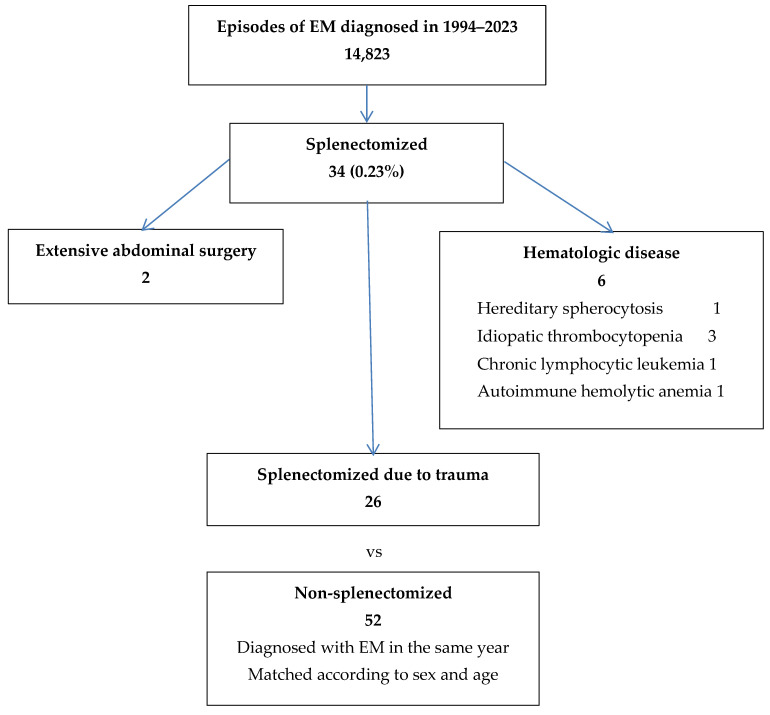 Figure 1
Peer Reviews
No public reviews on file for this paper yet. If you reviewed it on a platform where reviews are public (OpenReview, ICLR, NeurIPS, ICML), you can paste yours below so the community can read it here.
Videos
No videos yet. Explain this paper in a talk, walkthrough, or lecture? Add one.
Taxonomy
TopicsVector-borne infectious diseases · Viral Infections and Vectors · Dermatological diseases and infestations