The Influence of Sulfation Degree of Glycosaminoglycan-Functionalized 3D Collagen I Networks on Cytokine Profiles of In Vitro Macrophage–Fibroblast Cocultures
Franziska Ullm, Alexander Renner, Uwe Freudenberg, Carsten Werner, Tilo Pompe

TL;DR
This study explores how modifying collagen networks with sulfated glycosaminoglycans affects cytokine profiles in macrophage-fibroblast cocultures during wound healing.
Contribution
A novel in vitro hydrogel model using sulfated glycosaminoglycan-functionalized collagen I networks was developed to study extracellular matrix effects on cytokine communication.
Findings
Cytokine secretion (IL-6, FGF-2) was significantly influenced by glycosaminoglycan functionalization of collagen networks.
The coculture model successfully simulated progressed wound healing processes with stable collagen network structures.
Functionalized collagen networks modulate paracrine and autocrine communication between fibroblasts and macrophages.
Abstract
Cell–cell interactions between fibroblasts and immune cells, like macrophages, are influenced by interaction with the surrounding extracellular matrix during wound healing. In vitro hydrogel models that mimic and modulate these interactions, especially of soluble mediators like cytokines, may allow for a more detailed investigation of immunomodulatory processes. In the present study, a biomimetic extracellular matrix model based on fibrillar 3D collagen I networks with a functionalization with heparin or 6-ON-desulfated heparin, as mimics of naturally occurring heparan sulfate, was developed to modulate cytokine binding effects with the hydrogel matrix. The constitution and microstructure of the collagen I network were found to be stable throughout the 7-day culture period. A coculture study of primary human fibroblasts/myofibroblasts and M-CSF-stimulated macrophages was used to show…
Genes, proteins, chemicals, diseases, species, mutations and cell lines named across the full text — each resolved to its canonical identifier and authoritative record.
Click any figure to enlarge with its caption.
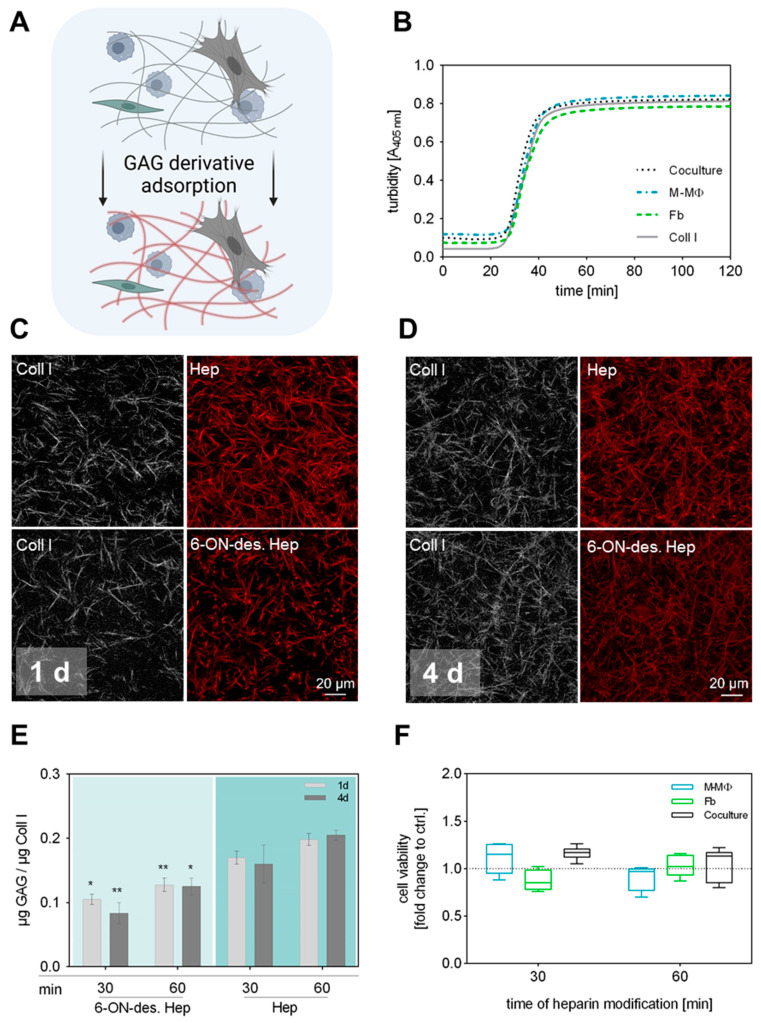 Figure 1
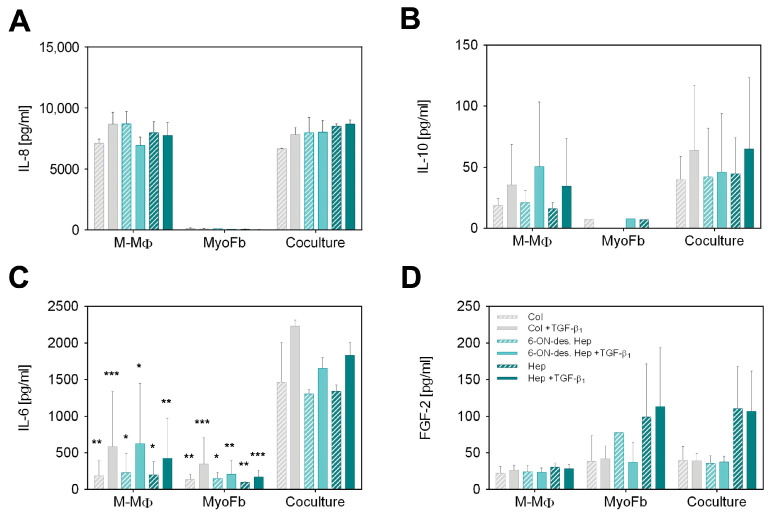 Figure 2
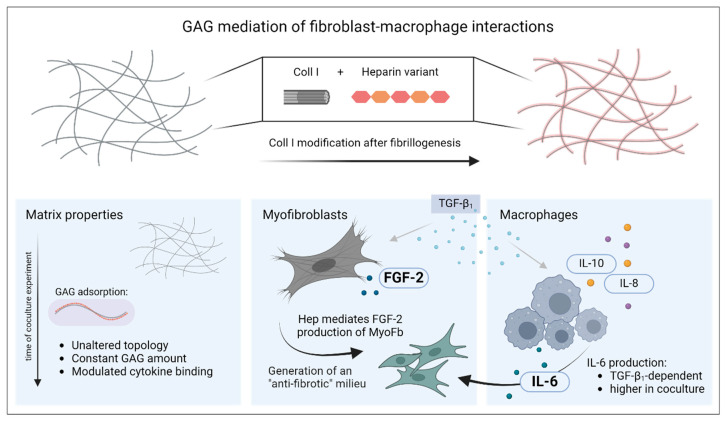 Figure 3
Peer Reviews
No public reviews on file for this paper yet. If you reviewed it on a platform where reviews are public (OpenReview, ICLR, NeurIPS, ICML), you can paste yours below so the community can read it here.
Videos
No videos yet. Explain this paper in a talk, walkthrough, or lecture? Add one.
Taxonomy
TopicsProteoglycans and glycosaminoglycans research · Wound Healing and Treatments · Cellular Mechanics and Interactions