Association of delayed cord clamping with acute kidney injury and two-year kidney outcomes in extremely premature neonates: a secondary analysis of the Preterm Erythropoietin Neuroprotection Trial (PENUT)
Matthew Harer, Henry Zapata, Namrata Todurkar, Kristen Favel, Russell Griffin, Michelle Starr, Jennifer Charlton, Ryan McAdams, David Askenazi, Tapas Kulkarni, Shina Menon, Cherry Mammen

TL;DR
This study found that delayed cord clamping in extremely premature babies did not reduce kidney injury but was linked to lower kidney function at two years.
Contribution
The study provides new insights into the long-term kidney outcomes of delayed cord clamping in extremely preterm neonates.
Findings
Delayed cord clamping did not reduce the incidence or severity of acute kidney injury.
Delayed cord clamping was associated with a 4.5-fold higher adjusted odds of reduced eGFR at two years.
No significant associations were found between delayed cord clamping and albuminuria or elevated blood pressure.
Abstract
Delayed cord clamping (DCC) occurs in most preterm births. Evaluate the association of DCC with acute kidney injury (AKI) and two-year kidney outcomes. Secondary analysis of the Preterm Erythropoietin Neuroprotection Trial of neonates born 240/7 to 276/7 weeks’ gestation. AKI and two year kidney outcomes were compared in neonates with DCC (≥30 seconds after delivery) to those with early cord clamping (ECC) (<30 seconds after delivery). The incidence and severity of AKI did not differ between the DCC and ECC groups (aOR 1.17 [95%CI 0.76–1.80]). At two years corrected age, DCC was associated with a 4.5-fold times increased adjusted odds of eGFR <90 mL/min/1.73m2. No significant associations were noted between DCC and albuminuria or elevated BP. DCC was not associated with decreased neonatal AKI, but was associated with higher adjusted odds of eGFR <90 mL/min/1.73m2 at two years.
Genes, proteins, chemicals, diseases, species, mutations and cell lines named across the full text — each resolved to its canonical identifier and authoritative record.
Click any figure to enlarge with its caption.
 Figure 1
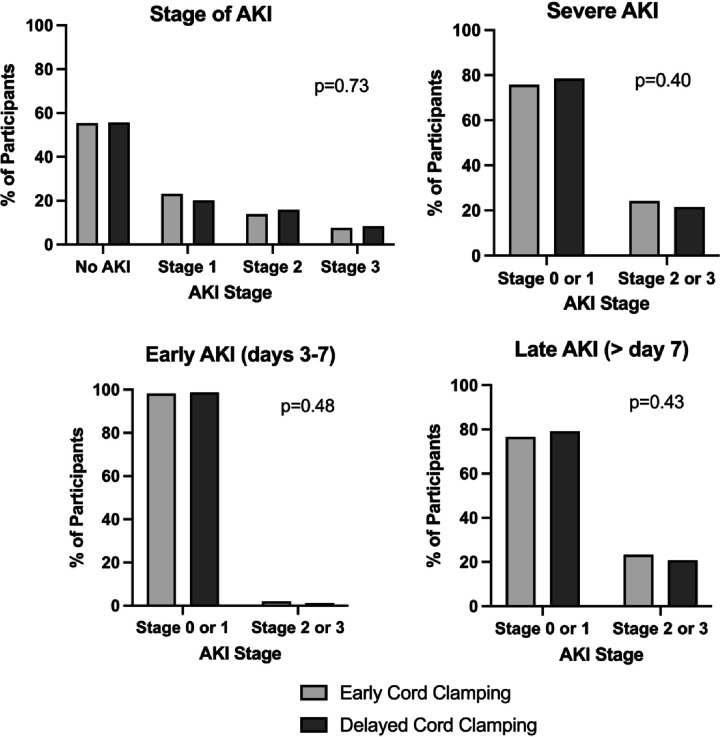 Figure 2
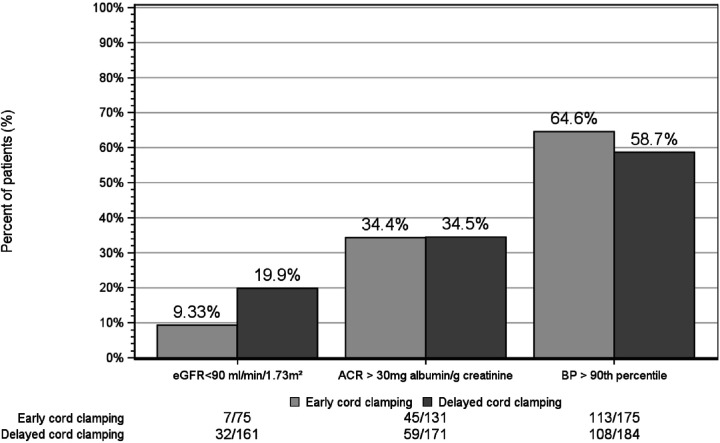 Figure 3
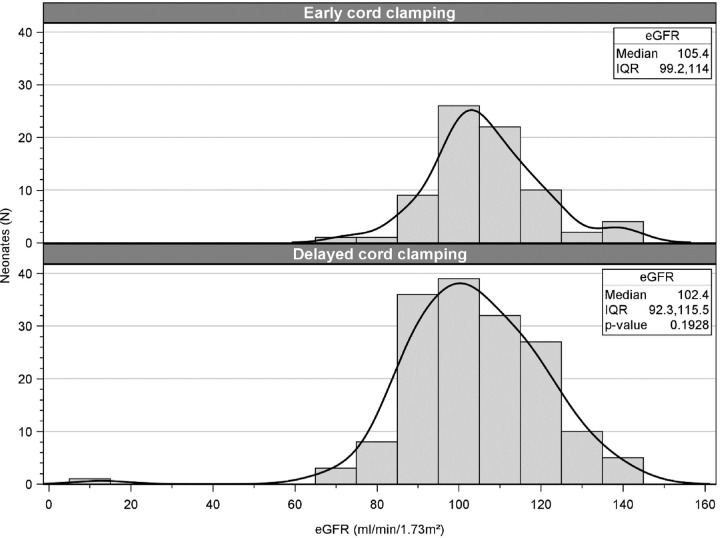 Figure 4
Peer Reviews
No public reviews on file for this paper yet. If you reviewed it on a platform where reviews are public (OpenReview, ICLR, NeurIPS, ICML), you can paste yours below so the community can read it here.
Videos
No videos yet. Explain this paper in a talk, walkthrough, or lecture? Add one.
Taxonomy
TopicsNeonatal and fetal brain pathology · Acute Kidney Injury Research · Neonatal Respiratory Health Research