The Impact of Pentraxin 3 Serum Levels and Angiotensin-Converting Enzyme Polymorphism on Pulmonary Infiltrates and Mortality in COVID-19 Patients
Zdravka Krivdić Dupan, Vlatka Periša, Mirjana Suver Stević, Martina Mihalj, Maja Tolušić Levak, Silva Guljaš, Tamer Salha, Domagoj Loinjak, Martina Kos, Matej Šapina, Ivana Canjko, Mirela Šambić Penc, Marin Štefančić, Nenad Nešković

TL;DR
This study shows that higher levels of a protein called pentraxin 3 and a specific genetic variant increase the risk of severe lung damage and death in patients with COVID-19.
Contribution
The study identifies PTX3 serum levels and ACE D/D polymorphism as novel predictors of severe disease and mortality in COVID-19.
Findings
PTX3 levels ≥ 2.765 ng/mL predicted severe lung infiltrates with high accuracy (AUC 0.871).
ACE D/D polymorphism significantly increased the risk of severe lung infiltrates (OR 7.7).
PTX3 and ACE polymorphism were significant predictors of poor outcomes and mortality in COVID-19 patients.
Abstract
Objectives: The aim of this study was to examine the impact of the pentraxin 3 (PTX3) serum level and angiotensin-converting enzyme (ACE) gene insertion/deletion (I/D) polymorphism on the severity of radiographic pulmonary infiltrates and the clinical outcomes of COVID-19. Methods: The severity of COVID-19 pulmonary infiltrates was evaluated within a week of admission by analyzing chest X-rays (CXR) using the modified Brixia (MBrixa) scoring system. The insertion (I)/deletion (D) polymorphism of the ACE gene and the serum levels of PTX3 were determined for all patients included in the study. Results: This study included 80 patients. Using a cut-off serum level of PTX3 ≥ 2.765 ng/mL, the ROC analysis (AUC 0.871, 95% CI 0.787–0.954, p < 0.001) showed a sensitivity of 85.7% and specificity of 78.8% in predicting severe MBrixa scores. Compared to ACE I/I polymorphism, D/D polymorphism…
Genes, proteins, chemicals, diseases, species, mutations and cell lines named across the full text — each resolved to its canonical identifier and authoritative record.
Click any figure to enlarge with its caption.
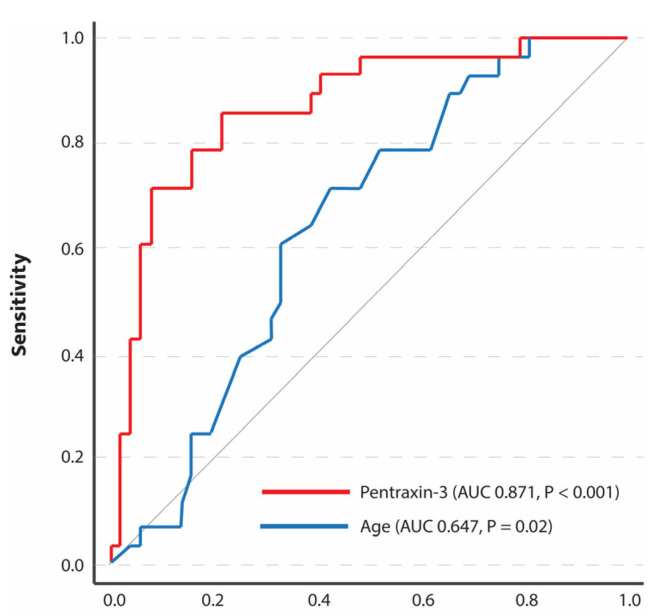 Figure 1
Peer Reviews
No public reviews on file for this paper yet. If you reviewed it on a platform where reviews are public (OpenReview, ICLR, NeurIPS, ICML), you can paste yours below so the community can read it here.
Videos
No videos yet. Explain this paper in a talk, walkthrough, or lecture? Add one.
Taxonomy
TopicsBiomarkers in Disease Mechanisms