Correction: Construction of antifungal dual-target (SE, CYP51) pharmacophore models and the discovery of novel antifungal inhibitors
Yue Dong, Min Liu, Jian Wang, Zhuang Ding, Bin Sun

TL;DR
This paper corrects a previous study on developing antifungal drug models targeting two enzymes and identifying new inhibitors.
Contribution
The correction provides updated information or clarifications regarding the pharmacophore models and antifungal inhibitors described in the original paper.
Findings
The original study aimed to construct dual-target pharmacophore models for antifungal agents.
The correction addresses potential errors or omissions in the initial findings and methodology.
New insights or revised conclusions may improve the development of antifungal drugs.
Abstract
Correction for ‘Construction of antifungal dual-target (SE, CYP51) pharmacophore models and the discovery of novel antifungal inhibitors’ by Yue Dong et al., RSC Adv., 2019, 9, 26302–26314, https://doi.org/10.1039/c9ra03713f.
Genes, proteins, chemicals, diseases, species, mutations and cell lines named across the full text — each resolved to its canonical identifier and authoritative record.
Click any figure to enlarge with its caption.
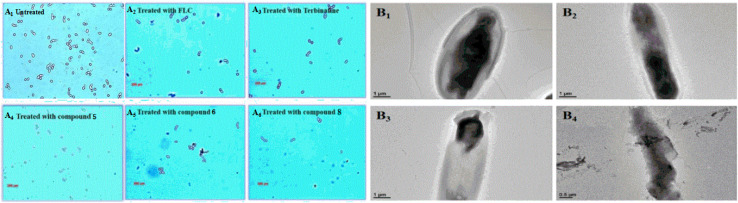 Figure 1
- —National Natural Science Foundation of China10.13039/501100001809
- —Natural Science Foundation of Shandong Province10.13039/501100007129
Peer Reviews
No public reviews on file for this paper yet. If you reviewed it on a platform where reviews are public (OpenReview, ICLR, NeurIPS, ICML), you can paste yours below so the community can read it here.
Videos
No videos yet. Explain this paper in a talk, walkthrough, or lecture? Add one.
Taxonomy
TopicsAntifungal resistance and susceptibility
The authors regret that an incorrect version of Fig. 8 was included in the original article. The correct version of Fig. 8 is presented here.
Fig. 8 (A_1_–6) Polarizing microscopy results of Candida albicans treated with the positive control drugs (fluconazole and terbinafine) and the target compounds (5, 6 and 8) at the specific concentration of 8 mg mL. (B_1–4_) TEM results for Candida albicans treated with the target compound (8) at the specific concentration of 8 mg mL^−1^.
The Royal Society of Chemistry apologises for these errors and any consequent inconvenience to authors and readers.