Online Search Interest in Gynecologists After the Release of the Film Barbie
Eva Senechal, Charles F. Bray, Christopher M. Worsham, Anupam B. Jena

TL;DR
This study examines if the release of the movie Barbie increased public interest in gynecologists in the US.
Contribution
The novelty lies in analyzing the impact of a popular film on public interest in gynecologic care.
Findings
The study found a significant increase in online search interest for gynecologists following the film's release.
The peak in search interest occurred shortly after the movie became available to the public.
Abstract
This cross-sectional study evaluates whether the film Barbie was associated with increased public interest in gynecologic care in the US after its release.
Genes, proteins, chemicals, diseases, species, mutations and cell lines named across the full text — each resolved to its canonical identifier and authoritative record.
Click any figure to enlarge with its caption.
 Figure
Peer Reviews
No public reviews on file for this paper yet. If you reviewed it on a platform where reviews are public (OpenReview, ICLR, NeurIPS, ICML), you can paste yours below so the community can read it here.
Videos
No videos yet. Explain this paper in a talk, walkthrough, or lecture? Add one.
Taxonomy
TopicsSocial Media in Health Education · Media Influence and Health
Introduction
Popular culture has been shown to influence health behaviors among the general public.^1^ For example, Katie Couric’s live streamed colonoscopy was associated with a transient 21% increase in colonoscopies, Angelina Jolie’s essay about her experience with breast cancer led to a transient 64% increase in genetic testing, and a 29% increase in suicide rates was observed in the months following the controversial season finale of 13 Reasons Why.^2,3,4^ The movie Barbie was released July 21, 2023, and sold 12.8 million tickets during its debut weekend, becoming one of the highest grossing films ever.^5^ While comedic, Barbie addresses serious topics about womanhood. In the film’s final scene, after deciding to leave Barbieland for the real world, Barbie enthusiastically tells a receptionist, “I’m here to see my gynecologist,” a joke that could be based either on her supposed lack of genitals or her evident excitement for care many women find unpleasant. We hypothesized that this final line may have spurred public interest in gynecologic care.
Methods
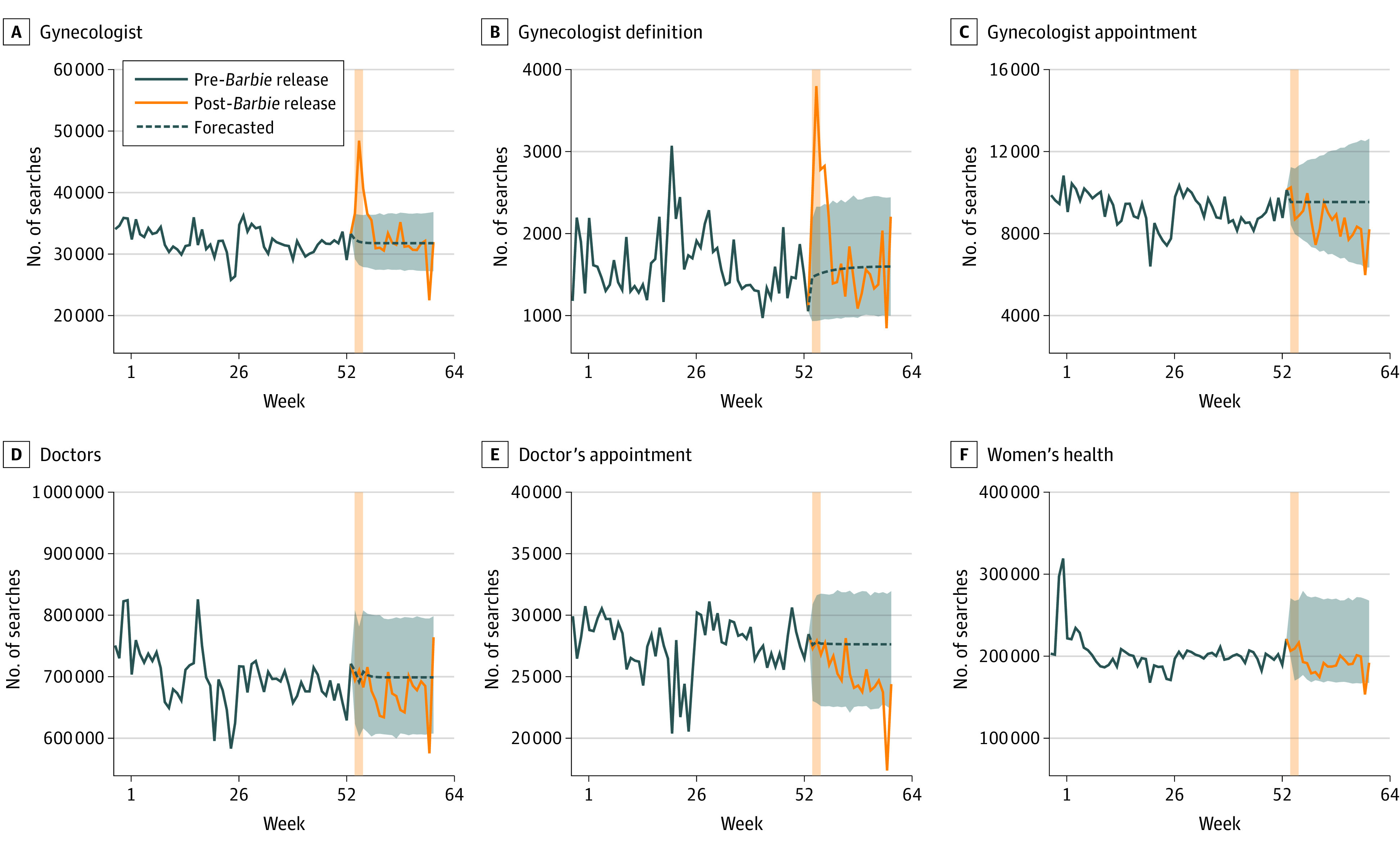
In this cross-sectional study, we analyzed online search trends in the US following Barbie’s release, focusing on a list of 34 queries related to understanding or seeking gynecologic care, women’s health care, or medical care more broadly (Figure). This study was deemed not human participant research by the Harvard Medical School Institutional Review Board and was therefore exempt from approval and the need for informed consent. The study followed the STROBE reporting guideline.
Search Trends for Gynecology and Related Terms Following the Release of the Film BarbieThe y-axis represents the aggregate weekly US search volume for search terms within the category. Vertical bars coincide with Barbie’s release date of July 21, 2023. Categories represent aggregate searches for the following terms (alternate spellings, eg, “gynaecologist,” were also included but are not listed for brevity): gynecologist = {“gynecologist,” “gynecology”}; gynecologist definition = {“gynecologist definition,” “gynecologist meaning,” “what is a gynecologist,” “what does a gynecologist do,” “why see a gynecologist,” “do I need a gynecologist”}; gynecologist appointment = {“gynecologist appointment,” “gynecologist near me,” “find a gynecologist”}; women’s health = {“womens health,” “preventive health care for women,” “reproductive health,” “birth control,” “contraceptives,” “breast health,” “mammogram,” “pap smear”}; doctors = {“doctor,” “primary care physician,” “family doctor,” “general practitioner,” “pediatrician,” “cardiologist,” “oncologist”}; doctor’s appointment = {“doctors appointment,” “doctors near me,” “find a doctor,” “make a doctors appointment”}.
Search queries were grouped into several categories: gynecologist, gynecologist definition, gynecologist appointment, women’s health, doctor, and doctor’s appointment. The first 3 categories measured topics directly related to the language used in Barbie. The last 3 categories assessed whether unobserved contemporaneous factors influencing health-seeking behavior more generally may have contributed to gynecologic-related search volume and, thus, served as control search terms. Weekly US online search trends in the year preceding and 3 months following the July 21, 2023, release date were obtained using Google Trends and Glimpse. Other than Barbie’s release, there were no major events during this period that may have led to widespread changes in search interest in gynecology.
Observed search volumes following Barbie’s release were compared with predicted search volumes generated using autoregressive integrated moving average based on weekly search data from June 2, 2022, through the week before the release. Percentage differences between measured and predicted search volumes were calculated as simple ratios, with 95% CIs calculated based on bootstrapped standard errors. The data analysis was performed using R, version 4.3.3 (R Foundation for Statistical Computing). A 2-sided P < .05, Bonferroni corrected for multiple outcomes, was considered significant.
Results
In the week following Barbie’s release, there were large increases in the national online search volume for terms referring to gynecologists (51.3%; 95% CI, 31.8%-72.1%; P < .001) and gynecologist definition (154.1%; 95% CI, 68.2%-304.5%; adjusted P = .03) (Figure). Meanwhile, there were no changes in searches for gynecologist appointments, suggesting that searches for information about gynecologists did not translate to searches for new gynecologic care. No changes were observed for search terms reflecting broader health interest (eg, searches for doctors’ appointments), supporting the assumption that the observed increase in gynecologist-related searches may have been influenced by the film’s release and not other factors.
Discussion
Our results suggest that Barbie’s closing line may have spurred interest in gynecology, further suggesting the potential influence of popular films on health literacy and awareness. While there were no changes in search volume associated with seeking care, a primary limitation of the study is that such changes in behavior may not be adequately captured by search trends, and in particular, they may be temporally far removed from changes in awareness. Furthermore, individuals searching for information about gynecologists may not themselves require gynecologic care. Therefore, it remains unclear whether a “Barbie effect” in awareness would translate to improved measurable health outcomes.
The reference list from the paper itself. Each links out to its DOI / PubMed record.
- 1Allem JP, Leas EC, Caputi TL, . The Charlie Sheen effect on rapid in-home human immunodeficiency virus test sales. Prev Sci. 2017;18(5):541-544. doi:10.1007/s 11121-017-0792-2 28516308 · doi ↗ · pubmed ↗
- 2Bridge JA, Greenhouse JB, Ruch D, . Association between the release of Netflix’s 13 Reasons Why and suicide rates in the United States: an interrupted time series analysis. J Am Acad Child Adolesc Psychiatry. 2020;59(2):236-243. doi:10.1016/j.jaac.2019.04.020 31042568 PMC 6817407 · doi ↗ · pubmed ↗
- 3Cram P, Fendrick AM, Inadomi J, Cowen ME, Carpenter D, Vijan S. The impact of a celebrity promotional campaign on the use of colon cancer screening: the Katie Couric effect. Arch Intern Med. 2003;163(13):1601-1605. doi:10.1001/archinte.163.13.1601 12860585 · doi ↗ · pubmed ↗
- 4Desai S, Jena AB. Do celebrity endorsements matter? Observational study of BRCA gene testing and mastectomy rates after Angelina Jolie’s New York Times editorial. BMJ. 2016;355:i 6357. doi:10.1136/bmj.i 6357 27974323 PMC 5156611 · doi ↗ · pubmed ↗
- 5Whitten S. ‘Barbenheimer’ tops $235 million in domestic debut, eyes second-highest box office weekend ever. CNBC. Published July 23, 2023. Updated July 24, 2023. Accessed March 1, 2024. https://www.cnbc.com/2023/07/23/barbie-and-oppenheimer-opening-weekend-box-office-results.html