Safety of a feed additive consisting of indigo carmine for cats, dogs and ornamental fish (Sensient Colors Europe GmbH)
Vasileios Bampidis, Giovanna Azimonti, Maria de Lourdes Bastos, Henrik Christensen, Mojca Durjava, Birgit Dusemund, Maryline Kouba, Marta López‐Alonso, Secundino López Puente, Francesca Marcon, Baltasar Mayo, Alena Pechová, Mariana Petkova, Fernando Ramos, Roberto Edoardo Villa

TL;DR
The paper assesses the safety of indigo carmine as a feed additive for cats, dogs, and ornamental fish at lower purity levels.
Contribution
The study confirms the safety of indigo carmine with at least 85% purity in animal feed.
Findings
Indigo carmine with 85% purity is safe for cats and dogs at up to 250 mg/kg feed.
It is safe for ornamental fish at up to 1000 mg/kg feed.
The FEEDAP Panel updated previous conclusions with new data.
Abstract
Following a request from the European Commission, EFSA was asked to deliver a scientific opinion on the safety of indigo carmine as a colourant feed additive for cats, dogs and ornamental fish. In its previous opinion, the FEEDAP Panel concluded that indigo carmine is safe for cats and dogs at levels up to 250 mg/kg complete feed and for ornamental fish up to 1000 mg/kg complete feed. These conclusions were limited to indigo carmine with a purity of at least 93% colouring matter. For the current assessment, the applicant submitted additional data on the characterisation and on the toxicological profile to support the safety of the additive with the purity of at least 85% colouring matter. Based on the new data submitted, the FEEDAP Panel concludes that indigo carmine (purity of at least 85% colouring matter) is safe for cats and dogs at levels up to 250 mg/kg complete feed and for…
Genes, proteins, chemicals, diseases, species, mutations and cell lines named across the full text — each resolved to its canonical identifier and authoritative record.
Click any figure to enlarge with its caption.
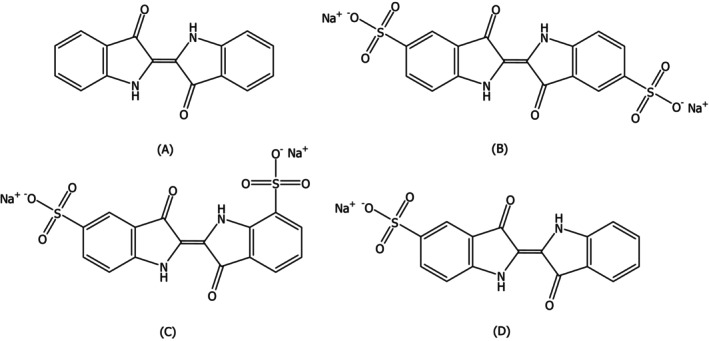 FIGURE 1
| Category of additive | Sensory additive |
|---|---|
|
| Colourant |
|
| Disodium 3,3′‐dioxo‐2,2′‐bi‐indolylidene‐5,5′‐disulfonate; Dark‐blue powder or granules |
|
| Cats, dogs and ornamental fish |
|
| Sensient Colors UK Ltd, on behalf of Feed Additive Synthetic Colours Group |
|
| New opinion |
| Daily feed intake (g dry matter/kg) | Safe concentration in feed (mg/kg complete feed) | |
|---|---|---|
| Dog | 17 | 264 |
| Cat | 20 | 220 |
| Ornamental fish | 5 | 978 |
Peer Reviews
No public reviews on file for this paper yet. If you reviewed it on a platform where reviews are public (OpenReview, ICLR, NeurIPS, ICML), you can paste yours below so the community can read it here.
Videos
No videos yet. Explain this paper in a talk, walkthrough, or lecture? Add one.
Taxonomy
TopicsAgricultural safety and regulations · Effects and risks of endocrine disrupting chemicals · Pesticide Residue Analysis and Safety
INTRODUCTION
1
Background and Terms of Reference as provided by the requestor
1.1
Regulation (EC) No 1831/2003 establishes rules governing the Community authorization of feed additives for animal nutrition and, in particular, Article 9 defines the terms of the authorization by the Commission.
The applicant Sensient Colors UK Ltd, on behalf of Feed Additive Synthetic Colours Group is seeking a Community authorisation of indigo carmine (E132) a feed additive for cats, dogs and ornamental fish to be used as a colourant (Table 1).
The opinion of the Scientific Panel on Additives and Products or Substances used in Animal Feed (FEEDAP) of the European Food Safety Authority (EFSA) on the subject, adopted in 28 April 2015 states that it is recommended to increase the specified minimum purity of indigo carmine from 85% to 93% total colouring matter to ensure the safety assessment is applicable.
The applicant wished to keep the purity of 85% and then has submitted additional data about the specifications in terms of analytical results of the different components of the additive.
The Commission gave the possibility to the applicant to submit additional data in order to complete the assessment and allow a revision of Authority's opinion. The new data have been received on 10 March 2017.
In view of the above, the Commission asks the Authority to deliver a new opinion of indigo carmine (E132) as a sensory additive (colorant) based on the additional data submitted by the applicant.
Additional information
1.2
Indigo carmine is currently authorised in cats, dogs and ornamental fish to add or restore colour in feedingstuffs, and subject to re‐evaluation.1
EFSA issued an opinion on the safety and efficacy of this product when used in feed for cats and dogs and ornamental fish (EFSA FEEDAP Panel, 2015).
DATA AND METHODOLOGIES
2
Data
2.1
The present assessment is based on data submitted by the applicant in the form of additional information2 to a previous application on the same product.3 The dossier was received on 26 June 2017 and the general information and supporting documentation are available on Open.EFSA at https://open.efsa.europa.eu/questions/EFSA‐Q‐2017‐00502.
In 2019, the European Union Reference Laboratory (EURL) issued an amendment to the previous report.4 EFSA has verified the amended report. It relates to the methods used for the control of indigo carmine in animal feed; in particular, the use of LC‐MS/MS is recommended for the quantification of indigo carmine in feedingstuffs.
Methodologies
2.2
The approach followed by the FEEDAP Panel to assess the safety and the efficacy of indigo carmine is in line with the principles laid down in Regulation (EC) No 429/20085 and the relevant guidance documents: Guidance on the identity, characterisation and conditions of use of feed additives (EFSA FEEEDAP Panel, 2017a), Guidance on the assessment of the safety of feed additives for the target species (EFSA FEEDAP Panel, 2017b).
ASSESSMENT
3
Indigo carmine is intended to be used as a sensory additive (functional group: substances that add or restore colour in feedingstuffs) in feed for cats, dogs and ornamental fish.
The additive, specified to contain > 85% total colouring matter, was characterised in the previous opinion on the safety and efficacy of indigo carmine for cats, dogs and ornamental fish (EFSA FEEDAP Panel, 2015). In the same opinion, the FEEDAP Panel concluded that indigo carmine is safe for cats and dogs at levels up to 250 mg/kg complete feed and for ornamental fish up to 1000 mg/kg complete feed. These conclusions were limited to indigo carmine with a purity of at least 93% colouring matter.
For the current assessment, the applicant confirmed its intention to maintain the same original specifications (min. 85% total colouring matter) and submitted additional data on the characterisation and on the toxicological profile.
Characterisation
3.1
Characterisation of the additive
3.1.1
The feed additive indigo carmine is described as a mixture of disodium 3,3′‐dioxo‐2,2′‐bi‐indolylidene‐5,5′‐disulfonate (CAS No. 860‐22‐0, IUPAC name: disodium salt of 2‐(1,3‐dihydro‐3‐oxo‐5‐sulfo‐2H‐indol‐2‐ylidene)‐2,3‐dihydro‐3‐oxo‐1H‐indole‐5‐sulfonic acid) and its constitutional isomer disodium 3,3′‐dioxo‐2,2′‐bi‐indolylidene‐5,7′‐disulfonate (CAS No. 54947‐75‐0, IUPAC name: disodium salt of 2‐(1,3‐dihydro‐3‐oxo‐7‐sulfo‐2H‐indol‐2‐ylidene)‐2,3‐dihydro‐3‐oxo‐1H‐indole‐5‐sulfonic acid). The chemical formula is C_16_H_8_N_2_Na_2_O_8_S_2_ and the molecular weight is 466.36 g/mol. Furthermore, the additive contains subsidiary colouring matters (e.g. sodium salt of indigo sulfonic acid (sodium salt of 2‐(1,3‐dihydro‐3‐oxo‐2H‐indol‐2‐ylidene)‐2,3‐dihydro‐3‐oxo‐1H‐indole‐5‐sulfonic acid)) together with sodium chloride and/or sodium sulfate as the principal uncoloured components. The structural formula of these molecules is given in Figure 1.
Structural formula of (A) indigo; (B) indigo carmine (5,5′ isomer); (C) indigo carmine (5,7′ isomer) and (D) sodium salt of indigo sulfonic acid.
The manufacturing process was described in detail in the previous opinion (EFSA FEEDAP Panel, 2015). In that original application, the applicant proposed to follow the specifications of the food additive6 as follows: total colouring matter ≥ 85% (calculated as disodium salt); disodium 3,3′‐dioxo‐2,2′‐bi‐indolylidene‐5,7′‐disulfonate ≤ 18%; subsidiary colouring matter ≤ 1%, organic compounds other than colouring matters (isatin‐5‐sulfonic acid, 5‐sulfoanthranilic acid and anthranilic acid) ≤ 0.5%, total; unsulfonated primary aromatic amines ≤ 0.01% (calculated as aniline), arsenic ≤ 3 mg/kg, mercury and cadmium ≤ 1 mg/kg and lead ≤ 10 mg/kg. The FEEDAP Panel notes that the current authorised limit7 for lead as food additive is ≤ 2 mg/kg. Analytical data submitted in the previous application were in line with these specifications.
To complete the previously assessed data set (EFSA FEEDAP Panel, 2015), the applicant submitted additional analytical data on eight independent batches of indigo carmine.8 The data showed that total colouring matters (reported as assay of the pure dye by spectrophotometric analysis)9 was in the range of 86.62%–96.80% (average: 90.94%); disodium 3,3′‐dioxo‐2,2′‐bi‐indolylidene‐5,7′‐disulfonate was in the range of 6.47%–13.77% (average: 10.81%); isatin‐5‐sulfonic acid was in the range of 0.03%–0.11% (average: 0.06%); 5‐sulfoanthranilic acid and anthranilic acid were not tested, a trisulfonated derivative was detected in six batches and was in the range of 0.01%–0.58% (average 0.17%); sodium salt of indigo sulfonic acid was detected in seven batches and was in the range of 0.02%–1.14% (average: 0.54%). In these batches lead, arsenic and mercury were also analysed.
In addition to the above information, the applicant also made available the same data set that was submitted in the context of a call for data of the European Commission10 addressing the recommendations made by EFSA in the scientific opinion on the re‐evaluation of indigotine, indigo carmine (E 132), as a food additive. The information includes data on (i) the identity of unsulfonated aromatic amines and their lowest achievable limits, and (ii) the lowest achievable limits for the impurities of toxic elements (arsenic, lead, mercury and cadmium) in the additive.11 In this submission, the applicant described other possible manufacturing processes than underlying the current application and was not in the position to relate the results of the analysis to a specific manufacturing process, and therefore, these results are considered of low relevance for the current assessment.
Unsulfonated aromatic amines were analysed in six samples from five independent batches via gas chromatography mass spectrometry (GC/MS). The FAF Panel assessed these data and noted that they were subject to considerable uncertainty (EFSA FAF Panel, 2023). Apart from aniline which was identified and quantified by comparison to an analytical standard, no conclusion could be made on other N‐containing impurities.
Analysis of heavy metals and arsenic from three manufacturers was also provided from a total of 84 batches showing compliance with the currently authorised specifications for food additive.12 The analysed levels of impurities do not raise concern.
Physico‐chemical properties of the additive
Indigo carmine is a dark blue powder or granules available in different granulation sizes from fine powders to coarse granules. The particle size distribution measured via laser diffraction/scattering technique in the products from three manufacturers was described in the former opinion of the FEEDAP Panel (EFSA FEEDAP Panel, 2015); however, no information on the dusting potential of the additive was submitted. Considering that the water solubility of indigo carmine is 16 g/L (EFSA FEEDAP Panel, 2015) together with the intended use levels in the target species (up to 200 mg/kg feed for cats and dogs and up to 5000 mg/kg feed for ornamental fish), no further characterisation of the fraction of small/nanoparticles is needed in the feed additive indigo carmine.
Conditions of use
3.1.2
The additive is to be used in feedingstuffs for cats, dogs and ornamental fish, to add or restore colour. No minimum or maximum contents in complete feed are specified; however, the applicant proposed typical inclusion levels of 10–200 mg/kg feedingstuffs for cats and dogs, 1000–5000 mg/kg for tropical fish (flake feed) and 500–2500 mg/kg for tropical fish and pond fish (extruded feed).
Safety for the target species
3.2
The toxicological profile of indigo carmine was previously evaluated by EFSA in 2014 (EFSA ANS Panel, 2014) and in 2015 (EFSA FEEDAP Panel, 2015). In those assessments, it was concluded that indigo carmine does not raise concern for genotoxicity and that no adverse effects were observed at doses less than or equal to 500 mg/kg body weight (bw) per day, based on a battery of repeated dose toxicity studies (including subacute, chronic, reproduction and developmental toxicity studies) in different laboratory animals.
In 2014, the EFSA ANS Panel confirmed the acceptable daily intake (ADI) of indigo carmine of 5 mg/kg bw (based on the NOAEL of 500 mg/kg bw per day). However, this ADI applied only to indigo carmine with a purity of at least 93% colouring matter (EFSA ANS Panel, 2014). This limitation was due to the adverse effects on the testes (including thickening of the tubular basement membrane and arrest spermatogenesis) that were observed in mice orally exposed to indigo carmine, of unknown purity, at 17 mg/kg bw per day and 39 mg/kg bw per day for 45 days (Dixit & Goyal, 2013) but that were not evident when indigo carmine with a purity of 93% colouring matter was tested in studies performed at higher doses (Borzelleca et al., 1986; Borzelleca & Hogan, 1985).
In its previous opinion, the FEEDAP Panel calculated the safe concentration in feed for the target species, using the no observed adverse effect level (NOAEL) of 500 mg/kg bw per day identified in a 2‐year study in rats and applying an uncertainty factor of 100, and concluded that indigo carmine (purity of at least 93% colouring matter) is safe for cats and dogs at levels up to 250 mg/kg complete feed and for ornamental fish up to 1000 mg/kg complete feed (EFSA FEEDAP Panel, 2015).
For the present assessment, the applicant submitted a 56‐day oral toxicity study in male mice,13 done with indigo carmine with 88% total colouring matter, aimed at investigating the adverse effects observed on the testes in the study by Dixit and Goyal (2013). The FEEDAP Panel noted that the same study has been recently evaluated by the FAF Panel in its assessment on the use of indigo carmine as food additive (EFSA FAF Panel, 2023).
The FAF Panel considered that no test item‐related adverse effects were observed, in particular on parameters of male reproduction, within the dose range tested (135, 277 and 548 mg/kg per day), and therefore, the new study does not confirm the adverse effects observed in the study carried out by Dixit and Goyal (2013). The FAF Panel also considered that these results are in accordance with the observations in chronic toxicity studies (Borzelleca & Hogan, 1985; Oettel et al., 1965) and in a three‐generation reproduction toxicity study with indigo carmine (Borzelleca et al., 1986) described in previous opinions (EFSA ANS Panel, 2014; EFSA FEEDAP Panel, 2015). The FAF Panel further considered that the results of the 56‐day study support the considerations of the ANS Panel that the adverse effects in the testes reported by Dixit and Goyal (2013) may be ascribed to impurities or contaminants present in the additive tested and not to indigo carmine itself. The FAF Panel noted that the purity of the additive tested in the 56‐day study was 88% and considered that the current specification for the food additive of 85% minimum for the colouring matter is still appropriate. Based on this study, the FAF Panel identified a NOAEL of 548 mg indigo carmine/kg bw per day, the highest dose tested (EFSA FAF Panel, 2023). The FEEDAP Panel evaluated the same 56‐day toxicity study in male mice and agreed with the assessment of the FAF Panel (EFSA FAF Panel, 2023).
The Panel notes that the adverse effects seen in testes when testing indigo carmine of unknown purity was not seen in the 56‐day study with indigo carmine 88%. Therefore, the FEEDAP Panel considers that the lowest NOAEL identified in the toxicological data set (500 mg/kg bw per day) can be applied to indigo carmine under assessment (85% purity).
The FEEDAP Panel re‐calculated the maximum safe concentration in feed for indigo carmine following the EFSA Guidance on the safety of feed additives for the target species (EFSA FEEDAP Panel, 2017b) (Table 2).
The calculated maximum safe dietary concentrations in complete feed for dogs and cats are above the maximum typical inclusion rate reported by the applicant (200 mg/kg complete feed). For ornamental fish, the maximum safe concentration is 978 mg indigo carmine/kg feed, which is below the maximum typical inclusion rate reported by the applicant (2500–5000 mg/kg complete feed). For practical reasons, the maximum safe concentrations can be rounded to 250 mg/kg complete feed for cats and dogs and 1000 mg/kg complete feed for ornamental fish.
CONCLUSIONS
4
Indigo carmine (purity of at least 85% colouring matter) is safe for cats and dogs at levels up to 250 mg/kg complete feed, and for ornamental fish up to 1000 mg/kg complete feed.
RECOMMENDATIONS
5
The analysis provided by the applicant confirms that indigo carmine contains less than 2 mg/kg lead, in compliance with the current specification set for its use as a food additive. The FEEDAP Panel recommends to align the specifications for the feed additive to the one set for food use, i.e. lead ≤ 2 mg/kg.
ABBREVIATIONSADIacceptable daily intakeANSEFSA Scientific Panel on Additives and Nutrient Sources added to FoodBWbody weightCASChemical Abstracts ServiceEURLEuropean Union Reference LaboratoryFEEDAPEFSA Scientific Panel on Additives and Products or Substances used in Animal FeedIUPACInternational Union of Pure and Applied ChemistryMWmolecular weightNOAELno observed adverse effect level
CONFLICT OF INTEREST
If you wish to access the declaration of interests of any expert contributing to an EFSA scientific assessment, please contact [email protected].
REQUESTOR
European Commission
QUESTION NUMBER
EFSA‐Q‐2017‐00502
COPYRIGHT FOR NON‐EFSA CONTENT
EFSA may include images or other content for which it does not hold copyright. In such cases, EFSA indicates the copyright holder and users should seek permission to reproduce the content from the original source.
PANEL MEMBERS
Vasileios Bampidis, Giovanna Azimonti, Maria de Lourdes Bastos, Henrik Christensen, Mojca Durjava, Birgit Dusemund, Maryline Kouba, Marta López‐Alonso, Secundino López Puente, Francesca Marcon, Baltasar Mayo, Alena Pechová, Mariana Petkova, Fernando Ramos, Roberto Edoardo Villa, and Ruud Woutersen.
The reference list from the paper itself. Each links out to its DOI / PubMed record.
- 1Borzelleca, J. F. , Goldenthal, E. I. , & Wazeter, F. X. (1986). Multigeneration study of FD&C Blue No. 2 in rats. Food and Chemical Toxicology, 24, 159–163. 10.1016/0278-6915(86)90351-0 3957164 · doi ↗ · pubmed ↗
- 2Borzelleca, J. F. , & Hogan, G. K. (1985). Chronic toxicity/carcinogenicity study of FD&C Blue No. 2 in mice. Food and Chemical Toxicology, 23, 719–722.4043877 10.1016/0278-6915(85)90264-9 · doi ↗ · pubmed ↗
- 3Dixit, A. , & Goyal, R. P. (2013). Evaluation of reproductive toxicity caused by indigo carmine on male Swiss albino mice. Pharmacology On Line, 1, 218–224.
- 4EFSA ANS Panel (EFSA Panel on Food Additives and Nutrient Sources Added to Food) . (2014). Scientific Opinion on the re‐evaluation of indigo carmine (E 132) as a food additive. EFSA Journal, 12(7), 3768. 10.2903/j.efsa.2014.3768 · doi ↗
- 5EFSA FAF Panel (EFSA Panel on Food Additives and Flavourings) , Younes, M. , Aquilina, G. , Degen, G. , Engel, K.‐H. , Fowler, P. , Frutos Fernandez, M. J. , Furst, P. , Gurtler, R. , Husoy, T. , Manco, M. , Mennes, W. , Passamonti, S. , Moldeus, P. , Shah, R. , Waalkens‐Berendsen, I. , Wright, M. , Cheyns, K. , Fitz Gerald, R. , … Gundert‐Remy, U. (2023). Follow‐up of the re‐evaluation of indigo carmine (E 132) as a food additive. EFSA Journal, 21(7), 1–31. 10.2903/j.efsa.202 · doi ↗ · pubmed ↗
- 6EFSA FEEDAP Panel (EFSA Panel on Additives and Products or Substances used in Animal Feed) . (2015). Scientific opinion on the safety and efficacy of indigo carmine (E 132) for cats and dogs and ornamental fish. EFSA Journal, 13(5), 4108. 10.2903/j.efsa.2015.4108 · doi ↗
- 7EFSA FEEDAP Panel (EFSA Panel on Additives and Products or Substances used in Animal Feed) , Rychen, G. , Aquilina, G. , Azimonti, G. , Bampidis, V. , Bastos, M. L. , Bories, G. , Chesson, A. , Cocconcelli, P. S. , Flachowsky, G. , Gropp, J. , Kolar, B. , Kouba, M. , López‐Alonso, M. , López Puente, S. , Mantovani, A. , Mayo, B. , Ramos, F. , Saarela, M. , … Innocenti, M. L. (2017 a). Guidance on the identity, characterisation and conditions of use of feed additives. EFSA Jour · doi ↗ · pubmed ↗
- 8EFSA FEEDAP Panel (EFSA Panel on Additives and Products or Substances used in Animal Feed) , Rychen, G. , Aquilina, G. , Azimonti, G. , Bampidis, V. , Bastos, M. L. , Bories, G. , Chesson, A. , Cocconcelli, P. S. , Flachowsky, G. , Gropp, J. , Kolar, B. , Kouba, M. , López‐Alonso, M. , López Puente, S. , Mantovani, A. , Mayo, B. , Ramos, F. , Saarela, M. , … Martino, L. (2017 b). Guidance on the assessment of the safety of feed additives for the target species. EFSA Journal, 1 · doi ↗ · pubmed ↗