Correction: How to estimate body condition in large lizards? Argentine black and white tegu (Salvator merianae, Duméril and Bibron, 1839) as a case study
Kelly R. McCaffrey, Sergio A. Balaguera-Reina, Bryan G. Falk, Emily V. Gati, Jenna M. Cole, Frank J. Mazzotti

Abstract
Genes, proteins, chemicals, diseases, species, mutations and cell lines named across the full text — each resolved to its canonical identifier and authoritative record.
Click any figure to enlarge with its caption.
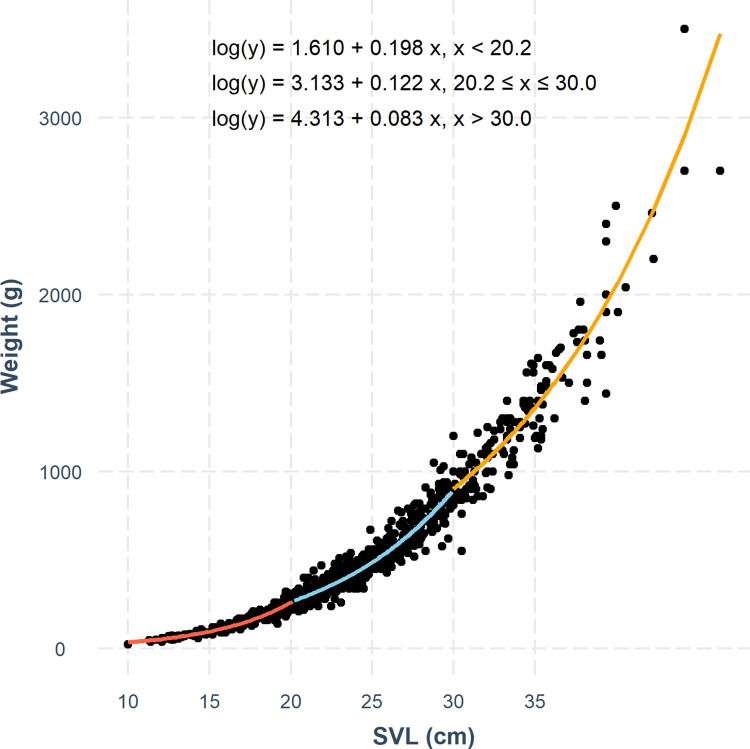 Figure 1
Peer Reviews
No public reviews on file for this paper yet. If you reviewed it on a platform where reviews are public (OpenReview, ICLR, NeurIPS, ICML), you can paste yours below so the community can read it here.
Videos
No videos yet. Explain this paper in a talk, walkthrough, or lecture? Add one.
Taxonomy
TopicsAmphibian and Reptile Biology · Species Distribution and Climate Change · Bat Biology and Ecology Studies
There is an error in reference 50. The correct reference is: McEachern MA, Yackel Adams AA, Klug PE, Fitzgerald LE, Reed RN. Brumation of introduced black and white tegus, Tupinambis merianae (Squamata: Teiidae), in southern Florida. Southeast Nat. 2015;14(2): 319–328.
In Fig 2, there is an error in the third equation. The symbol “<” should have been “>”. The correct equation should read as “log(y) = 4.313 + 0.083x, x > 30.0”. Please see the correct Fig 2 here.
The reference list from the paper itself. Each links out to its DOI / PubMed record.
- 1Mc Caffrey KR, Balaguera-Reina SA, Falk BG, Gati EV, Cole JM, Mazzotti FJ (2023) How to estimate body condition in large lizards? Argentine black and white tegu (Salvator merianae, Duméril and Bibron, 1839) as a case study. PLOS ONE 18(2): e 0282093. 10.1371/journal.pone.028209336827271 PMC 9955610 · doi ↗ · pubmed ↗