Reducing the gender gap on adolescents’ interest in study fields: The impact of perceived changes in ingroup gender norms and gender prototypicality
Vincenzo Iacoviello, Giulia Valsecchi, Matthieu Vétois, Juan M. Falomir-Pichastor

TL;DR
This study explores how changing perceptions of gender norms affect adolescents' interest in traditionally gendered academic fields like STEM and HEED.
Contribution
The research experimentally examines the impact of perceived changes in gender norms on reducing the gender gap in academic interests.
Findings
Perceived changes in gender norms slightly reduced the gender gap in interest for HEED fields among gender-typical participants.
No significant change was observed in interest for STEM fields despite the manipulation of gender norm perceptions.
Entrenched gender stereotypes appear resilient to shifts in perceived gender norms.
Abstract
Despite some progress towards gender equality in Western societies, traditional gender norms still shape career choices, perpetuating a gender gap where girls are more likely to pursue traditionally feminine fields like healthcare, elementary education, and domestic roles (HEED), while boys are drawn to masculine domains such as science, technology, engineering, and mathematics (STEM). This research investigates whether, and under which conditions, the perception that gender norms are progressively changing towards less gender dichotomy can reduce this gender gap in academic fields. We recruited a sample of 642 high-school students (394 women and 248 men), and experimentally manipulated both the salience of changes in gender norm (stability vs change) and participants’ gender prototypicality. The main dependent variable was participants’ interest in stereotypically feminine (HEED) and…
Genes, proteins, chemicals, diseases, species, mutations and cell lines named across the full text — each resolved to its canonical identifier and authoritative record.
Click any figure to enlarge with its caption.
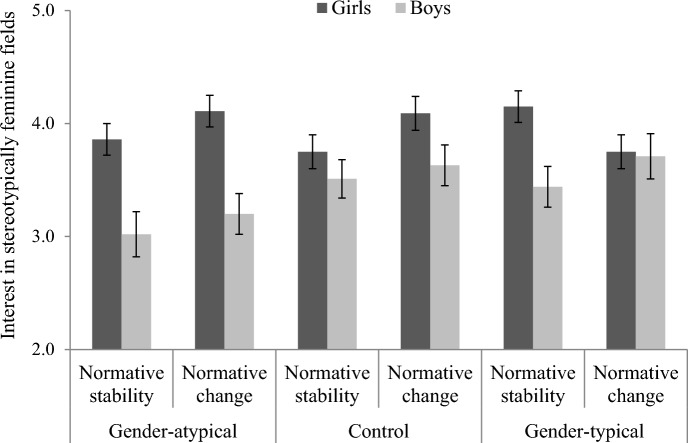 Figure 1
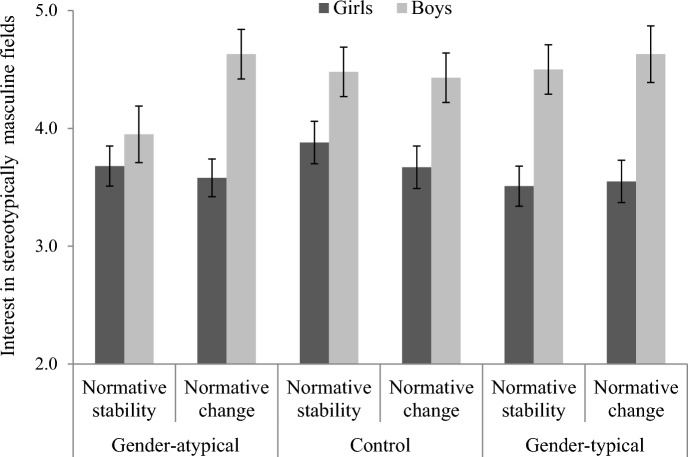 Figure 2
Peer Reviews
No public reviews on file for this paper yet. If you reviewed it on a platform where reviews are public (OpenReview, ICLR, NeurIPS, ICML), you can paste yours below so the community can read it here.
Videos
No videos yet. Explain this paper in a talk, walkthrough, or lecture? Add one.
Taxonomy
TopicsFrench Urban and Social Studies