The impact of Boric Acid tubes on quantitative urinary bacterial cultures in hospitalized patients
Debby Ben-David, Yael Cohen, Iris Zohar, Yasmin Maor, Orna Schwartz

TL;DR
This study shows that using boric acid tubes for urine collection reduces bacterial culture positivity in samples processed within 4–24 hours, improving diagnostic accuracy.
Contribution
Demonstrates the effectiveness of boric acid tubes in reducing false positives in urine cultures for hospitalized patients.
Findings
Culture positivity decreased from 30.4% to 24.0% for 4–24-hour processed samples after using boric acid tubes.
The intervention significantly reduced positivity only in the 4–24-hour processing window (OR 0.80, 95% CI 0.67–0.94).
No significant changes were observed in specimens processed in <4 or ≥24 hours.
Abstract
The accuracy of urine culture results can be affected by pre-analytical factors such as transport delays and storage conditions. The objectives of this study were to analyze urine collection practices and assess the impact of introducing boric acid tubes for urine collection on quantitative urinary bacterial cultures of hospitalized patients in medical wards. A quasi-experimental pre-post study conducted in an acute care facility. In the pre-intervention phase (2020–2021), urine samples were transported without preservatives at room temperature. In 2022 (post-intervention), we transitioned to boric acid transport tubes, evaluating its effect on significant bacterial growth (≥ 105 CFU/ml). Bivariate and multivariate analyses identified predictors of culture positivity. Throughout the duration of the study, a total of 12,660 urine cultures were analyzed. Date and time documentation was…
Genes, proteins, chemicals, diseases, species, mutations and cell lines named across the full text — each resolved to its canonical identifier and authoritative record.
Click any figure to enlarge with its caption.
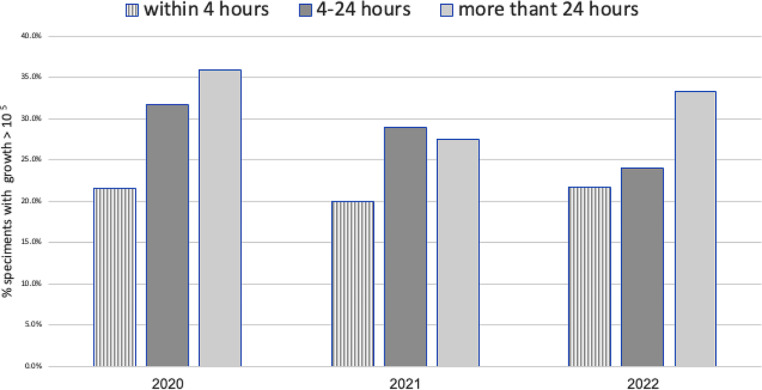 Figure 1
Peer Reviews
No public reviews on file for this paper yet. If you reviewed it on a platform where reviews are public (OpenReview, ICLR, NeurIPS, ICML), you can paste yours below so the community can read it here.
Videos
No videos yet. Explain this paper in a talk, walkthrough, or lecture? Add one.
Taxonomy
TopicsUrinary Tract Infections Management · Pediatric Urology and Nephrology Studies · Bacterial Identification and Susceptibility Testing