The impact of non- and anthracycline-based chemotherapy on fatigue in breast cancer survivors: results from WF-97415
Nancy E. Avis, Beverly J. Levine, Heidi D. Klepin, Shannon L. Mihalko, Peter H. Brubaker, Tonya Moore, Amy C. Ladd, Susan F. Dent, Mary Helen Hackney, Bonnie Ky, William O. Ntim, Lynne I. Wagner, Kathryn E. Weaver, W. Gregory Hundley

TL;DR
This study found that breast cancer survivors receiving either non- or anthracycline-based chemotherapy experience similar fatigue levels, which are higher than those receiving AIs alone or non-cancer controls.
Contribution
The study provides new evidence on the comparative fatigue outcomes of different chemotherapy regimens in breast cancer survivors.
Findings
Chemotherapy groups showed a sharp increase in fatigue at 3 months compared to non-chemotherapy and non-cancer controls.
Non- and anthracycline-based chemotherapy groups did not significantly differ in fatigue levels at any time point.
Fatigue levels in chemotherapy groups remained higher than in AIs-only and non-cancer groups over 12 months.
Abstract
To examine the differential effect of non- and anthracycline-based chemotherapy on fatigue over 12 months post-diagnosis among breast cancer survivors. This study is based on a prospective Wake Forest NCI Community Oncology Research Program (NCORP) multicenter cohort study (WF-97415) of women with stage I to III breast cancer and non-cancer controls. Analyses compared those: 1) receiving, or 2) not receiving anthracycline chemotherapy, 3) receiving aromatase inhibitors (AIs) without chemotherapy, with 4) a comparator group without a history of cancer. In-person clinic assessments were conducted at: baseline (prior to chemotherapy or start of AI therapy), and 3 and 12 months after baseline. The Functional Assessment of Chronic Illness Therapy-Fatigue scale was the primary outcome. Estimated least squares means by group using mixed models with a random subject effect, fixed effects of…
Genes, proteins, chemicals, diseases, species, mutations and cell lines named across the full text — each resolved to its canonical identifier and authoritative record.
Click any figure to enlarge with its caption.
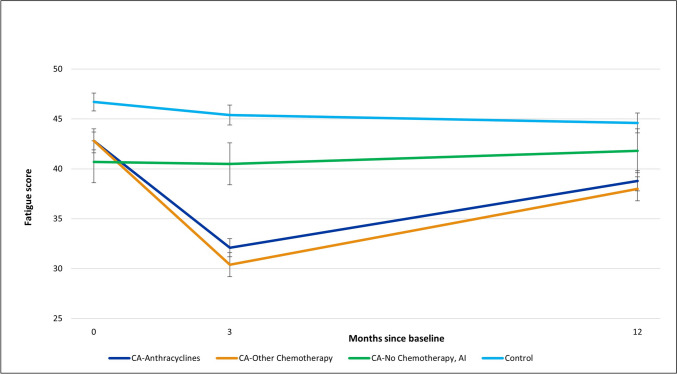 Figure 1
Peer Reviews
No public reviews on file for this paper yet. If you reviewed it on a platform where reviews are public (OpenReview, ICLR, NeurIPS, ICML), you can paste yours below so the community can read it here.
Videos
No videos yet. Explain this paper in a talk, walkthrough, or lecture? Add one.
Taxonomy
TopicsCancer survivorship and care · Cancer-related cognitive impairment studies · Cancer Treatment and Pharmacology