The prognostic value of colonoscopy grading for acute graft-versus-host disease in patients with malignant hematological disorders after unrelated cord blood transplantation
森林 汪, 光宇 孙, 小玉 朱, 雪梅 徐, 飞 叶, 世兰 李, 思 陈

TL;DR
This study shows that less severe colonoscopy findings in blood cancer patients after a specific transplant are linked to better treatment outcomes and survival.
Contribution
The study demonstrates that colonoscopy grading is an independent predictor of treatment response and survival in patients with intestinal acute graft-versus-host disease.
Findings
Patients with mild colonoscopy grades (I/II) had significantly higher treatment response rates than those with severe grades (III/IV).
Mild colonoscopy grades were associated with a 70.4% two-year survival rate compared to 34.8% in severe cases.
Colonoscopy grading was identified as an independent prognostic factor for treatment outcomes and survival.
Abstract
探讨肠镜下分级对非血缘脐血移植(UCBT)后出现肠道急性移植物抗宿主病(IT-aGVHD)的恶性血液病患者的预后评估价值。 收集2016年6月至2023年6月在安徽省立医院进行UCBT后出现激素耐药的IT-aGVHD患者50例,比较肠镜下黏膜损伤较轻组(27例,肠镜下分级为Ⅰ、Ⅱ级)和较重组(23例,肠镜下分级为Ⅲ、Ⅳ级)患者IT-aGVHD治疗的有效率、生存率等,回顾性分析影响患者预后的因素。 轻症组、重症组患者在肠镜检查后28 d有效率分别为92.6%和47.8%(P<0.001),56 d有效率分别为81.5%和39.1%(P=0.002),最优有效率分别为92.6%和65.2%(P=0.040),差异均有统计学意义。多因素分析发现,肠镜下分级是影响IT-aGVHD治疗有效率的独立危险因素。轻症组、重症组患者肠镜检查后2年的总生存率分别为70.4%(95%CI 52.0%~88.8%)和34.8%(95%CI 14.8%~54.8%),差异有统计学意义(P=0.003)。多因素分析显示,肠镜下分级、巨细胞病毒感染状态、二线治疗方案及患者的年龄是影响生存的独立危险因素。 肠镜下黏膜损伤程度较轻组(Ⅰ、Ⅱ级)患者的治疗有效率和预后优于损伤程度较重组(Ⅲ、Ⅳ级)。
Genes, proteins, chemicals, diseases, species, mutations and cell lines named across the full text — each resolved to its canonical identifier and authoritative record.
Click any figure to enlarge with its caption.
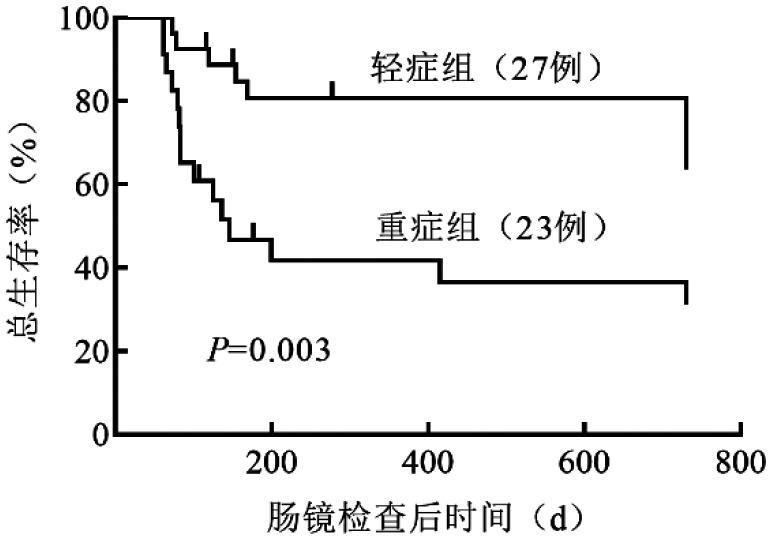 Figure 1
Peer Reviews
No public reviews on file for this paper yet. If you reviewed it on a platform where reviews are public (OpenReview, ICLR, NeurIPS, ICML), you can paste yours below so the community can read it here.
Videos
No videos yet. Explain this paper in a talk, walkthrough, or lecture? Add one.
Taxonomy
TopicsMycobacterium research and diagnosis · Oral health in cancer treatment · Mesenchymal stem cell research