Correlation analysis of polyclonal plasma cell proportion in the bone marrow with clinical characteristics of patients with newly diagnosed multiple myeloma
筱露 龙, 欣然 王, 宁 安, 松雅 刘, 喆 李, 春晖 李, 伟 穆, 迪 王, 春蕊 李

TL;DR
This study finds that higher polyclonal plasma cell proportion in bone marrow of newly diagnosed multiple myeloma patients correlates with better clinical indicators like higher hemoglobin and lower tumor markers.
Contribution
The study establishes novel correlations between polyclonal plasma cell proportion and specific clinical features in newly diagnosed multiple myeloma patients.
Findings
Higher pPC% correlates with better clinical indicators like higher HGB and lower M protein levels.
pPC% differs significantly across DS, ISS, and R-ISS staging groups but not FISH risk categories.
Patients with pPC% <2.5% show worse clinical features including higher tumor burden markers.
Abstract
探究初诊多发性骨髓瘤(NDMM)患者骨髓多克隆浆细胞占比(pPC%)与临床特征的相关性。 回顾性分析2018年1月至2023年1月在华中科技大学同济医学院附属同济医院收治的317例NDMM患者,纳入患者均有明确的pPC%结果。分析pPC%与临床特征的关系。 共纳入317例患者,其中男180例,女137例,中位确诊年龄61(26~91)岁,≥60岁患者占55.8%。NDMM患者骨髓pPC%在各DS分期、ISS分期、R-ISS分期组差异均有统计学意义(P值分别为0.002、0.010、0.049),而不同的FISH危险分层患者pPC%差异无统计学意义(P=0.971)。NDMM患者pPC%与患者初诊时HGB呈正相关(r=0.211,P<0.01);与血钙、血肌酐、单克隆免疫球蛋白(M蛋白)定量、β2微球蛋白水平呈负相关(r分别为−0.141、−0.120、−0.181、−0.207,P值为0.012、0.033、0.004、0.002)。与pPC%≥2.5%患者相比,pPC%<2.5%组患者初诊时受累轻链、血钙、血肌酐、M蛋白和β2微球蛋白水平明显升高(P值均<0.05),HGB降低(P<0.001),ISS分期Ⅲ期比例更高(P=0.034)。 NDMM患者pPC%与良好预后的临床特征相关,包括更高的HGB,更低的血钙、血肌酐、M蛋白定量、β2微球蛋白,受累轻链,更低的晚期疾病占比(DS分期、ISS分期Ⅲ期),在临床特点上表现为肿瘤负荷较小。
Genes, proteins, chemicals, diseases, species, mutations and cell lines named across the full text — each resolved to its canonical identifier and authoritative record.
Click any figure to enlarge with its caption.
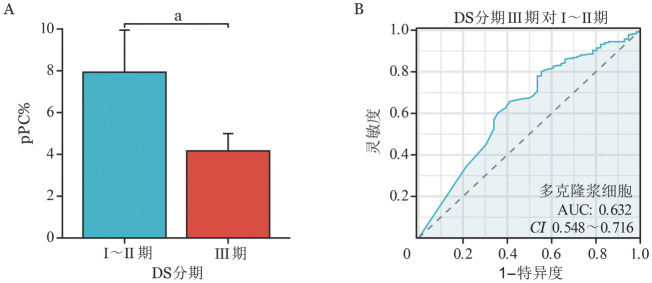 Figure 1
Peer Reviews
No public reviews on file for this paper yet. If you reviewed it on a platform where reviews are public (OpenReview, ICLR, NeurIPS, ICML), you can paste yours below so the community can read it here.
Videos
No videos yet. Explain this paper in a talk, walkthrough, or lecture? Add one.
Taxonomy
TopicsHematological disorders and diagnostics