Practical but Inaccurate? A-Mode Ultrasound and Bioelectrical Impedance Underestimate Body Fat Percentage Compared to Dual-Energy X-ray Absorptiometry in Male College Students
Markus Olinto, Victor César Lins, Gabriel Rocha, Marco Aurélio Dourado, Maurilio Dutra

TL;DR
Bioelectrical impedance and ultrasound underestimate body fat percentage compared to the gold-standard DXA method in male college students.
Contribution
This study compares the accuracy of BIA and US against DXA for body fat estimation in men.
Findings
BIA and US showed high correlation but significant underestimation of body fat compared to DXA.
BIA underestimated BF% by 4.4%, while US underestimated it by 9.6% on average.
Both methods exhibited wide agreement limits and potential proportional bias.
Abstract
Bioelectrical impedance (BIA) and ultrasound (US) have become popular for estimating body fat percentage (BF%) due to their low cost and clinical convenience. However, the agreement of these devices with the gold-standard method still requires investigation. The aim was to analyze the agreement between a gold-standard %BF assessment method with BIA and US devices. Twenty-three men (aged 30.1 ± 7.7 years, weighing 82.5 ± 14.9 kg, 1.77 ± 0.05 m tall) underwent dual-energy X-ray absorptiometry (DXA), BIA (tetrapolar) and US (three-site method) %BF assessments. Pearson and concordance correlations were analyzed. A T-test was used to compare the means of the methods, and Bland–Altman plots analyzed agreement and proportional bias. Alpha was set at <0.05. The Pearson coefficients of BIA and US with DXA were high (BIA = 0.94; US = 0.89; both p < 0.001). The concordance coefficient was high for…
Genes, proteins, chemicals, diseases, species, mutations and cell lines named across the full text — each resolved to its canonical identifier and authoritative record.
Click any figure to enlarge with its caption.
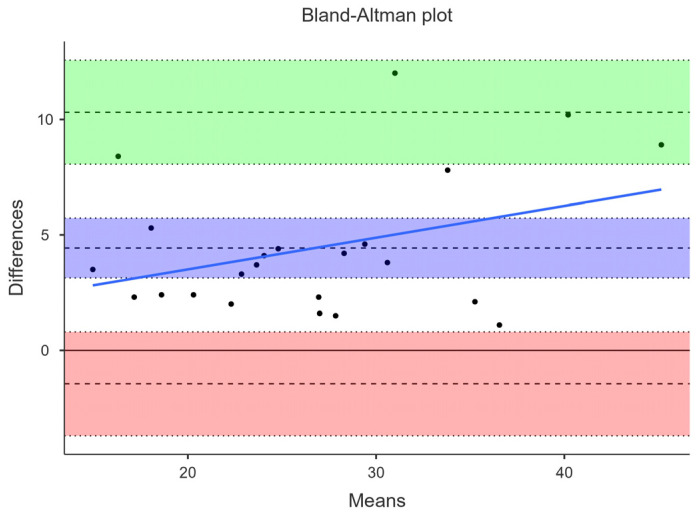 Figure 1
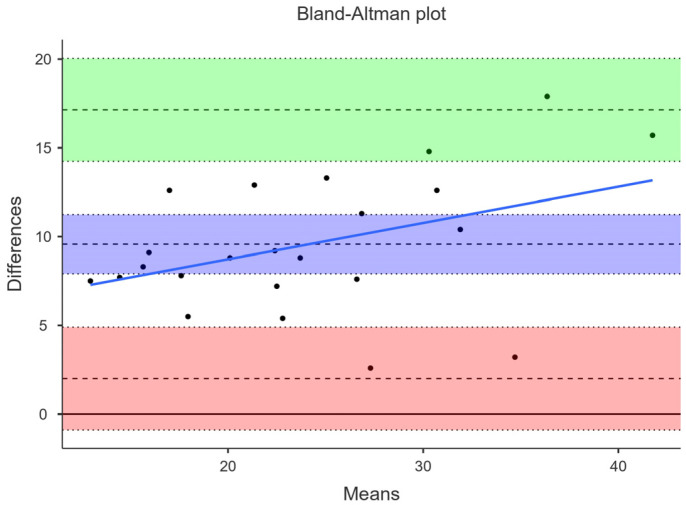 Figure 2
Peer Reviews
No public reviews on file for this paper yet. If you reviewed it on a platform where reviews are public (OpenReview, ICLR, NeurIPS, ICML), you can paste yours below so the community can read it here.
Videos
No videos yet. Explain this paper in a talk, walkthrough, or lecture? Add one.
Taxonomy
TopicsBody Composition Measurement Techniques · Nutrition and Health in Aging · Thermoregulation and physiological responses