Wall Motion Score Index Predicts Persistent Moderate or Severe Secondary Mitral Regurgitation and its Prognostic Role in Patients Undergoing Percutaneous Coronary Intervention
Linfang Qiao, Haozhang Huang, Jiulin Liu, Congzhuo Jia, Yibo He, Sijia Yu, Hongyu Lu, Ziyou Zhou, Tian Chang, Shiqun Chen, Ning Tan, Jin Liu, Yong Liu, Jiyan Chen

TL;DR
This study finds that a heart function measure called WMSI can predict ongoing heart issues in patients with a specific heart condition after a common heart procedure.
Contribution
The study demonstrates that elevated wall motion score index after PCI is a novel independent predictor of persistent secondary mitral regurgitation and adverse outcomes.
Findings
Persistent moderate or severe secondary mitral regurgitation occurred in 39.8% of patients after PCI.
Elevated WMSI after PCI independently predicted persistent sMR and increased risks of heart failure and mortality.
WMSI was associated with major adverse cardiovascular events and all-cause mortality in adjusted models.
Abstract
Patients with secondary mitral regurgitation (sMR) often present with greater mortality and comorbidity, which may be predicted by some risk factors. This study was designed to investigate the prognostic meaning of the echocardiographically detected wall motion score index (WMSI) in coronary artery disease (CAD) patients with moderate or severe baseline sMR who underwent percutaneous coronary intervention (PCI) therapy. The present study was a multi-center and prospective cohort of consecutive CAD patients with baseline moderate or severe sMR who underwent PCI. All underwent echocardiography at baseline and at follow-up after PCI to assess sMR and WMSI. The primary endpoint was the persistence of moderate or severe sMR after the second echocardiographic measurement. Logistic and Cox proportional hazards models were constructed for the primary (persistent moderate or severe…
Genes, proteins, chemicals, diseases, species, mutations and cell lines named across the full text — each resolved to its canonical identifier and authoritative record.
Click any figure to enlarge with its caption.
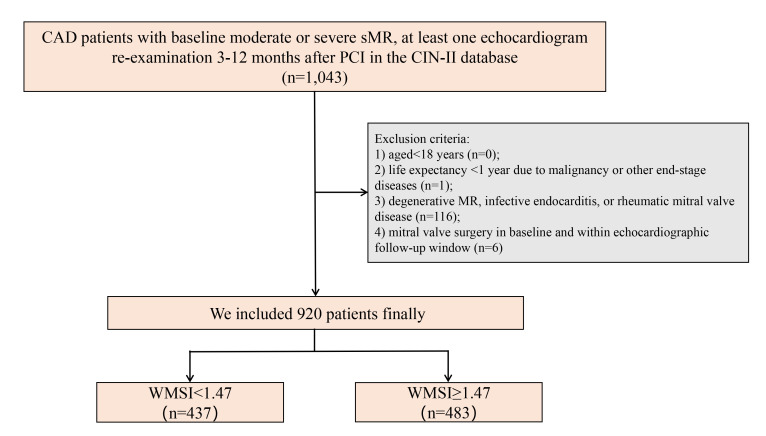 Figure 1
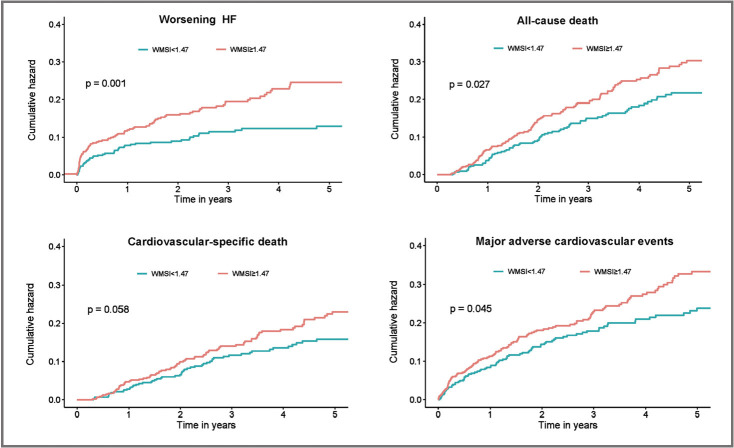 Figure 2
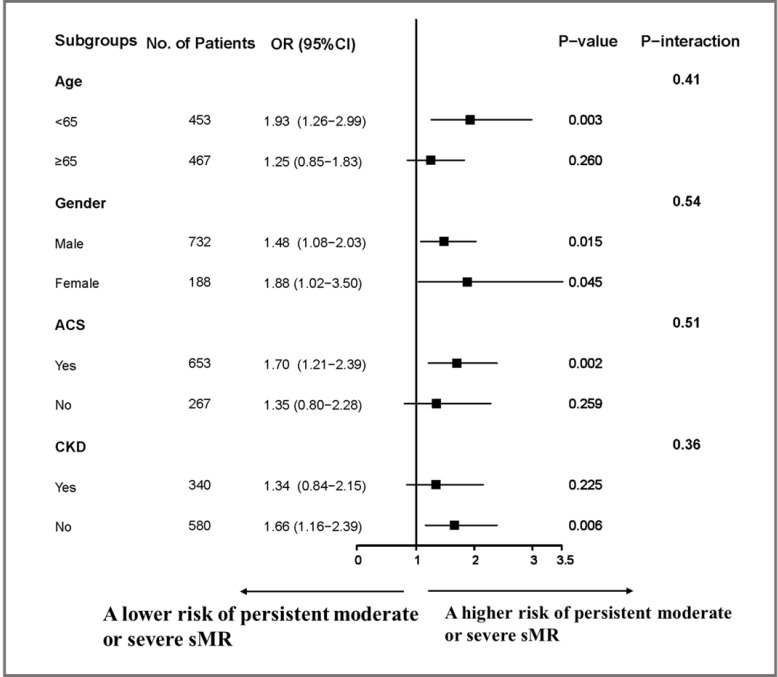 Figure 3
Peer Reviews
No public reviews on file for this paper yet. If you reviewed it on a platform where reviews are public (OpenReview, ICLR, NeurIPS, ICML), you can paste yours below so the community can read it here.
Videos
No videos yet. Explain this paper in a talk, walkthrough, or lecture? Add one.
Taxonomy
TopicsCardiac Valve Diseases and Treatments · Cardiovascular Function and Risk Factors · Cardiac Imaging and Diagnostics