Peri-Operative Changes of Inflammatory Markers and Their Implications in Pulmonary Endarterectomy
Qianqian Liu, Ziru Zhao, Jing Yang, Yunshan Cao, Min Zhang

TL;DR
This paper reviews how inflammatory markers change before and after pulmonary endarterectomy surgery and their possible significance.
Contribution
The study compiles recent data on inflammatory markers during pulmonary endarterectomy to explore their potential implications.
Findings
Levels of inflammatory factors change during the peri-operative period of PEA.
The specific role of these inflammatory markers remains unclear but may be relevant.
The study aims to understand the potential implications of these changes.
Abstract
Pulmonary endarterectomy (PEA) is used to treat chronic thromboembolic pulmonary hypertension (CTEPH) patients, and it can effectively remove organized thrombotic materials and proliferative intima as well as improve hemodynamics. It has been reported that the levels of several inflammatory factors were altered in the peri-operative period of PEA. Even though their specific role remains unknown, this could have some relevance. In this study, we reviewed the recently published data addressing these factors in PEA, attempting to understand their potential implications.
Genes, proteins, chemicals, diseases, species, mutations and cell lines named across the full text — each resolved to its canonical identifier and authoritative record.
Click any figure to enlarge with its caption.
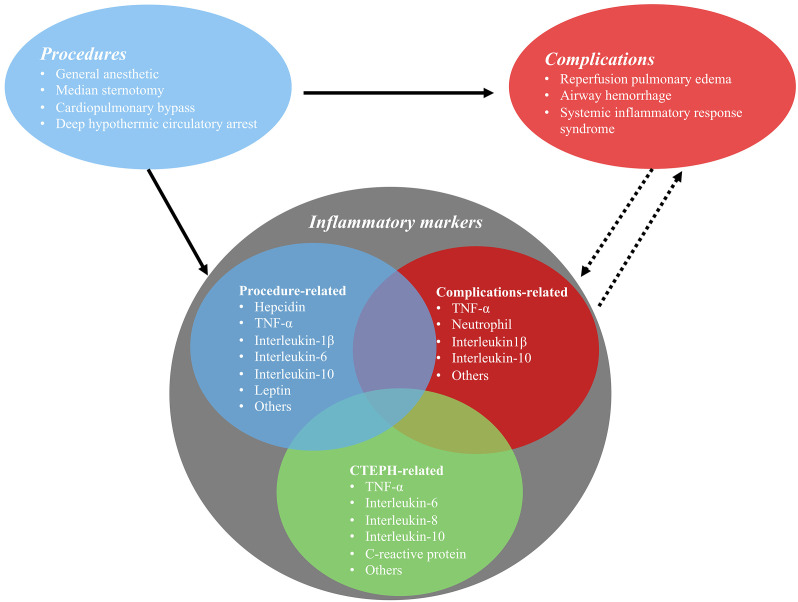 Figure 1
Peer Reviews
No public reviews on file for this paper yet. If you reviewed it on a platform where reviews are public (OpenReview, ICLR, NeurIPS, ICML), you can paste yours below so the community can read it here.
Videos
No videos yet. Explain this paper in a talk, walkthrough, or lecture? Add one.
Taxonomy
TopicsPulmonary Hypertension Research and Treatments · Extracellular vesicles in disease · Venous Thromboembolism Diagnosis and Management