Intergroup evaluative bias in facial representations of immigrants and citizens in the United States
Ryan J. Hutchings, Imani Morgan, Jeffrey W. Sherman, Andrew R. Todd

TL;DR
This study reveals that facial representations of immigrants in the U.S. are often perceived as less trustworthy and less competent compared to citizens, reflecting anti-immigrant biases.
Contribution
The study introduces a novel method using a reverse-correlation image-classification paradigm to uncover implicit biases in facial representations of immigrants.
Findings
Immigrants' faces were rated as less trustworthy and competent than citizens' faces by independent raters.
Visualizations of immigrants' faces were more likely to be categorized as non-White race/ethnicity.
Image generators' personal characteristics did not reliably predict how their immigrant representations were judged.
Abstract
We used a reverse-correlation image-classification paradigm to visualize facial representations of immigrants and citizens in the United States. Visualizations of immigrants’ faces were judged by independent raters as less trustworthy and less competent and were more likely to be categorized as a non-White race/ethnicity than were visualizations of citizens’ faces. Additionally, image generators’ personal characteristics (e.g., implicit and explicit evaluations of immigrants, nativity status) did not reliably track with independent judges’ ratings of image generators’ representations of immigrants. These findings suggest that anti-immigrant sentiment and racial/ethnic assumptions characterize facial representations of immigrants in the United States, even among people who harbor positivity toward immigrants.
Genes, proteins, chemicals, diseases, species, mutations and cell lines named across the full text — each resolved to its canonical identifier and authoritative record.
Click any figure to enlarge with its caption.
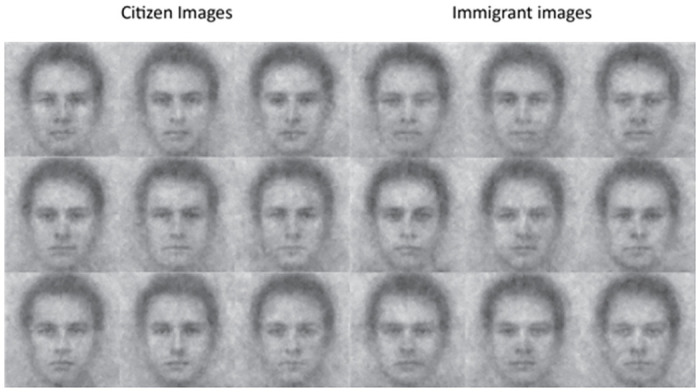 Figure 1
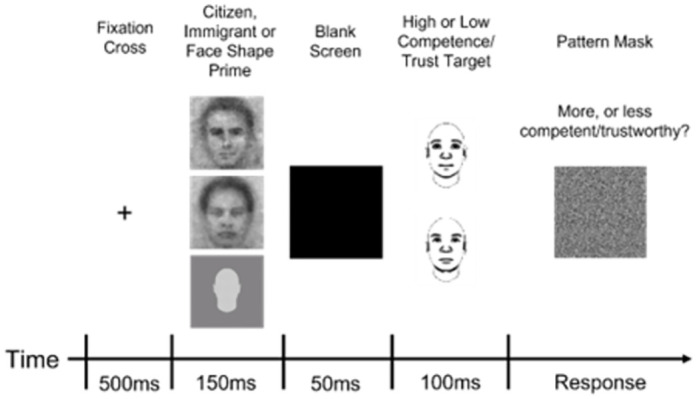 Figure 2
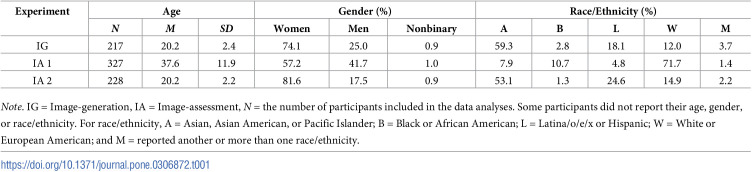 Figure 3
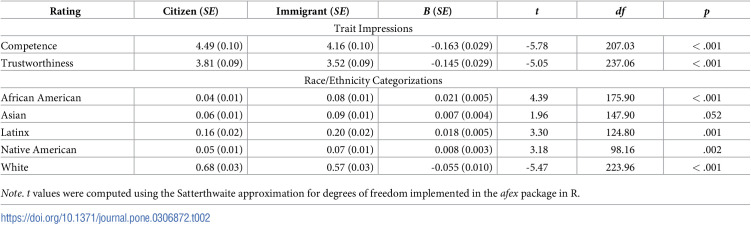 Figure 4
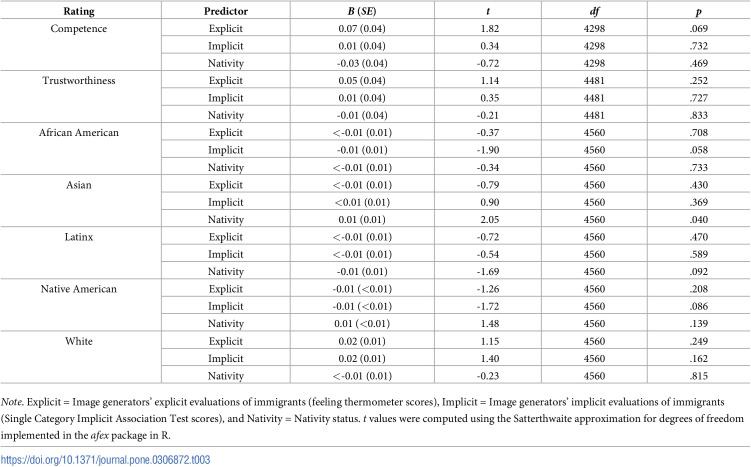 Figure 5
 Figure 6
Peer Reviews
No public reviews on file for this paper yet. If you reviewed it on a platform where reviews are public (OpenReview, ICLR, NeurIPS, ICML), you can paste yours below so the community can read it here.
Videos
No videos yet. Explain this paper in a talk, walkthrough, or lecture? Add one.
Taxonomy
TopicsEvolutionary Psychology and Human Behavior · Social and Intergroup Psychology · Names, Identity, and Discrimination Research