91-month follow-up of solitary punctate chorioretinitis in a Chinese patient
Chu Liu, Mengke Liu, Xinyue Lan, Junjie Zhu, Zhengwei Zhang

TL;DR
A Chinese patient with a rare eye condition called solitary punctate chorioretinitis was followed for 91 months, showing lesion stability and partial vision recovery without treatment.
Contribution
This is the longest follow-up study of solitary punctate chorioretinitis, providing new insights into its progression and management.
Findings
The lesion remained stable in size and location for 91 months without scarring.
Visual acuity improved from counting fingers to 0.8 over the follow-up period.
Abnormal vascular structures were confirmed via OCTA, but no anti-VEGF treatment was needed.
Abstract
Solitary Punctate Chorioretinitis (SPC) is a recently identified form of punctate inner choroidopathy (PIC) characterized by a single lesion in the fovea of the macula. Previous studies with a maximum follow-up of 48 months were insufficient. Our review uncovered a case sustained for 91 months. A 28-year-old young woman experienced with sudden visual loss in her right eye. Comprehensive examinations, including assessment of best-corrected visual acuity (BCVA), slit-lamp biomicroscopy, noncontact tonometry, fundus fluorescein angiography (FFA), fundus autofluorescence (FAF), optical coherence tomography angiography (OCTA), perimetry, and microperimetry, were conducted. Over 91 months, the lesion slightly enlarged, remained yellow-white and punctate, and stayed in the central macula of the posterior pole. OCT images depicted subsidence in the inner nuclear layer (INL), the outer…
Genes, proteins, chemicals, diseases, species, mutations and cell lines named across the full text — each resolved to its canonical identifier and authoritative record.
Click any figure to enlarge with its caption.
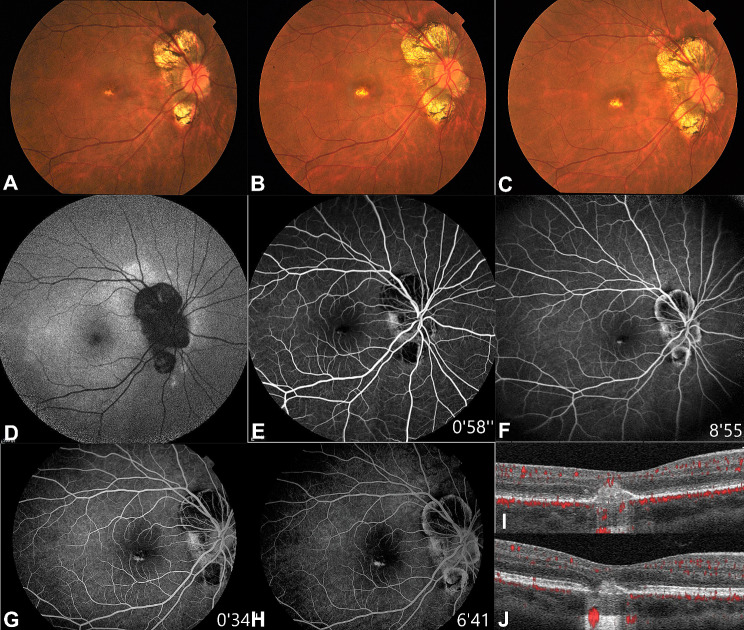 Figure 1
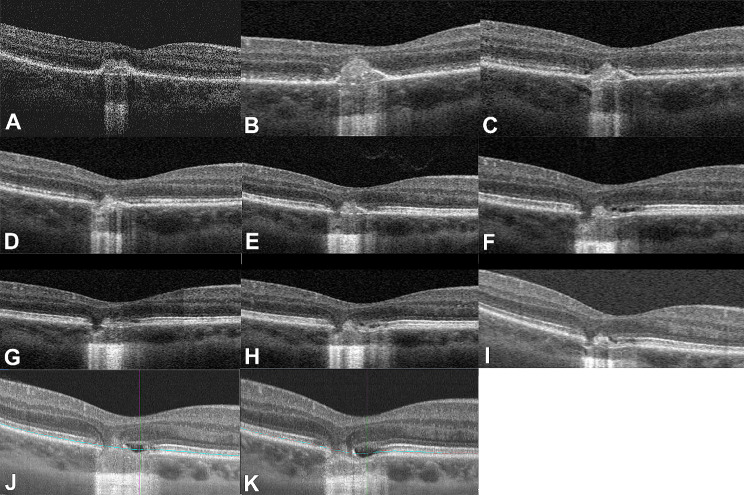 Figure 2
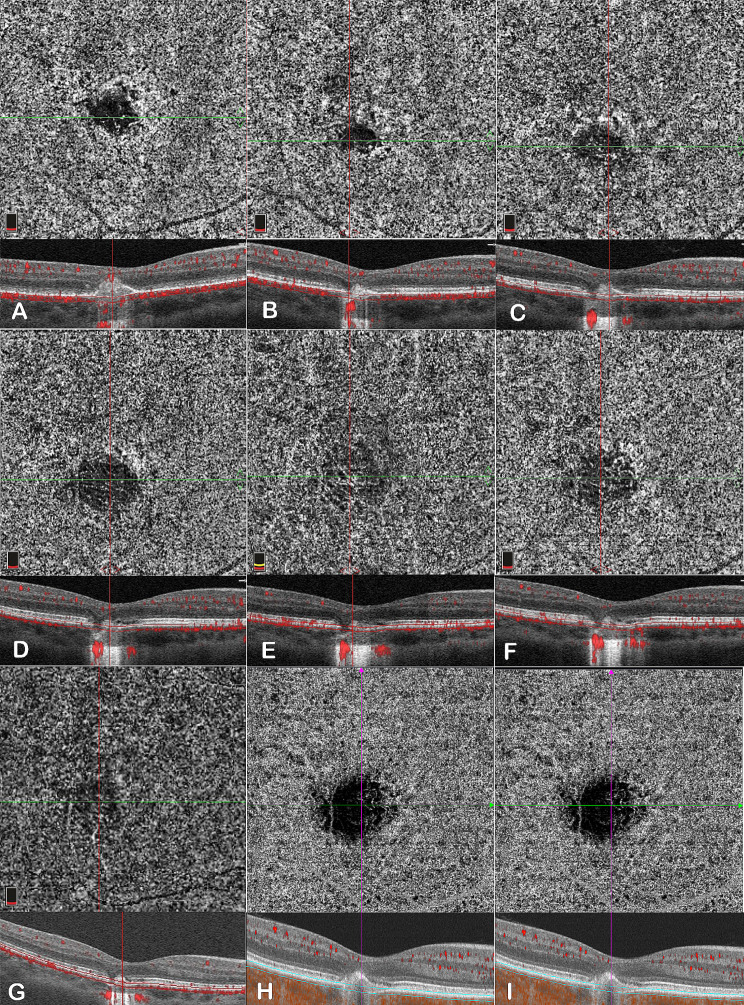 Figure 3
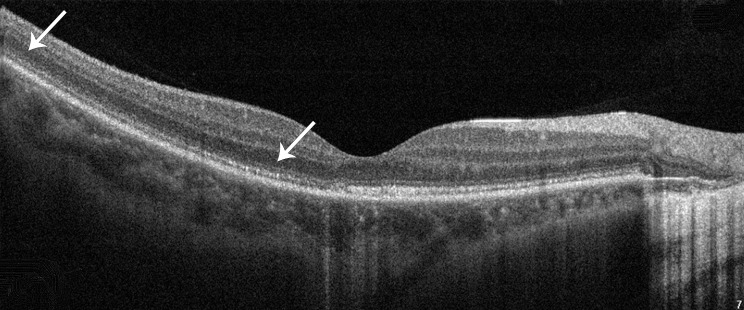 Figure 4
Peer Reviews
No public reviews on file for this paper yet. If you reviewed it on a platform where reviews are public (OpenReview, ICLR, NeurIPS, ICML), you can paste yours below so the community can read it here.
Videos
No videos yet. Explain this paper in a talk, walkthrough, or lecture? Add one.
Taxonomy
TopicsRetinal Diseases and Treatments · Ocular Diseases and Behçet’s Syndrome · Glaucoma and retinal disorders