Voronoi diagrams and Delaunay triangulation for modelling animal territorial behaviour
Rhainer Guillermo‐Ferreira, Alexander E. Filippov, Alexander Kovalev, Stanislav N. Gorb

TL;DR
This paper uses movable automata inspired by dragonflies to model animal territorial competition and explores how attraction and repulsion affect behavior.
Contribution
The study introduces a novel model using movable automata to simulate animal territorial behavior with attraction and repulsion dynamics.
Findings
Faster males exhibit velocity distributions similar to Maxwell distributions in Brownian dynamics.
Smaller animals are concentrated in regions of small velocities and areas.
Larger animals spend more time surrounded by smaller ones and are slowed by interactions.
Abstract
We explore the use of movable automata in numerical modelling of male competition for territory. We used territorial dragonflies as our biological inspiration for the model, assuming two types of competing males: (a) faster and larger males that adopt a face‐off strategy and repulse other males; (b) slower and smaller males that adopt a non‐aggressive strategy. The faster and larger males have higher noise intensity, leading to faster motion and longer conservation of motion direction. The velocity distributions resemble the Maxwell distributions of velocity, expected in Brownian dynamics, with two probable velocities and distribution widths for the two animal subpopulations. The fast animals' trajectories move between visually fixed density folds of the slower animal subpopulation. A correlation is found between individual velocity and individual area distribution, with smaller animals…
Genes, proteins, chemicals, diseases, species, mutations and cell lines named across the full text — each resolved to its canonical identifier and authoritative record.
Click any figure to enlarge with its caption.
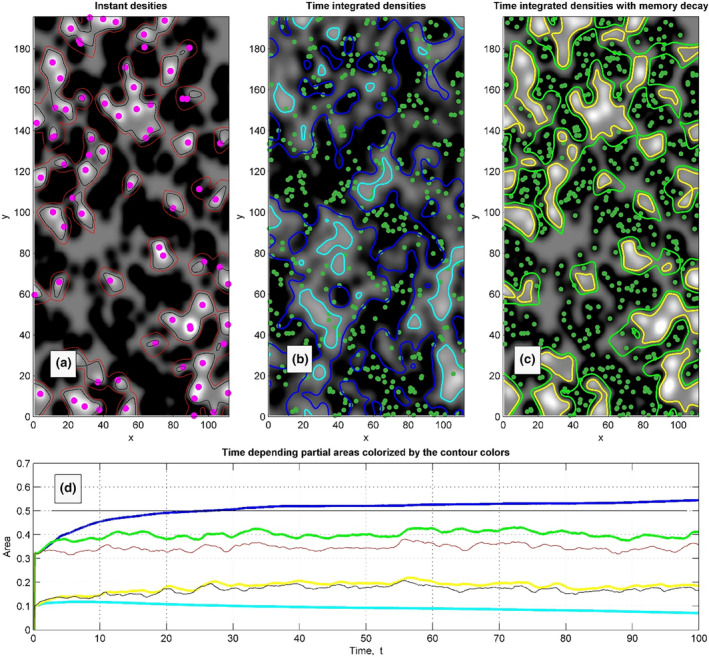 Figure 1
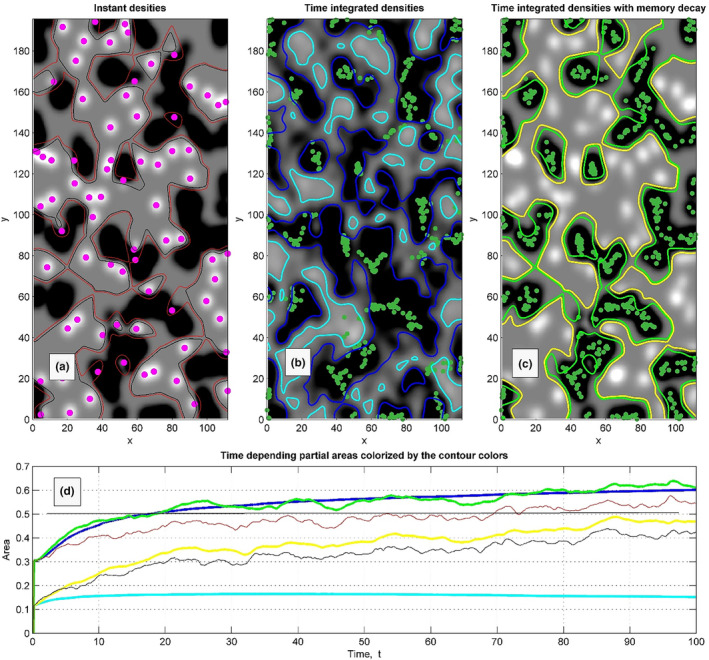 Figure 2
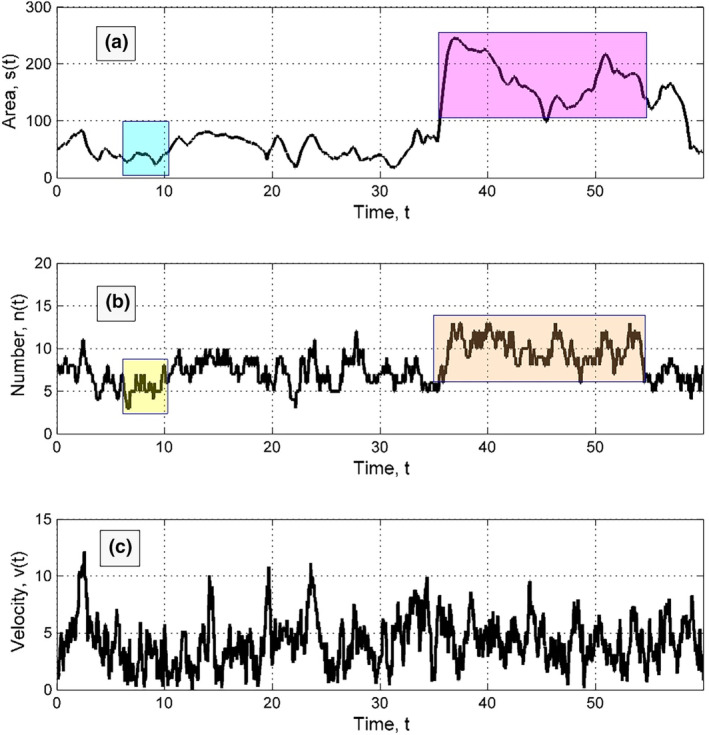 Figure 3
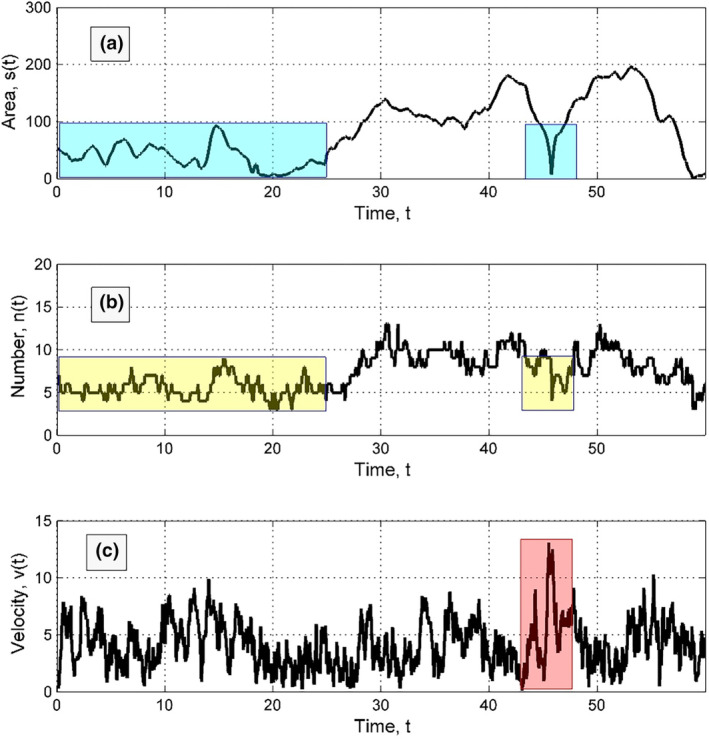 Figure 4
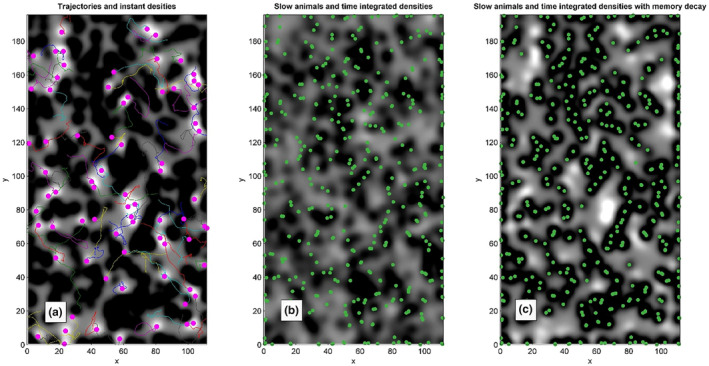 Figure 5
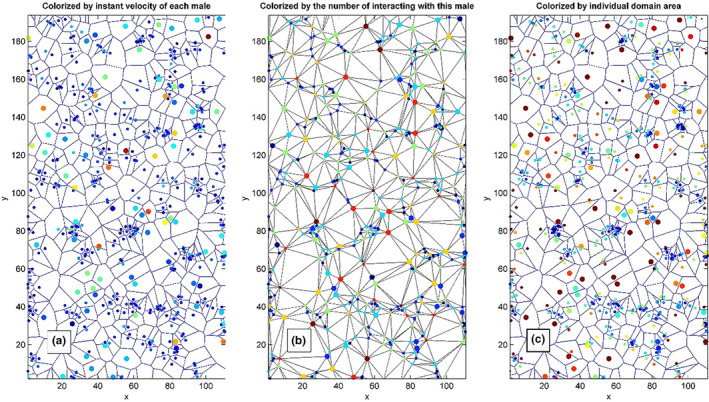 Figure 6
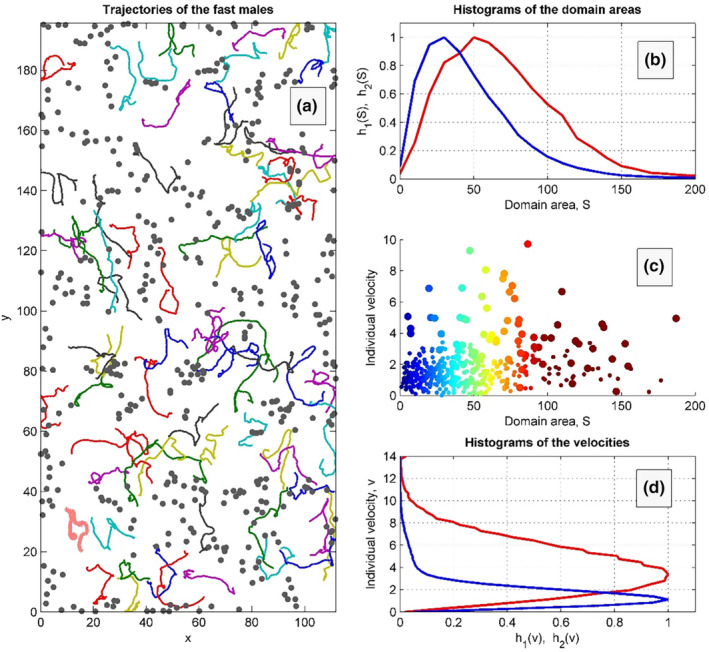 Figure 7
 Figure 8
Peer Reviews
No public reviews on file for this paper yet. If you reviewed it on a platform where reviews are public (OpenReview, ICLR, NeurIPS, ICML), you can paste yours below so the community can read it here.
Videos
No videos yet. Explain this paper in a talk, walkthrough, or lecture? Add one.
Taxonomy
TopicsAnimal Behavior and Reproduction · Plant and animal studies · Ecology and Vegetation Dynamics Studies