Building bio-innovation systems through advanced biotechnology education
Edgar Cardozo Ruíz Díaz, Silverio Andrés Quintana, Cinthia Mabel Rojas, Danilo Fernández Ríos

TL;DR
This paper explores how advanced biotechnology education can help build sustainable innovation systems, using Paraguay as a case study.
Contribution
The paper introduces a case study on Paraguay’s educational program that bridges academic research and industrial needs in biotechnology.
Findings
Educational programs can foster interdisciplinary collaboration in biotechnology.
Such programs help align academic research with industrial demands.
They contribute to sustainable growth in the biotechnology sector.
Abstract
We discuss the role of advanced biotechnology education in fostering sustainable bio-innovation systems. As a case study, we focus on Paraguay’s Graduate Diploma in Innovation Management and Biotechnological Projects, which emphasizes interdisciplinary collaboration, stakeholder integration, and professionals skilled in the interplay between biotechnology, society, and governance. We highlight the relevance of educational programs in addressing the gap between academic research and industrial needs, thereby contributing to sustainable growth in the biotechnology sector.
Genes, proteins, chemicals, diseases, species, mutations and cell lines named across the full text — each resolved to its canonical identifier and authoritative record.
Click any figure to enlarge with its caption.
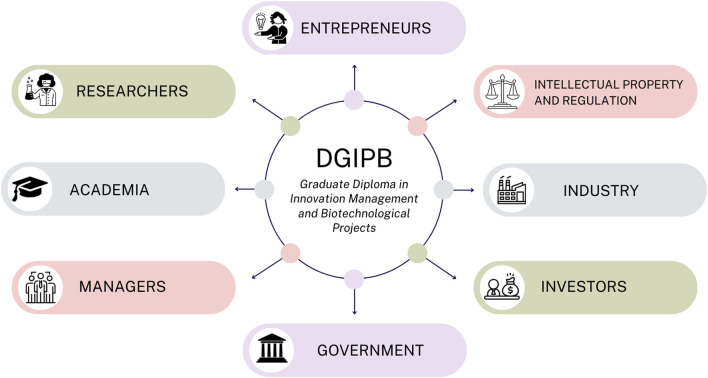 Figure 1
Peer Reviews
No public reviews on file for this paper yet. If you reviewed it on a platform where reviews are public (OpenReview, ICLR, NeurIPS, ICML), you can paste yours below so the community can read it here.
Videos
No videos yet. Explain this paper in a talk, walkthrough, or lecture? Add one.
Taxonomy
TopicsBiotechnology and Related Fields · Biomedical and Engineering Education · CRISPR and Genetic Engineering