How should we measure population-level inbreeding depression? Impacts of standing genetic associations between selfing rate and deleterious mutations
Kuangyi Xu

TL;DR
The paper explores how inbreeding depression and selfing rates are genetically linked and how this affects population evolution.
Contribution
It introduces new metrics for measuring population-level inbreeding depression based on selfing rate and offspring fitness correlations.
Findings
The association between selfing rate and inbreeding depression shifts from positive to negative as mutation selection strength increases.
Standing genetic associations between selfing rate and fitness alleles influence the evolution of population selfing rates.
New metrics for population-level inbreeding depression are proposed using correlation coefficients between selfing rates and offspring fitness.
Abstract
Inbreeding depression (ID) is a major selective force during mating system evolution primarily contributed by highly to partially recessive deleterious mutations. Theories suggest that transient genetic association with fitness alleles can be important in affecting the evolution of alleles that modify the selfing rate during its sweep. Nevertheless, empirical tests often focus on the pre-existing genetic association between selfing rate and ID maintained under mutation–selection balance. Therefore, how this standing genetic association is affected by key factors and its impacts on the evolution of selfing remain unclear. I show that as the selection coefficient of deleterious mutations increases, the association between selfing rate and ID declines from positive to negative. These results predict that association between selfing and ID tends to be negative in populations with low…
Genes, proteins, chemicals, diseases, species, mutations and cell lines named across the full text — each resolved to its canonical identifier and authoritative record.
Click any figure to enlarge with its caption.
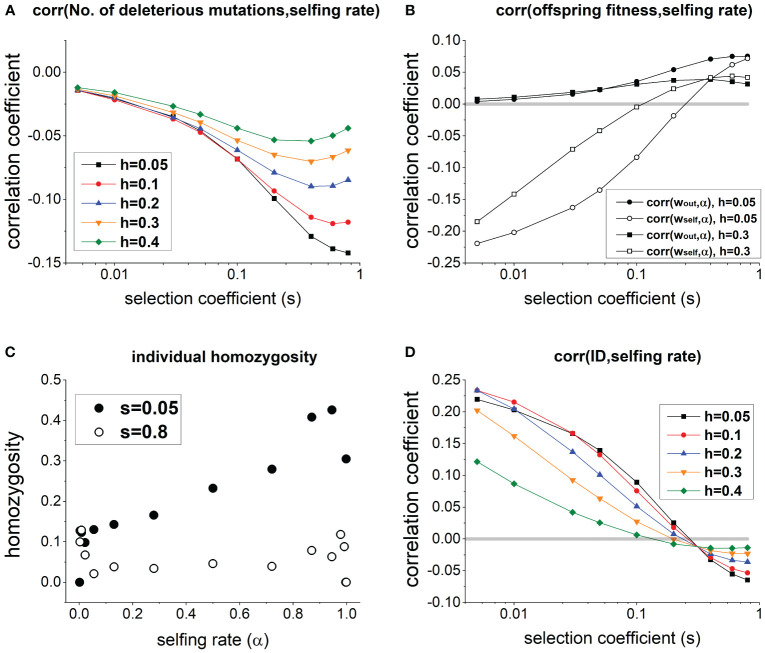 Figure 1
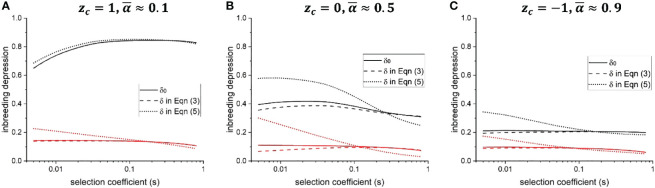 Figure 2
Peer Reviews
No public reviews on file for this paper yet. If you reviewed it on a platform where reviews are public (OpenReview, ICLR, NeurIPS, ICML), you can paste yours below so the community can read it here.
Videos
No videos yet. Explain this paper in a talk, walkthrough, or lecture? Add one.
Taxonomy
TopicsEvolution and Genetic Dynamics · Genetic diversity and population structure · Animal Behavior and Reproduction