Etiology and perinatal outcomes between early and late-onset nonimmune hydrops fetalis
Seval Yılmaz Ergani, Müjde Can İbanoğlu, Ayberk Çakır, Çağlayan Ateş, Gökcen Örgül, Nazan Vanlı Tonyalı, Özge Yücel Çelik, Dilek Şahin

TL;DR
This study compares causes and outcomes of early and late-onset nonimmune hydrops fetalis, finding differences in birth timing and complications.
Contribution
The study provides new insights into the distinct etiologies and perinatal outcomes of early versus late-onset nonimmune hydrops fetalis.
Findings
Early-onset cases had higher skeletal, CNS, and GI anomalies, with most deliveries before 24 weeks.
Late-onset cases showed higher cardiac anomalies and better live birth rates compared to early-onset cases.
Abstract
We aimed to compare the etiology and perinatal outcomes of non-immune hydrops fetalis diagnosed early- and late-onset at our hospital. The records of the patients who applied to our department were reviewed, and we reached 42 non-immune hydrops fetalis cases retrospectively and examined the medical records. Hydrops diagnosis week, birth week, accompanying anomalies, and perinatal outcomes were compared as ≤12 weeks (early-onset) and >12 weeks (late-onset). The prevalence of non-immune hydrops fetalis was 0.05%, and the median week of diagnosis for hydrops was 18 weeks. Consanguinity (16.7%) was found in seven pregnancies, and the other seven patients (16.7%) had a history of hydrops in previous pregnancies. Anomalies of the skeletal system, central nervous system, and gastrointestinal tract accounted for 66.7% of ≤12 weeks in non-immune hydrops fetalis cases. Cardiac abnormalities…
Genes, proteins, chemicals, diseases, species, mutations and cell lines named across the full text — each resolved to its canonical identifier and authoritative record.
Click any figure to enlarge with its caption.
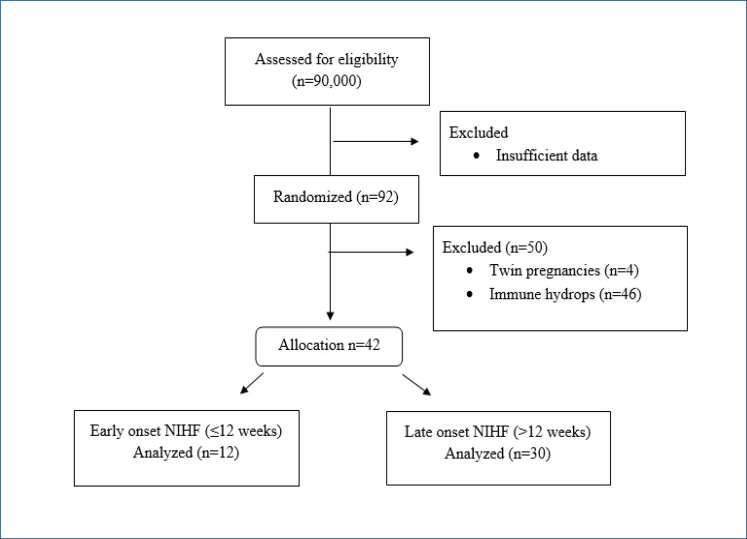 Figure 1
Peer Reviews
No public reviews on file for this paper yet. If you reviewed it on a platform where reviews are public (OpenReview, ICLR, NeurIPS, ICML), you can paste yours below so the community can read it here.
Videos
No videos yet. Explain this paper in a talk, walkthrough, or lecture? Add one.
Taxonomy
TopicsParvovirus B19 Infection Studies · Blood groups and transfusion · Erythrocyte Function and Pathophysiology