Asymmetric fracture dislocation of the hips: case report
Hassan Hachicha, Mohamed Chaker, Safouen Ben Brahim, Mehdi Meddeb, Hassen Makhlouf, Mondher Mestiri

TL;DR
A rare case of bilateral hip fracture dislocation caused by a high-speed collision is reported, emphasizing the importance of timely treatment.
Contribution
This case report highlights the management of an extremely rare bilateral asymmetric hip fracture dislocation.
Findings
Bilateral asymmetric hip fracture dislocation is a rare injury caused by high-velocity trauma.
Reduction of the hips must be performed within 6 hours to prevent complications.
Long-term monitoring is essential for patients with this type of injury.
Abstract
Bilateral asymmetric hip fracture dislocation is an extremely rare entity. The injury is caused by a high velocity mechanism. We reported a case of bilateral hip fracture dislocation and its management. A 30-year-old man with no previous medical or surgical history was involved in a road accident involving a high-speed collision between two trucks. X-rays of the pelvis revealed asymmetrical bilateral fracture-luxation of the hips. The reduction of the hips was done under general anesthesia. Asymmetrical bilateral traumatic dislocation fracture of the hip is a rare serious injury. Reduction must be performed within 6 hours. Short- and long-term monitoring of the patient is essential.
Genes, proteins, chemicals, diseases, species, mutations and cell lines named across the full text — each resolved to its canonical identifier and authoritative record.
Click any figure to enlarge with its caption.
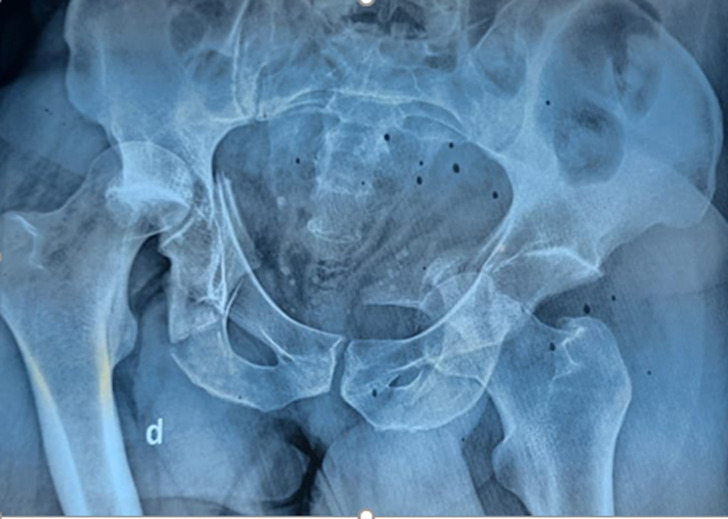 Figure 1
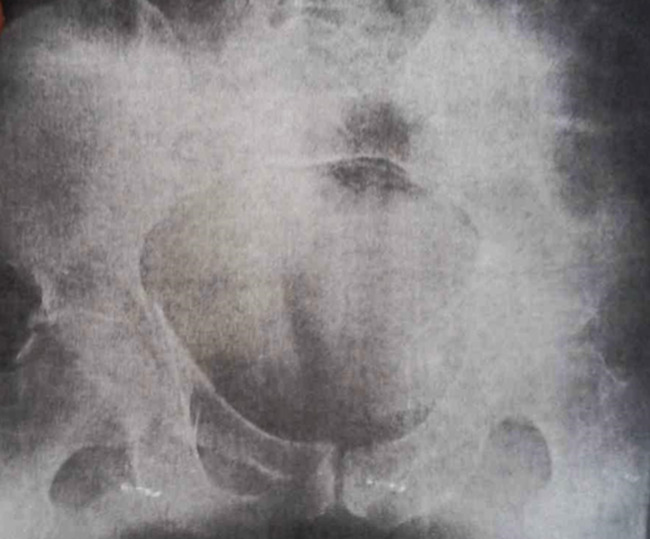 Figure 2
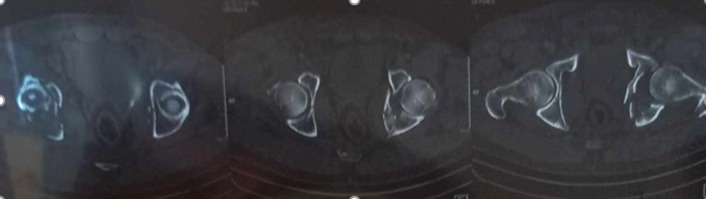 Figure 3
Peer Reviews
No public reviews on file for this paper yet. If you reviewed it on a platform where reviews are public (OpenReview, ICLR, NeurIPS, ICML), you can paste yours below so the community can read it here.
Videos
No videos yet. Explain this paper in a talk, walkthrough, or lecture? Add one.
Taxonomy
TopicsHip disorders and treatments · Hip and Femur Fractures · Pelvic and Acetabular Injuries
Introduction
Traumatic dislocation of the hip is a serious injury with a vital and functional prognosis in both the short and long term. The patient's vital and functional prognosis in the short and long term [1,2]. Traumatic hip dislocations account for 2-5% of all dislocations [3]. Bilateral forms are very rare. Their mechanism is quite specific and associated with road accidents. Bilateral hip dislocation is a rare injury, accounting for 1.25% of all hip dislocations [4]. Asymmetrical dislocations are even rarer, accounting for around 0.01-0.02% of all joint dislocations [4,5]. These patients must be considered as polytrauma patients, and the associated can be life-threatening. The basic treatment is to reduce dislocations within 6 hours to prevent avascular necrosis [4]. Our case illustrates this unusual lesion.
Patient and observation
Patient information: a 30-year-old man with no previous medical or surgical history was involved in a road accident involving a high-speed collision between two trucks.
Clinical findings: the patient was hemodynamically and respiratorily stable. The primary investigation ruled out circulatory, respiratory and neurological problems. The position of the right lower limb was adducted and internally rotated. The position of the left lower limb was external rotation and abduction. The patient had no sensory-motor deficits and normal pulses in both lower limbs.
Diagnostic assessment: X-rays of the pelvis revealed asymmetrical bilateral fracture-luxations of the hips, with right superior-posterior and left anteroinferior dislocation (Figure 1).
Asymmetric dislocated hip fracture
Therapeutic intervention: the patient was admitted to the outpatient department and transferred within 6 hours to the operating room. Under general anaesthesia, a closed reduction was performed within 6 hours of trauma for both hip dislocations at the same time. Simultaneously: for the right hip dislocation, the reduction maneuver was performed on a hard surface, with counter-pressure on the anterosuperior iliac spines and traction in line with the femur, with the hip and knee flexed at 90 degrees; a clicking sound is audible during reduction. For the left hip, traction was applied along the axis of the deformity, flexing the hip to 90 degrees with an external rotation, with an audible click indicating reduction. After reduction, both hips were stable over the full range of motion distal neurovascular status. Post-reduction radiographs (Figure 2) and CT scans (Figure 3) demonstrated adequate of both hips. The patient was maintained in skin traction for both hips for 6 weeks.
standard radiograph of the pelvis after reduction
axial section of pelvis showing bilateral reduction of dislocations
Patient's perspective: the patient received analgesics and anti-thrombotic medication during his stay. He was discharged in the 3^rd^ week with the onset of soft callus construction.
Informed consent: the patient gives his informed consent.
Discussion
Traumatic hip dislocation is more common in younger male patients younger age [4,6]. It accounts for 2-5% of all traumatic joint dislocations, and 90% are posterior [2,7]. Traumatic dislocation of the hip is symmetrical and bilateral (bilaterally anterior or bilaterally posterior) is a rare event, even more unusual is simultaneous asymmetrical (anterior and posterior) dislocation of both hips. This type of trauma usually occurs as a result of road accidents involving severe deceleration forces on a bent knee; associated injuries associated injuries are acetabular fractures and knee injuries [4,5]. The most common example of a bilateral hip dislocation is that of the car driver not wearing a seatbelt, or in front-seat passengers not unrestrained front-seat passengers [4,8]. During the rapid deceleration of the vehicle, the body pivots forward on the fixed legs and the knees strike the dashboard, transmitting the dislocating force to the hip joints [8]. Depending on the position of the legs at the moment of impact, the impact may cause anterior or posterior dislocation [4,9,10].
The 1^st^-line complementary examination that should be requested and that highlights these lesions is a frontal X-ray of the pelvis. Associated lesions include acetabular fracture, femoral fracture (4% of patients), knee ligament damage or fracture of the patella or proximal tibia (25%), damage to the femoral artery, venous thrombosis and sciatic nerve injury (7-19%) [2,5]. Computed tomography is a good diagnostic method and provides additional information, but should never delay urgent management treatment, which is limited to reducing the dislocation. The reduction of these traumatic hip dislocations must be performed within a six hours post-trauma according to Hougaard [11] to twelve hours post-trauma, whether open or closed, to reduce the risk of complications [6,12]. Ideally, reduction should always be performed under general anaesthetic. It is performed on a curarized patient, using gentle, non-aggressive maneuvers [13]. Reduction maneuvers vary according to the type of hip dislocation.
For posterior dislocations, the Boehler maneuver [14] is performed in the decubitus on a hard surface, with counter-pressure on the anterosuperior iliac spines. It consists of a traction movement in the axis of the femur, with the hip and knee in 90-degree flexion audible during reduction [13,14].
For anterior dislocations, the Allis maneuver is performed [13,14], with a traction in the axis of the deformity, with the hip flexed to 90 degrees. This may be combined with small movements of internal and external rotation. Abduction movements should be avoided, as they are associated with a high risk of fracture of the hip neck, according to Bigelow [14].
Complications are manifold and include avascular necrosis of the femoral head, post-traumatic arthritis and sciatic nerve injury [2,6]. Other potential complications reported in the literature include heterotopic ossifications, deep-vein thrombosis and limitation of hip movement [2]. The rates of these complications vary according to the type of dislocation and whether open or closed reduction is performed. Delayed management of these dislocations leads to a significant increase complications, namely avascular necrosis of the femoral head and post-traumatic arthritis [15]. Neurovascular lesions may accompany hip dislocations in which the sciatic nerve is most often injured [2,15]. The case illustrated represents an unusual, uncommon and severe combination of injuries resulting from a high-speed vehicle accident. Hip dislocation is an orthopaedic emergency that needs to be treated in good time without forgetting that the patient's vital prognosis is always the overriding paramount concern.
Conclusion
Asymmetrical bilateral traumatic dislocation fracture of the hip is a rare serious injury. Reduction must be performed within 6 hours in order to optimize the prognosis of this condition. Short- and long-term monitoring of the patient is essential, as long-term arthrosic is unavoidable.
The reference list from the paper itself. Each links out to its DOI / PubMed record.
- 1Jean-Eric KK Blaise YLRégis AAJ Yannick BG Michel K Luxation traumatique bilatérale asymétrique de la hanche chez un adulte 2021
- 2Sahin O Ozturk C Dereboy F Karaeminogullari O Asymmetrical bilateral traumatic hip dislocation in an adult with bilateral acetabular fracture Arch Orthop Trauma Surg 2007 Oct 127864361734783210.1007/s 00402-007-0308-9 · doi ↗ · pubmed ↗
- 3Elouakili I Chahbouni M Najib A Rhanim A Kharmaz M Lamrani M Oet al Luxation traumatique bilatérale de la hanche J Traumatol Sport 2011 Dec 12842556
- 4Alshammari A Alanazi B Almogbil I Alfayez SM Asymmetric bilateral traumatic hip dislocation: A case report Ann Med Surg 2018 Jun 2632182110.1016/j.amsu.2018.06.008PMC 603988030002824 · doi ↗ · pubmed ↗
- 5Buckwalter J Westerlind B Karam M Asymmetric Bilateral Hip Dislocations: a Case Report and Historical Review of the Literature Iowa Orthop J 201535709126361448 PMC 4492136 · pubmed ↗
- 6Alnaser AAMA Abd-Elmaged HMA Mohammed FEA Abd ALLAHRAAA Mohamed Ahmed Hussien MAA bilateral asymmetrical hip dislocation: A rare case report Clin Case Rep 2022 Oct 91010 e 6439 e Collection 2022 Oct 3624545710.1002/ccr 3.6439 PMC 9548659 · doi ↗ · pubmed ↗
- 7Lam F Walczak J Franklin A Traumatic asymmetrical bilateral hip dislocation in an adult Emerg Med J EMJ 2001 Nov 18650671169651910.1136/emj.18.6.506PMC 1725706 · doi ↗ · pubmed ↗
- 8Loupasis G Morris EW Asymmetric bilateral traumatic hip dislocation Arch Orthop Trauma Surg 1998118317980993219810.1007/s 004020050344 · doi ↗ · pubmed ↗