Factors influencing mental health service delivery during public health emergencies: a scoping review protocol
Pawel Hursztyn, Almas Khan, Karen Matvienko-Sikar, Kairi Kõlves, Marguerite Nyhan, John Browne, Yashi Gandhi, Francine Cournos, Pawel Hursztyn

TL;DR
This paper outlines a scoping review protocol to examine how mental health services respond to public health emergencies, focusing on effectiveness and implementation challenges.
Contribution
The study introduces a structured approach using the 'Four Ss' framework to analyze mental health interventions during emergencies.
Findings
The review will identify types of mental health interventions adapted during public health emergencies.
It will explore barriers and facilitators to implementing these interventions in different contexts.
Findings will inform decision-making for improving mental health service delivery during emergencies.
Abstract
Unforeseeable public health emergencies (PHEs) profoundly impact psychological well-being and disrupt mental health care provision in affected regions. To enhance preparedness for future emergencies, it is crucial to understand the effectiveness of mental health services, their underlying mechanisms, the populations they are tailored to, and their appropriateness across distinct emergencies. The aim of this scoping review will be to explore how mental health services have responded to PHEs, focusing on their effectiveness as well as barriers and facilitators to implementation. Following the five-stage Arksey-O'Malley guidance, as updated further by Westphaln and colleagues, this mixed-methods scoping review will search academic and grey literature. Publications related to mental health interventions and supports delivered during PHEs will be considered for inclusion. The interventions…
Genes, proteins, chemicals, diseases, species, mutations and cell lines named across the full text — each resolved to its canonical identifier and authoritative record.
Click any figure to enlarge with its caption.
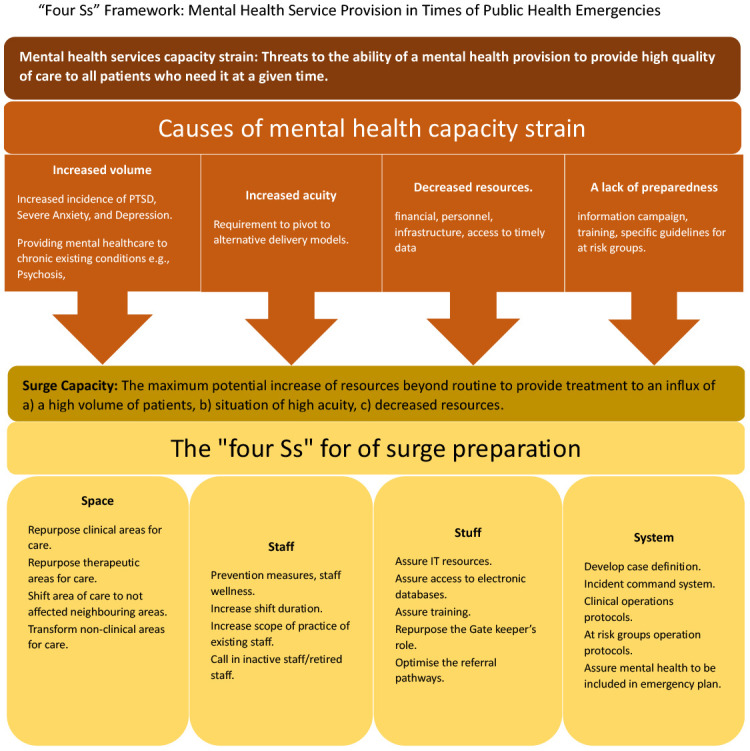 Figure 1
| Inclusion Criteria | Exclusion Criteria |
|---|---|
| Publications related to any mental health interventions/
| Publications that concentrate on mental health
|
| Publications related to any reorganisation of mental health care
| Publications that only focus on the epidemiology of
|
| Publications regarding mental health Interventions and/or
| Mental health policy documents. |
| Publications that use any research methodologies and study
|
|
| “mental health” OR suicid* OR self-harm OR “self harm” OR selfharm OR “non-suicidal self-injury” OR
|
|
| “psychological response” OR “psychosocial response” OR “psychosocial support” OR “crisis management”
|
|
| “public health emergenc*” OR pandemic* OR COVID-19 OR “infectious disease*” OR “natural disaster*”
|
| Items |
|---|
| 1. First Author |
| 2. Year of publication |
| 3. Geographical location |
| 4. Study design/methodology |
| 5. Study population
|
| 6. Type of public health emergency |
| 7. Name and or type of Intervention and/or support provided.
|
- —Health Research Board
Peer Reviews
No public reviews on file for this paper yet. If you reviewed it on a platform where reviews are public (OpenReview, ICLR, NeurIPS, ICML), you can paste yours below so the community can read it here.
Videos
No videos yet. Explain this paper in a talk, walkthrough, or lecture? Add one.
Taxonomy
TopicsMental Health Treatment and Access · Disaster Response and Management · COVID-19 and Mental Health
Background
Public health emergencies (PHEs) defined as “serious, sudden unexpected or unusual events that constitute a public health risk” ^ 1 ^, can be caused by disease outbreaks (e.g., pandemics, epidemics, local outbreaks), man-made or natural disasters (e.g., floods, hurricanes, earth quakes, bush fires), and war or military conflicts. PHEs can have a significant impact on the delivery of care for patients with pre-existing mental health conditions. For example, in the recent COVID-19 pandemic mental health services in many countries pivoted to remote out-patient care for their existing patient populations ^ 2 ^. The extent to which these new treatment modalities were successfully implemented and effective is the subject of ongoing research. A further PHE challenge for mental health care service providers is the creation of additional demand due to the increased incidence and prevalence of mental health conditions, e.g., severe anxiety, post-traumatic stress disorder (PTSD), depression, and acute stress disorders, as an immediate consequence of emergencies ^ 3– 5 ^.
While there is considerable evidence on the responses of mental health services to public health emergencies, the nature of this research varies not only methodologically (e.g., descriptive studies, evaluations highlighting barriers and facilitators of implementation, and effectiveness studies, in qualitative and quantitative forms) but also in the context of specific PHE type. For instance, a considerable body of evidence has investigated the effectiveness of various psychological interventions aimed at supporting the mental health of individuals who have been exposed to infectious disease outbreaks ^ 6 ^. Additionally, research has explored the effectiveness of tele-mental health and technology mediated interventions ^ 7, 8 ^. Fewer studies however, focused on the acceptability and usability of these mental health interventions ^ 9 ^.
The body of research pertaining to factors that facilitate or constrain the implementation of mental health interventions and supports subsequent to PHE is another recognisable domain. These factors encompass the adaptability of intervention to the emergency context, the unique characteristics of a region’s mental health system, and the specific needs of the affected individuals. They include a wide range of factors, including but not limited to the mental health system, mental health policies, financing, human and infrastructure resources, safety measures, privacy and confidentiality protocols, cultural considerations, and the impact of stigma ^ 10– 12 ^. Importantly, these factors remain similar in any type of emergency ^ 10– 12 ^.
Although different types of PHEs may be perceived as very different situations, they all require mental health services to pivot away from normal practice into emergency response mode. This pivot varies geographically, and by the type of PHE, however, many aspects are consistent irrespective of the situation, for example, the initiation of emergency decision-making structures, new staff responsibilities, and increased reliance on alternative service delivery modes such as remote consultation and patient transfer. A substantial body of literature on mental health interventions delivered during public health emergencies as well as variation in research methodologies and application of interventions for different PHEs, provides justification for use of a scoping review design. The objective of this review is to report on and map the existing evidence to gain a clearer understanding of the available mental health interventions and supports, their relevance to the public health emergency scenario, and the characteristics of the population they target. Therefore, the aim of this review will be to explore how have mental health services respond to previous PHEs with a specific focus on the effectiveness of responses, as well as barriers and facilitators to implementation.
Methods
The structure of this protocol aligns with the five-stage Arksey O’Malley guidance ^ 13 ^ further refined by Westphaln and colleagues ^ 14 ^. These refined guidelines will also be implemented during the review process. The Preferred Reporting Items for Systematic Reviews and Meta-Analysis Scoping Review extension (PRISMA-ScR) ^ 15 ^ also will be used to report on terminology and fundamental components as the review process progresses. The scoping review protocol will be published in HRB Open.
Selection of relevant studies
** Eligibility criteria.** Primary and/or secondary research publications involving individuals with pre-existing or newly developed mental health conditions who engaged with mental health services in instances of PHEs are of interest for this scoping review. Language restrictions will not be imposed in the search and selection process. Regarding methodology all research methods and study designs will be considered for inclusion. Studies exclusively focused on the epidemiological aspect of mental health conditions during PHEs will be omitted, as this review focuses exclusively on the provision of mental health services during emergencies. Please see the summary of the eligibility criteria in Table 1. Below are the detailed eligibility criteria structured within the Population, Concept, Construct (PCC) construct for clarity.
Population
The scope of this review encompasses research about individuals dealing with pre-existing or newly developing mental health conditions and/or suicidal thoughts and behaviours, including but not limited to psychosis, mood disorders, post-traumatic stress disorder (PTSD), depression, anxiety, self-harm suicidal attempt. The focus is on those who have actively engaged with mental health services in the context of PHEs.
Concept
Publications that address any modifications to mental health systems, community-based support structures and psychosocial interventions that have been implemented in response to the impact of an emergency will be included. All studies that have documented or investigated the implementation or evaluation of mental health interventions or support provision during PHEs will be included. For the purpose of this review, the concept of mental health intervention and/or support is operationally defined as any adjustment to mental health care introduced at a national, regional, or community level as a consequence of a public health emergency documented in academic or grey literature.
Context
The scoping review will include any studies that concentrate on mental health interventions, or the provision of supports delivered across various settings and to diverse populations during public health emergencies, including pandemic, and/or man-made or natural disaster, and/or war, or military conflict.
The research inquiry outlined above was formulated as a direct response to a preliminary exploration undertaken within the Medline database. This initial exploration revealed the substantial volume of publications indicating varying nature of the literature in terms of study designs and types of mental health interventions and supports deployed within distinct PHEs.
** Search strategy.** The review will involve searches across both academic and grey literature sources. Academic databases to be searched are Medline via Ovid, EMBASE via Ovid, PsycINFO via Ovid, CINAHL via EBSCO, Web of Science, and Cochrane Central Register of Controlled Trials while grey literature searches will involve searching the Social Care Institute for Excellence (SCIE) database, WHO Library and Digital Information Networks database, The DART Europe E-thesis Portal, United Nations iLibrary database, The National Academies Press database extension for emergency preparedness and disaster management, and first fifty results of the Google Scholar database. Additionally, the reference list of identified articles will be reviewed to identify any additional sources that may be relevant for this scoping review. In cases where there is duplication of sources, such as when a primary source is used in evidence synthesis, the primary source will be excluded if context of evidence synthesis is relevant to this review.
The search strategy for this review encompasses a wide range of terms related to mental health conditions, the concept of interventions and supports, as well as terms related to various types of PHEs. Please refer to Table 2 for the list of key terms developed in alignment with the PCC (Population, Concept, Context) construct. The key terms have been sourced from previous research publications, enhancing their relevance. The use of MeSH headings, Boolean operators, truncation, and phrases enclosed in inverted commas will be applied where appropriate to optimise the search query. The University College Cork librarian contributed to the development of a search strategy applicable to different search engines. Considering the broad and evolving nature of mental health interventions delivered during PHEs, the search strategy may be altered if additional terms or sources of evidence are uncovered.
Charting data
** Data management.** Rayyan software ^ 16 ^ will be used to manage data, including the removal of duplications, screening, and data extraction of identified articles.
Incorporating the framework adapted from the Dr. Anesi and his colleagues, known as “Four Ss” ^ 17 ^, will offer a structured and systematic approach to organise and chart data. This comprehensive framework offers four primary categories: Space, Staff, Stuff, and System, each further subdivided into more specific themes, as illustrated in Figure 1. It is important to highlight that any themes that will emerge during the review process and were not originally included in the “Four Ss” framework will either be reported separately or incorporated as an extension of the adaptive “Four Ss” framework. This will allow for a detailed exploration of the evidence and will ensure that all relevant aspects are considered and reported in this review.
“Four Ss” framework.
** Selection process.** The initial screening will involve assessing titles and abstracts for eligibility. The subsequent full-text review of publications that pass the initial screening, conducted against inclusion and exclusion criteria, will ensure selection of only most relevant publications. Two reviewers will autonomously evaluate titles, abstracts, and full text of publications. Any disagreements during the review process will be resolved through consensus discussion or recourse to a third reviewer opinion. A pilot screening will be carried out with five publications at the beginning of each stage of the review.
** Data extraction.** The full-text screening process will determine the eligibility of publications for data extraction. A predefined data extraction tool designed in Excel (XLSX) will be utilised to extract information of interest for this scoping review. These includes lead author, year of publication, study design/methodology, location, population, PHE type, and fields related to the interventions and/or supports delivered during PHEs created in accordance with the adapted "Four Ss" framework. Please see the template of the data extraction tool in Table 3. Importantly, if any new themes develop during the review process, these will be isolated individually or incorporated into the adaptive “Four Ss” framework. To ensure consistency, the data extraction tool will be tested on a small subset of data retrieved independently by two reviewers. Any discrepancies will be discussed and resolved by wider research team prior to applying data extraction to all included publications. One reviewer will extract data from all included publications, while a second reviewer will double-check all collected data.
** Data analysis.** The planned approach for reporting and presenting data will involve various forms to include graphs, tables and narrative description of results to effectively convey the varying nature of mental health interventions and/or supports provided during PHEs. The initial stage of analysis will involve quantitative (proportional) assessment of mental health responses to specific PHEs using the “four Ss” framework. This approach will allow us to recognise the types of interventions and supports available, as well as the determinants associated with these interventions. Next step will involve quantitative estimation of an effectiveness of the interventions in specific PHE context. The review will provide aggregated estimates (Standardised Mean Difference; SMD) to convey the effectiveness of interventions, where possible. Lastly, the review will quantitatively (proportions) and qualitatively (thematic analysis) explore the barriers and facilitators of the implementation of mental health service responses to PHEs. The alignment of all extracted data with the “Four Ss” framework ensures a structured and systematic analysis that will contribute to comprehensive understanding of the evidence in context of space, staff, stuff, and system. This approach to the reporting and analysing data is likely to yield nuanced and valuable insights into the nature of mental health interventions provided during PHEs.
Deviation from the protocol
Given broad nature of mental health interventions and supports delivered during specific PHEs it is prudent to acknowledge the potential for deviation in the review methodology during the review process. The deviation can arise particularly in the included publications and emergence of new themes. Any such changes will be documented and reported in the final report after completing the review process, in comparison to the original scoping review protocol.
The reference list from the paper itself. Each links out to its DOI / PubMed record.
- 1Wilder-Smith A Osman S : Public health emergencies of international concern: a historic overview. J Travel Med. 2020;27(8): taaa 227. 10.1093/jtm/taaa 227 33284964 PMC 7798963 · doi ↗ · pubmed ↗
- 2WHO: Mental health in emergencies.2022; [cited 2023 May 19]. Reference Source
- 3Mental Health and Substance Use W: Mental Health and COVID-19: Early evidence of the pandemic’s impact: Scientific brief, 2 March 2022..2022;13. Reference Source
- 4Charlson F van Ommeren M Flaxman A : New WHO prevalence estimates of mental disorders in conflict settings: a systematic review and meta-analysis. Lancet. 2019;394(10194):240–8. 10.1016/S 0140-6736(19)30934-1 31200992 PMC 6657025 · doi ↗ · pubmed ↗
- 5Beaglehole B Mulder RT Frampton CM : Psychological distress and psychiatric disorder after natural disasters: systematic review and meta-analysis. Br J Psychiatry. 2018;213(6):716–22. 10.1192/bjp.2018.210 30301477 · doi ↗ · pubmed ↗
- 6Doherty A Benedetto V Harris C : The effectiveness of psychological support interventions for those exposed to mass infectious disease outbreaks: a systematic review. BMC Psychiatry. 2021;21(1): 592. 10.1186/s 12888-021-03602-7 34814859 PMC 8610770 · doi ↗ · pubmed ↗
- 7Prescott MR Sagui-Henson SJ Welcome Chamberlain CE : Real world effectiveness of digital mental health services during the COVID-19 pandemic. P Lo S One. 2022;17(8): e 0272162. 10.1371/journal.pone.0272162 35980879 PMC 9387818 · doi ↗ · pubmed ↗
- 8Kunzler AM Stoffers-Winterling J Stoll M : Mental health and psychosocial support strategies in highly contagious emerging disease outbreaks of substantial public concern: A systematic scoping review. P Lo S One. 2021;16(2): e 0244748. 10.1371/journal.pone.0244748 33534786 PMC 7857635 · doi ↗ · pubmed ↗