Keeping the Time: The Impact of External Clock-Speed Manipulation on Time-Based Prospective Memory
Gianvito Laera, Giovanna Mioni, Sandrine Vanneste, Patrizia Silvia Bisiacchi, Alexandra Hering, Matthias Kliegel

TL;DR
This study explores how manipulating clock speed affects people's ability to monitor time for future tasks, suggesting they track time by counting clock digits.
Contribution
The study provides new evidence that people use numerical progression of clock ticks to track target times for prospective memory.
Findings
Participants in the slower clock condition increased time monitoring in the second TBPM block.
Participants in the faster clock condition checked the clock less frequently during the 4th minute.
TBPM performance was not affected by clock-speed manipulation.
Abstract
Several studies have suggested that time monitoring is important for appropriate time-based prospective memory (TBPM). However, it is still unknown if people actively use internal timing processes to monitor the approaching target time, and whether they do so by tracking the duration between clock digits, or by counting and matching the numerical progression of clock ticks’ digits with the target time. Therefore, in the present study, we investigated whether a manipulation of the external time affected time monitoring and TBPM performance. In two experiments, participants performed two identical TBPM tasks: a first TBPM block with no clock-speed manipulation followed by a second TBPM block, where the clock-speed was manipulated as faster or slower (experimental conditions) or normal (control condition). The results showed that only participants in the slower clock condition increased…
Genes, proteins, chemicals, diseases, species, mutations and cell lines named across the full text — each resolved to its canonical identifier and authoritative record.
Click any figure to enlarge with its caption.
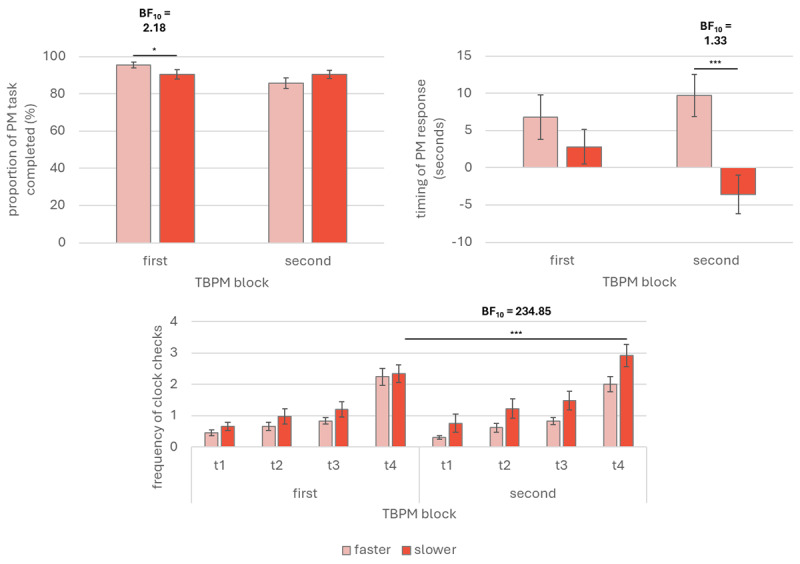 Figure 1
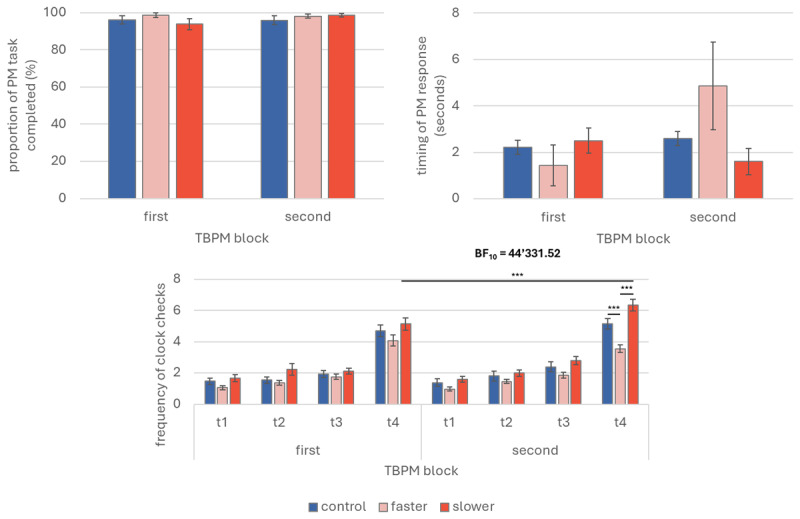 Figure 2
Peer Reviews
No public reviews on file for this paper yet. If you reviewed it on a platform where reviews are public (OpenReview, ICLR, NeurIPS, ICML), you can paste yours below so the community can read it here.
Videos
No videos yet. Explain this paper in a talk, walkthrough, or lecture? Add one.
Taxonomy
TopicsCognitive Functions and Memory · EEG and Brain-Computer Interfaces · Neural and Behavioral Psychology Studies