Bifurcation and hybrid control of a discrete eco-epidemiological model with Holling type-III
Lizhi Fei, Hengmin Lv, Heping Wang

TL;DR
This paper studies a discrete eco-epidemiological model and analyzes its bifurcations and control strategies.
Contribution
The novel contribution is the hybrid control strategy for managing bifurcations in the model.
Findings
The system exhibits Neimark-Sacker and flip bifurcations at the positive fixed point.
A hybrid control strategy successfully manages the Neimark-Sacker bifurcation.
Numerical simulations confirm the analytical results.
Abstract
In this paper, a three dimensional discrete eco-epidemiological model with Holling type-III functional response is proposed. Boundedness of the solutions of the system is analyzed. Existence condition and stability of all fixed points are discussed for the proposed model. Furthermore, we obtained the transcritical bifurcation surfaces of the system by bifurcation theory. Based on the explicit criteria for the Neimark Sacker bifurcation and flip bifurcation, we obtained that the system undergoes these two types of bifurcations at the positive fixed point. Then we apply a hybrid control strategy that based on both parameter perturbation and a state feedback strategy to control the Neimark-Sacker bifurcation. Finally, some numerical simulations are carried out to support the analytical results.
Genes, proteins, chemicals, diseases, species, mutations and cell lines named across the full text — each resolved to its canonical identifier and authoritative record.
Click any figure to enlarge with its caption.
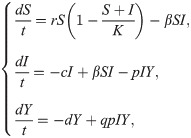 Figure 1
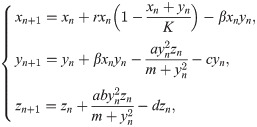 Figure 2
 Figure 3
 Figure 4
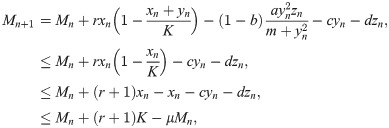 Figure 5
 Figure 6
 Figure 7
 Figure 8
 Figure 9
 Figure 10
 Figure 11
 Figure 12
 Figure 13
 Figure 14
 Figure 15
 Figure 16
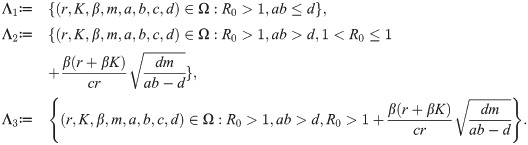 Figure 17
 Figure 18
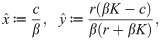 Figure 19
 Figure 20
 Figure 21
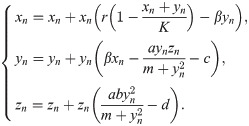 Figure 22
 Figure 23
 Figure 24
 Figure 25
 Figure 26
 Figure 27
 Figure 28
 Figure 29
 Figure 30
 Figure 31
 Figure 32
 Figure 33
 Figure 34
 Figure 35
 Figure 36
 Figure 37
 Figure 38
 Figure 39
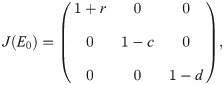 Figure 40
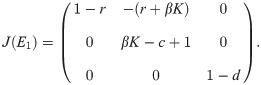 Figure 41
 Figure 42
 Figure 43
 Figure 44
 Figure 45
 Figure 46
 Figure 47
 Figure 48
 Figure 49
 Figure 50
Peer Reviews
No public reviews on file for this paper yet. If you reviewed it on a platform where reviews are public (OpenReview, ICLR, NeurIPS, ICML), you can paste yours below so the community can read it here.
Videos
No videos yet. Explain this paper in a talk, walkthrough, or lecture? Add one.
Taxonomy
TopicsMathematical and Theoretical Epidemiology and Ecology Models · Evolution and Genetic Dynamics · Fractional Differential Equations Solutions