Unveiling the Drug Formulation Code: A Journey to Three-Dimensional Precision
Esteban Zavaleta-Monestel, Monserrat Barrantes-López, Jonathan García-Montero, Sebastián Arguedas-Chacón, Jeimy Campos-Hernández

TL;DR
This paper explores how 3D printing is transforming personalized medicine by enabling precise, customized drug formulations.
Contribution
The paper highlights the novel application of 3D printing in creating personalized, multi-drug, and controlled-release medications.
Findings
3D printing allows for the creation of personalized multi-dose and controlled-release tablets.
The technology improves pharmacokinetic adjustments and organoleptic qualities for individual patients.
Studies show 3D printing offers safety and effectiveness for future pharmaceutical applications.
Abstract
Magistral formulations emerged years ago and were of great help in the personalization of treatments for patients. Over time, innovation began in this area with new technologies such as three-dimensional (3D) printing, which has brought greater benefits, ease of preparation, new scopes, and even cost reduction. Three-dimensional printing of medicines opened the way to create personalized multi-dose, controlled-release, multi-drug tablets, among others. In addition, this technology manages to be more specific in adjusting pharmacokinetics, doses, and even organoleptic qualities, which is precisely what is sought since the medication is being personalized for a patient due to a particular case or condition. Throughout the research, some studies can be observed that function as a base that provides safety and effectiveness for the subsequent use of other pharmaceuticals in the 3D printing…
Genes, proteins, chemicals, diseases, species, mutations and cell lines named across the full text — each resolved to its canonical identifier and authoritative record.
Click any figure to enlarge with its caption.
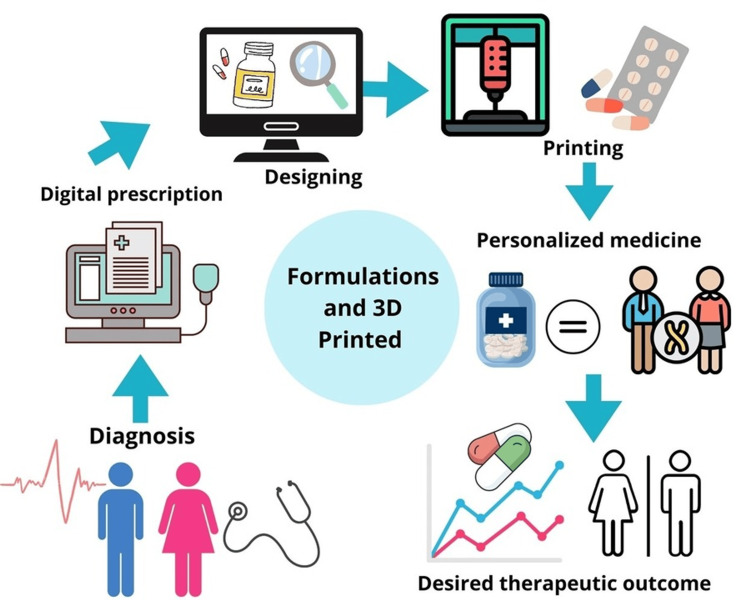 Figure 1
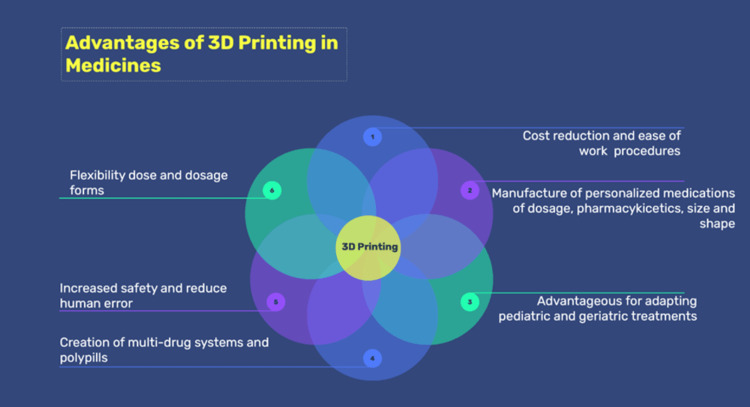 Figure 2
Peer Reviews
No public reviews on file for this paper yet. If you reviewed it on a platform where reviews are public (OpenReview, ICLR, NeurIPS, ICML), you can paste yours below so the community can read it here.
Videos
No videos yet. Explain this paper in a talk, walkthrough, or lecture? Add one.
Taxonomy
Topics3D Printing in Biomedical Research · Safe Handling of Antineoplastic Drugs · Pharmaceutical studies and practices