Association Between Traumatic Brain Injury and Cognitive Decline Among Middle-to-Older Aged Men in the Vietnam Era Twin Study of Aging
Alexander Ivan B. Posis, John E. Alcaraz, Humberto Parada, Aladdin H. Shadyab, Jeremy A. Elman, Matthew S. Panizzon, Chandra A. Reynolds, Carol E. Franz, William S. Kremen, Linda K. McEvoy

TL;DR
This study found that traumatic brain injury (TBI) is linked to faster cognitive decline in older men, especially in executive function for those with a specific gene variant or who experienced TBI in early life.
Contribution
The study reveals that TBI's impact on cognitive decline varies by APOE ε4 carrier status and age at injury, emphasizing a life course perspective.
Findings
TBI was associated with faster decline in executive function among APOE ε4 carriers.
Early-life TBI was linked to faster executive function decline regardless of APOE ε4 status.
No significant associations were found for episodic memory or processing speed decline overall.
Abstract
Traumatic brain injury (TBI) is associated with increased risk of dementia. However, whether TBI is associated with greater cognitive decline over time in specific cognitive domains among older adults is not well understood. This prospective cohort study used data from 1476 male Vietnam Era Twin Study of Aging participants (average age at study entry = 57.9 years, range = 51–71 years; 97.6% non-Hispanic; 92.5% White) collected from 2003 to 2019, who had complete information on prior TBI. Participants completed a comprehensive neuropsychological assessment at up to three visits over up to a 12-year follow-up period during which they also self-reported their history of TBI. Multivariable, linear mixed-effects models were used to assess associations between TBI and cognitive performance trajectories. Effect measure modification by apolipoprotein E (APOE) epsilon 4 (ε4) genotype status was…
Genes, proteins, chemicals, diseases, species, mutations and cell lines named across the full text — each resolved to its canonical identifier and authoritative record.
Click any figure to enlarge with its caption.
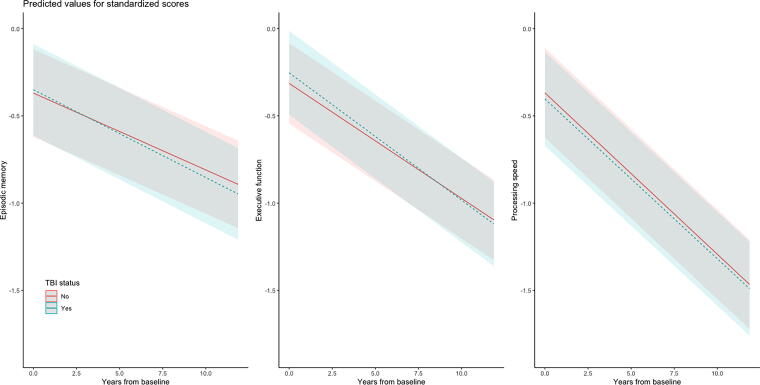 Figure 1
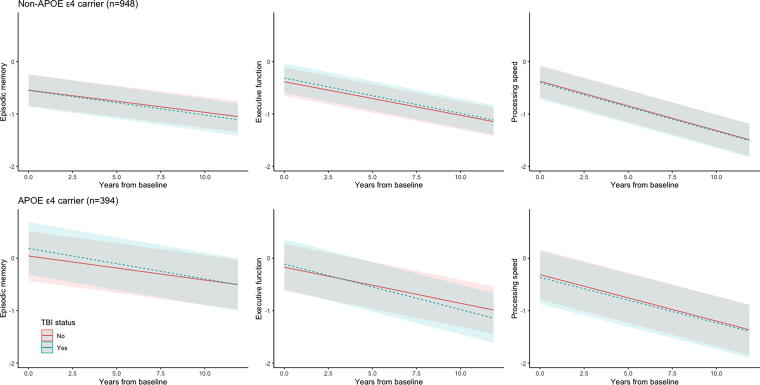 Figure 2
Peer Reviews
No public reviews on file for this paper yet. If you reviewed it on a platform where reviews are public (OpenReview, ICLR, NeurIPS, ICML), you can paste yours below so the community can read it here.
Videos
No videos yet. Explain this paper in a talk, walkthrough, or lecture? Add one.
Taxonomy
TopicsTraumatic Brain Injury Research · Traumatic Brain Injury and Neurovascular Disturbances · Posttraumatic Stress Disorder Research