Infant attention to rhythmic audiovisual synchrony is modulated by stimulus properties
Laura K. Cirelli, Labeeb S. Talukder, Haley E. Kragness

TL;DR
This study explores how infants aged 8 to 12 months pay attention to rhythmic sounds and matching visual movements.
Contribution
The study reveals how stimulus properties like pitch and tempo influence infants' audiovisual attention in non-speech contexts.
Findings
Infants showed greater attention to low-pitch auditory rhythms compared to high-pitch ones.
Infants did not consistently prefer the hand that was synchronized with the auditory rhythm.
Rhythmic complexity and pitch interact to influence infants' attention to aligned visual stimuli.
Abstract
Musical interactions are a common and multimodal part of an infant’s daily experiences. Infants hear their parents sing while watching their lips move and see their older siblings dance along to music playing over the radio. Here, we explore whether 8- to 12-month-old infants associate musical rhythms they hear with synchronous visual displays by tracking their dynamic visual attention to matched and mismatched displays. Visual attention was measured using eye-tracking while they attended to a screen displaying two videos of a finger tapping at different speeds. These videos were presented side by side while infants listened to an auditory rhythm (high or low pitch) synchronized with one of the two videos. Infants attended more to the low-pitch trials than to the high-pitch trials but did not display a preference for attending to the synchronous hand over the asynchronous hand within…
Genes, proteins, chemicals, diseases, species, mutations and cell lines named across the full text — each resolved to its canonical identifier and authoritative record.
Click any figure to enlarge with its caption.
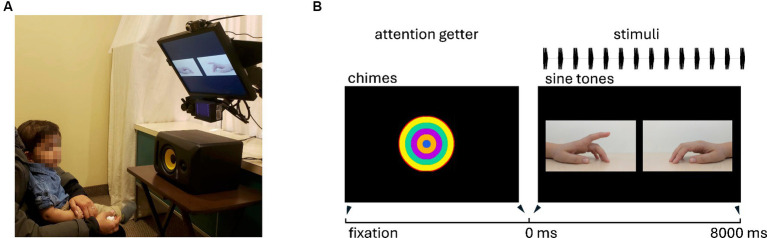 Figure 1
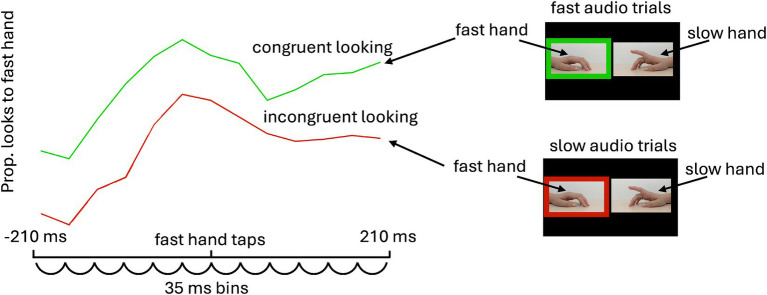 Figure 2
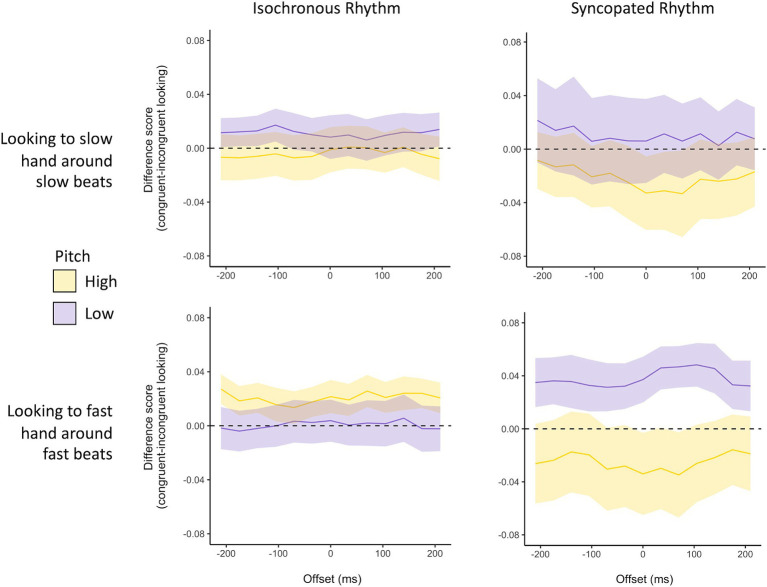 Figure 3
Peer Reviews
No public reviews on file for this paper yet. If you reviewed it on a platform where reviews are public (OpenReview, ICLR, NeurIPS, ICML), you can paste yours below so the community can read it here.
Videos
No videos yet. Explain this paper in a talk, walkthrough, or lecture? Add one.
Taxonomy
TopicsMultisensory perception and integration · Neuroscience and Music Perception · Hearing Loss and Rehabilitation