Secretan’s Syndrome: It Is Time to Talk About It
Achraf Tebbaa El Hassali, Mohammed Barrached, Adnane Lachkar, Najib Abdeljaouad, Hicham Yacoubi

TL;DR
This paper discusses Secretan’s syndrome, a rare condition with unclear causes, through the case of a young woman with a painful hand swelling.
Contribution
The paper presents a new clinical case that highlights the diagnostic and treatment challenges of Secretan’s syndrome.
Findings
The patient exhibited a unilateral and painful swelling on the right hand.
Diagnosis and treatment required a multidisciplinary and personalized approach.
The case underscores the need for further research into the syndrome’s etiology and management.
Abstract
Secretan’s syndrome is a rare condition; the exact etiology remains unclear. It has no specific treatment and the care must be multidisciplinary and personalized. We report a case of a young female patient who presented with a unilateral and painful swelling of the dorsum of the right hand. The diagnosis and treatment of this patient were challenging.
Genes, proteins, chemicals, diseases, species, mutations and cell lines named across the full text — each resolved to its canonical identifier and authoritative record.
Click any figure to enlarge with its caption.
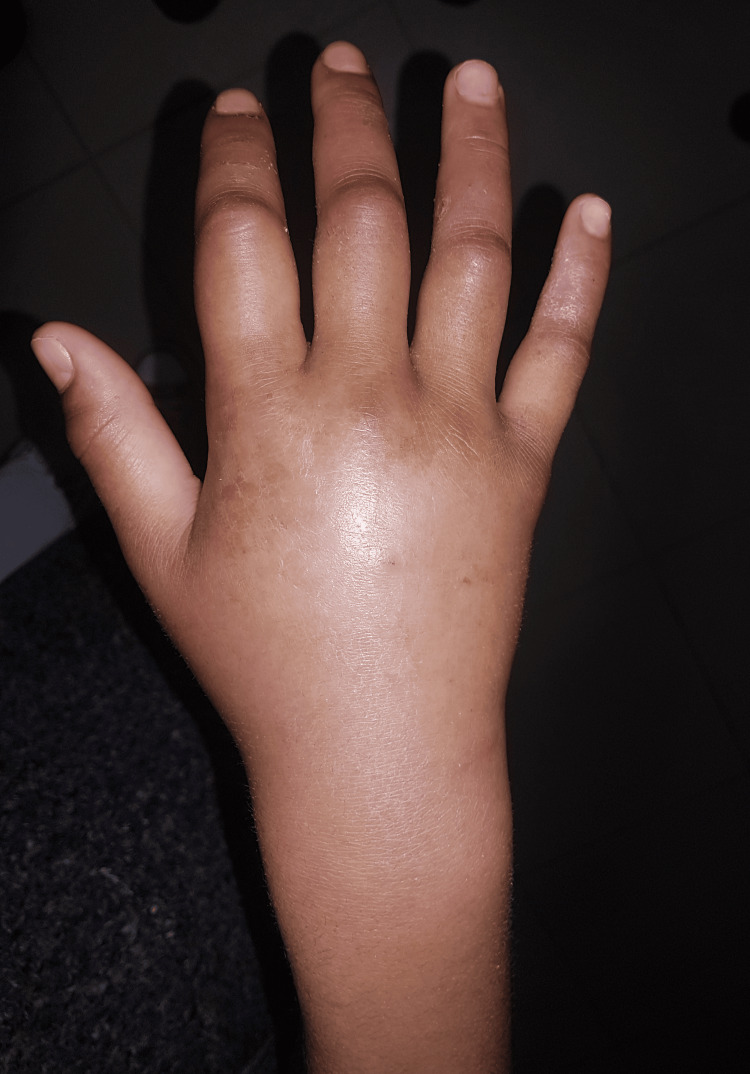 Figure 1
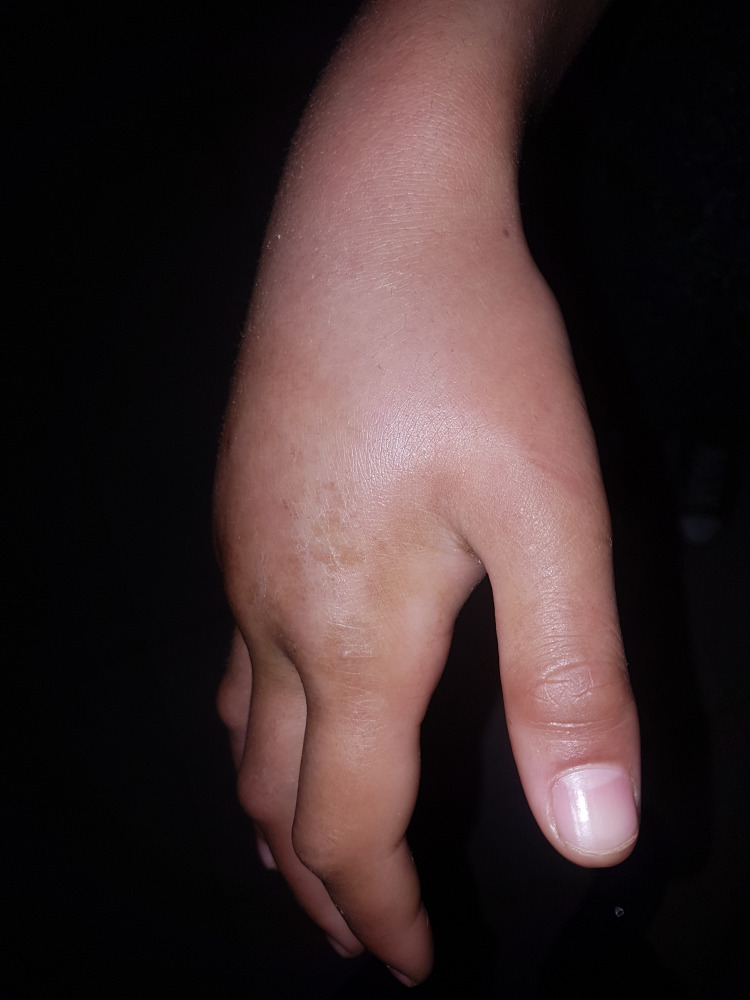 Figure 2
| Parameter | Patient’s values | Normal values |
| C-reactive protein | 1.68 mg/L | <6 mg/L |
| Creatinine | 7.20 mg/L | 5.7-11.1 mg/L |
| Urea | 0.28 g/L | 0.15-0.39 g/L |
| White blood cells | 7500/μL | 4000-10.000/μL |
| Sodium | 140 mmol/L | 135-145 mmol/L |
| Potassium | 3.9 mmol/L | 3.5-4.5 mmol/L |
| Calcium | 2.30 mmol/L | 2.25-2.62 mmol/L |
| Glycemia | 0.80 g/L | 0.70-0.95 g/L |
| Aspartate aminotransferase | 15 IU/L | 5-34 IU/L |
| Alanine aminotransferase | 30 IU/L | 0-55 IU/L |
| Gamma-glutamyl transferase | 25 IU/L | 9-36 IU/L |
| Alkaline phosphatase | 99 IU/L | 40-150 IU/L |
| Lactate dehydrogenase | 159 IU/L | 125-220 IU/L |
| Hemoglobin | 13 g/dL | 12-16 g/dL |
| Platelet count | 360000/μL | 150 000-400 000/μL |
| Protein | 76 g/L | 65-80 g/L |
| Albumin | 42 g/L | 35-50 g/L |
| Prothrombin | 92% | 70-100% |
Peer Reviews
No public reviews on file for this paper yet. If you reviewed it on a platform where reviews are public (OpenReview, ICLR, NeurIPS, ICML), you can paste yours below so the community can read it here.
Videos
No videos yet. Explain this paper in a talk, walkthrough, or lecture? Add one.
Taxonomy
TopicsChild Abuse and Related Trauma · Restraint-Related Deaths · Traumatic Ocular and Foreign Body Injuries
Introduction
Secretan’s syndrome, characterized by the appearance of hard edema, sometimes with cyanosis, on the dorsum of one or both hands, was first described in 1901 by the Swiss doctor Henri-François Secretan (1856-1916) [1,2]. The exact etiology of this syndrome remains unclear. The initial location at the dorsum of the hand has been extended to other locations including the foot or the ankle. It is considered a subtype of Munchausen syndrome also called “pathomimia” or “factitious disorder” [2,3].
We report a case of Secretan’s syndrome without triggering factor in a 17-year-old patient, discussing it with data from recent literature. The interest of our case lies in its rarity and in its psychosomatic involvement, which constitutes a real diagnostic and therapeutic challenge.
Case presentation
This is a case of a 17-year-old female patient, a high school student, with no notable personal or family pathological and psychiatric history. She has also no history of taking medication or drug abuse.
She consulted for a unilateral and painful swelling of the dorsum of the right hand, which had appeared gradually over the past 20 days without any notion of trauma, triggering factor, or other associated signs.
On clinical examination, the patient was conscious, stable neurologically and hemodynamically (blood pressure: 130/80 mmHg, heart rate: 79 beat/min), had a respiratory rate of 20 cycles/min, her temperature was 37°C, and her body mass index was 20.5 kg/m^2^. Pitting edema was present at the dorsum of her right hand going up to the wrist, with pain on palpation; the hand was cold with no inflammatory signs. The pain reported by the patient is intermittent of moderate intensity (VAS pain 5/10), limited to the right hand, mechanical in nature, and exacerbated by palpation and mobilization.
Active mobility is refused by the patient given the pain and passive flexion of the fingers are limited. Furthermore, the vascular and nervous examinations were normal. The examination of the opposite limb as well as the rest of the musculoskeletal system was without abnormality. The clinical appearance of the hand is represented in Figures 1, 2.
An image of the dorsum of the hand showing swelling
A lateral image of the hand showing swelling
She had an X-ray of the right hand on anteroposterior (AP) and lateral views that were unremarkable. The complete biological assessment carried out was normal as presented in Table 1; the patient also had an electrocardiogram (ECG) that showed no abnormalities.
Ultrasound of the right hand suggested phlegmonous infiltration. Magnetic resonance imaging (MRI) showed no abnormalities other than soft tissue edema of the right hand.
The patient was put on paracetamol 3 g/day. She took the treatment only if she experienced pain for four days (one to three doses per day) then she stopped it. The course after discharge (7 days later) from the hospital was marked by spontaneous resolution of the edema after five days, without any surgical treatment. This was predicted by the patient.
A psychiatric interview (suggested to ease her anxiety) with the patient was able to individualize some borderline personality traits such as impulsivity, chronic feeling of emptiness, emotional and relational instability, and an in-depth understanding of medical knowledge with a reluctance toward the causes of her illness. In fact, she knows the anatomy of the hand well. The patient reports also having read several scientific articles and books about factitious disorders. She also knows a former patient that we treated in our department and therefore knows the care circuit well.
Cognitive behavioral therapy was indicated and followed regularly by the patient after the diagnosis of Secretan’s syndrome was announced. The cognitive behavioral therapy sessions aimed to learn to regulate emotions, tolerate distress, and manage interpersonal conflicts differently than with a self-inflicted injury, managing anxiety and validating feelings of suffering and finally expression of emotions and self-affirmation.
After eight sessions, she was able to confirm the self-inflicted nature of the edema without explaining the mechanism. She says that it was a kind of call for help and I quote "I was in pain and no one realized, I did this to encourage my loved ones to help me to stop suffering." The patient's follow-up for 12 months did not mention any recurrence of physical or psychological symptoms or medication intake.
Discussion
Secretan’s syndrome has been described through several reported cases of Swiss tunnel-boring machine workers who presented with bone fractures and persistent hand lesions that could not be explained by the minimal trauma suffered [2,3]. This clinical description was subsequently broadened to include other locations, notably the lower limbs. Three clinical forms that currently exist are the benign form, the hyperplastic form, and the mixed form. In the benign type, soft tissue infiltration occurs and improves well with psychiatric care. The hyperplastic type occurs after repeated trauma and can be complicated by hematoma or fibrosis and, therefore, requires medical-surgical care associated with psychological care, and in the mixed type the combination of the two forms is found [3,4]. The exact cause of this disorder remains poorly understood but factitious trauma and pathomimia are often suspected [4].
A similarity with self-mutilation and Munchausen syndrome is reported in the literature. Secretan’s syndrome is included in the DSM (the Diagnostic and Statistical Manual of Mental Disorders) as “a factitious disorder with physical signs and symptoms” [4,5].
The factitious nature of hand edema can be suspected in the presence of several of the following arguments: an atypical clinical presentation, personal or family psychiatric history, an unusual clinical course, inconclusive results of blood and radiological tests, a worsening or spectacular improvement under treatment or upon discharge from hospitalization, a prediction of improvement in symptoms, repeated medical consultations with excessive demand for explorations and invasive procedures, etc. [5-8].
Caregivers must be attentive to the symptoms reported and must offer psychological treatment each time an artificial origin is suspected [9-11].
Conclusions
Secretan’s syndrome is a rare and underdiagnosed clinical entity. Considered as an elimination diagnosis, the medical approach must be systematic and meticulous. No specific treatment is indicated. Care must be multidisciplinary and personalized.
The reference list from the paper itself. Each links out to its DOI / PubMed record.
- 1Henri-Francois Secretan (1856-1916) and his syndrome Acta Med Hist Adriat Al Aboud K Al Aboud D 23724292011 https://pubmed.ncbi.nlm.nih.gov/22292544/22292544 · pubmed ↗
- 2[Secretan's syndrome: myth or pathomimia?]J Mal Vasc Collet S Forli A Carpentier PH Laviolette F Imbert B Blaise S 67723920142421074910.1016/j.jmv.2013.10.002 · doi ↗ · pubmed ↗
- 3Secretan's syndrome: case report Acta Chir Belg Lemmens L van Doninck J de Smet L 12312411920193076472110.1080/00015458.2017.1399702 · doi ↗ · pubmed ↗
- 4Escalation of automutilation of the hand Acta Orthop Belg De Smet L Van Houdenhove B Fabry G 212214631997 https://pubmed.ncbi.nlm.nih.gov/9415730/9415730 · pubmed ↗
- 5Factitious lesions of the hand Rev Bras Ortop Oliveira RK Bayer LR Lauxen D Roth F Serrano PD Ruschel PH 3813864820133130413810.1016/j.rboe.2012.09.008PMC 6565958 · doi ↗ · pubmed ↗
- 6Secretan syndrome: a fluctuating case of factitious lymphedema Cutis Demircioğlu D Durmaz EÖ Sezer E Şahin S 051082021 https://pubmed.ncbi.nlm.nih.gov/35167799/10.12788/cutis.042535167799 · doi ↗ · pubmed ↗
- 7Factitious disorders of the upper extremity J Am Acad Orthop Surg Birman MV Lee DH 7885202012 https://pubmed.ncbi.nlm.nih.gov/22302445/2230244510.5435/JAAOS-20-02-078 · doi ↗ · pubmed ↗
- 8Secretan's syndrome Orthopedics Ramos JA Bush D Harrington TM 2392403020071737555310.3928/01477447-20070301-12 · doi ↗ · pubmed ↗