Correlation between serum sex hormone-binding globulin levels and nutrition indicators and malnutrition exposure risk in men and postmenopausal women with type 2 diabetes
Jinxin Lin, Weiming Wu, Yifu Weng, Yingru Lan, Yuqiong Wen, Shuiqing Lai, Xiaoying Fu, Jian Kuang, Haixia Guan, Hongmei Chen

TL;DR
This study found that serum SHBG levels are linked to nutrition indicators and malnutrition risk in men and postmenopausal women with type 2 diabetes.
Contribution
The novel contribution is identifying SHBG as a potential biomarker for malnutrition risk in T2DM patients.
Findings
SHBG levels were inversely correlated with BMI, albumin, transferrin, and prealbumin in both men and postmenopausal women.
Higher SHBG levels were independently associated with increased malnutrition exposure risk in T2DM patients.
Non-alcoholic fatty liver disease was associated with reduced malnutrition exposure risk.
Abstract
This study sought to investigate the correlation between serum sex hormone-binding globulin (SHBG) levels and nutrition indicators and the malnutrition exposure risk in men and postmenopausal women with type 2 diabetes mellitus (T2DM). A cross-sectional analysis was conducted, involving patients diagnosed with T2DM at the Guangdong Provincial People’s Hospital between May 2018 and December 2019. The study comprised 551 participants (363 men, mean age of 55.55 ± 11.57 years), among whom 167 (30.31%) were classified as with malnutrition exposure risk (GNRI ≤ 98). Multivariable logistic regression analysis revealed that SHBG (OR = 1.04, 95% CI: 1.02–1.05, P < 0.001), glycated hemoglobin (OR = 1.36, 95% CI: 1.22–1.51, P < 0.001), hemoglobin (OR = 0.96, 95% CI: 0.94–0.97, P < 0.001), and non-alcoholic fatty liver disease (OR = 0.41, 95% CI: 0.23–0.73, P < 0.003) were independently…
Genes, proteins, chemicals, diseases, species, mutations and cell lines named across the full text — each resolved to its canonical identifier and authoritative record.
Click any figure to enlarge with its caption.
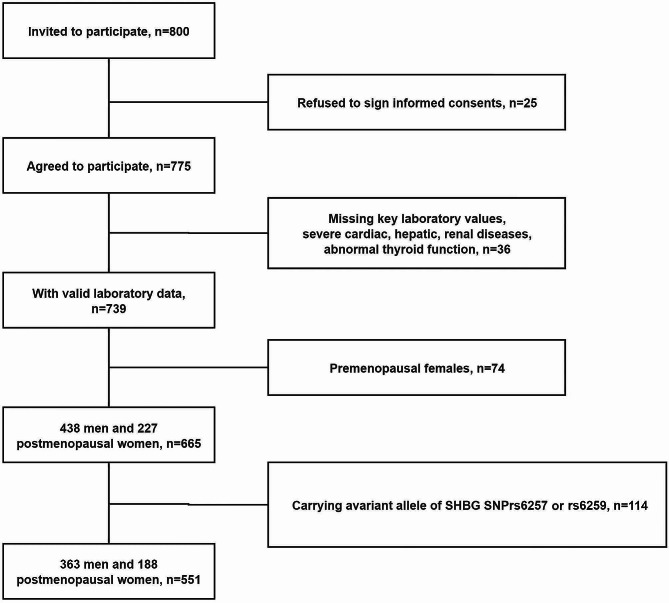 Figure 1
Peer Reviews
No public reviews on file for this paper yet. If you reviewed it on a platform where reviews are public (OpenReview, ICLR, NeurIPS, ICML), you can paste yours below so the community can read it here.
Videos
No videos yet. Explain this paper in a talk, walkthrough, or lecture? Add one.
Taxonomy
TopicsHormonal and reproductive studies · Muscle metabolism and nutrition · Pharmacology and Obesity Treatment