Southeast Asia initiative to combat SARS-CoV-2 variants (SEACOVARIANTS) consortium
Le Nguyen Truc Nhu, Mary Chambers, Narisara Chantratita, Phaik Yeong Cheah, Nicholas P.J. Day, Wanwisa Dejnirattisai, Susanna J. Dunachie, Alba Grifoni, Raph L. Hamers, Jennifer Hill, E. Yvonne Jones, Paul Klenerman, Juthathip Mongkolsapaya, Gavin Screaton, Alessandro Sette

TL;DR
This project builds scientific capacity in Southeast Asia to quickly assess and respond to new SARS-CoV-2 variants and future emerging infections.
Contribution
The project establishes a multidisciplinary platform in Southeast Asia to rapidly evaluate SARS-CoV-2 variants and strengthen local pandemic response capabilities.
Findings
The SEACOVARIANTS consortium will enhance regional scientific capacity for real-time assessment of emerging SARS-CoV-2 variants.
The initiative will create a research network and train scientists in Southeast Asia to lead future outbreak responses.
The project demonstrates that low and middle-income countries can develop novel research platforms to address emerging infections.
Abstract
A strong and effective COVID-19 and future pandemic responses rely on global efforts to carry out surveillance of infections and emerging SARS-CoV-2 variants and to act accordingly in real time. Many countries in Southeast Asia lack capacity to determine the potential threat of new variants, or other emerging infections. Funded by Wellcome, the Southeast Asia initiative to combat SARS-CoV-2 variants (SEACOVARIANTS) consortium aims to develop and apply a multidisciplinary research platform in Southeast Asia (SEA) for rapid assessment of the biological significance of SARS-CoV-2 variants, thereby informing coordinated local, regional and global responses to the COVID-19 pandemic. Our proposal is delivered by the Vietnam and Thailand Wellcome Africa Asia Programmes, bringing together a multidisciplinary team in Indonesia, Thailand and Vietnam with partners in Singapore, the UK and the USA.…
Genes, proteins, chemicals, diseases, species, mutations and cell lines named across the full text — each resolved to its canonical identifier and authoritative record.
Click any figure to enlarge with its caption.
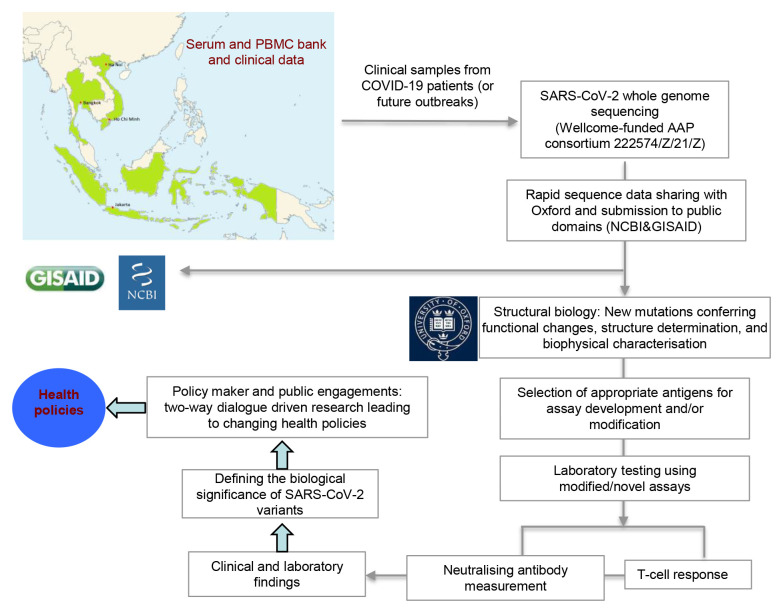 Figure 1
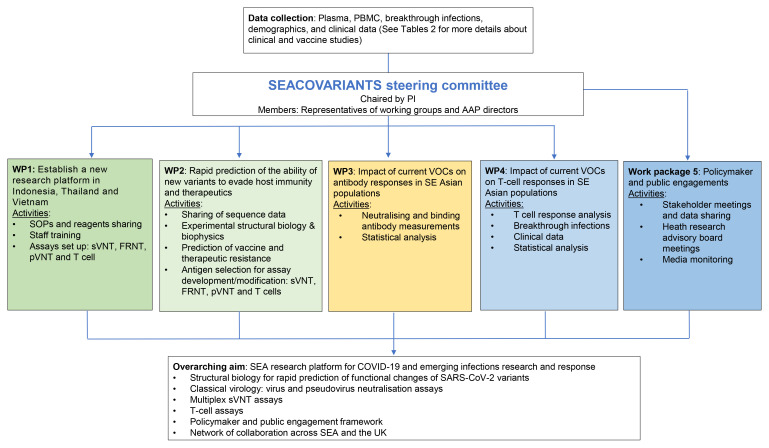 Figure 2
 Figure 3
 Figure 4
 Figure 5
Peer Reviews
No public reviews on file for this paper yet. If you reviewed it on a platform where reviews are public (OpenReview, ICLR, NeurIPS, ICML), you can paste yours below so the community can read it here.
Videos
No videos yet. Explain this paper in a talk, walkthrough, or lecture? Add one.
Taxonomy
TopicsSARS-CoV-2 and COVID-19 Research · COVID-19 epidemiological studies · COVID-19 Clinical Research Studies