Genetic features of BEL-1-producing and KPC-2-producing E. coli from hospital wastewater: human source or sewages adaptation
Laura Romero-Oraá, Marina R. Pulido, Fatima Galán, María Victoria García Palacios, Alvaro Pascual, Lorena López-Cerero

TL;DR
The study investigates E. coli isolates from hospital wastewater that produce BEL-1 and KPC-2 enzymes, suggesting they adapted to sewage rather than coming directly from patients.
Contribution
The paper presents evidence that BEL-1-producing E. coli may have evolved in hospital sewage ecosystems rather than originating from human sources.
Findings
BEL-1 and KPC-2 co-producing E. coli isolates were found in hospital wastewater over 10 months.
The isolates carried similar plasmids with shared genetic regions and a phage-like structure, suggesting in situ adaptation.
No colonized patients were found, supporting the idea that these isolates originated in the sewage environment.
Abstract
Hospital sewage is an ecosystem that facilitates the transfer of antibiotic and heavy metal resistance genes and the interaction of human and environmental bacteria. In this environment, we have detected the presence of 7 KPC-2 and BEL-1 co-producing E. coli isolates of two different clones over a 10-month period in the same hospital. All isolates carried blaKPC-2 and the operon mer on the same IncP plasmid of similar size and an IncN plasmid of different size each clone carrying blaBEL-1. Both IncN-blaBEL-1 plasmids shared a 77 kb region containing blaBEL-1 alongside with fosE, bla OXA-10 and aac(6’)-1b genes in a class 3 integron within a Tn3 transposon. The major IncN plasmid contained in addition a region homolog to P1-like bacteriophage RCS47, including the lytic RepL and lysogenic proteins, but other phage regions were incomplete. The characters such as the temporal persistence in…
Genes, proteins, chemicals, diseases, species, mutations and cell lines named across the full text — each resolved to its canonical identifier and authoritative record.
Click any figure to enlarge with its caption.
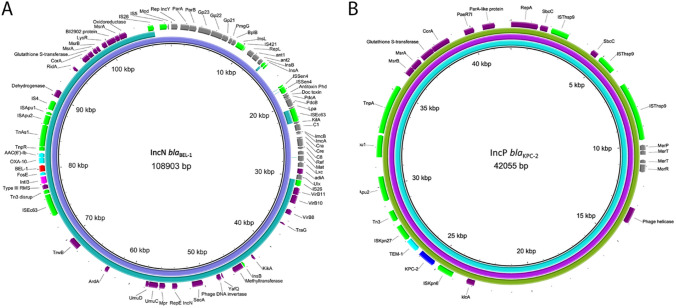 Figure 1
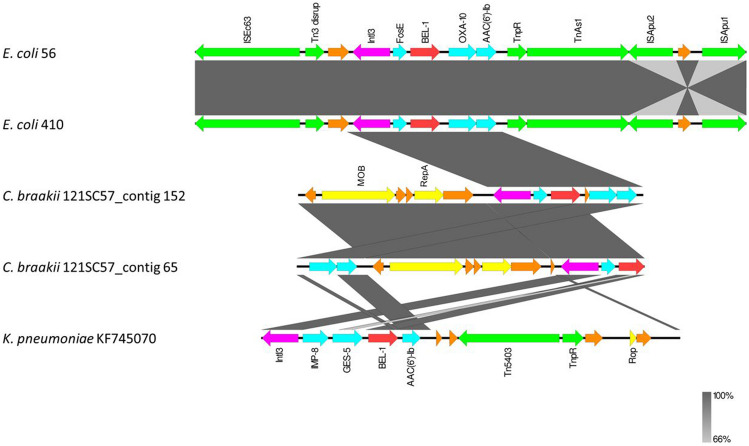 Figure 2
Peer Reviews
No public reviews on file for this paper yet. If you reviewed it on a platform where reviews are public (OpenReview, ICLR, NeurIPS, ICML), you can paste yours below so the community can read it here.
Videos
No videos yet. Explain this paper in a talk, walkthrough, or lecture? Add one.
Taxonomy
TopicsAntibiotic Resistance in Bacteria · Bacterial biofilms and quorum sensing · Bacteriophages and microbial interactions