Socioeconomic Status and Adherence to Preventive Measures During the COVID-19 Pandemic in Switzerland: A Population Based Digital Cohort Analysis
Stefano Tancredi, Bernadette W. A. van der Linden, Arnaud Chiolero, Stéphane Cullati, Medea Imboden, Nicole Probst-Hensch, Dirk Keidel, Melissa Witzig, Julia Dratva, Gisela Michel, Erika Harju, Irene Frank, Elsa Lorthe, Hélène Baysson, Silvia Stringhini, Christian R. Kahlert

TL;DR
This study examines how socioeconomic status in Switzerland affected people's adherence to pandemic measures, finding that income and education influenced behavior after vaccines became widely available.
Contribution
The study reveals that socioeconomic disparities in adherence to preventive measures emerged only after the pandemic's initial phase and vaccine rollout.
Findings
High adherence to preventive measures was observed across all socioeconomic strata before June 2021.
After June 2021, individuals with higher income and education were less likely to adhere to preventive measures.
SES differences in adherence emerged only after vaccines became widely available and restrictions eased.
Abstract
To assess the association between socioeconomic status (SES) and self-reported adherence to preventive measures in Switzerland during the COVID-19 pandemic. 4,299 participants from a digital cohort were followed between September 2020 and November 2021. Baseline equivalised disposable income and education were used as SES proxies. Adherence was assessed over time. We investigated the association between SES and adherence using multivariable mixed logistic regression, stratifying by age (below/above 65 years) and two periods (before/after June 2021, to account for changes in vaccine coverage and epidemiological situation). Adherence was high across all SES strata before June 2021. After, participants with higher equivalised disposable income were less likely to adhere to preventive measures compared to participants in the first (low) quartile [second (Adj.OR, 95% CI) (0.56, 0.37–0.85),…
Genes, proteins, chemicals, diseases, species, mutations and cell lines named across the full text — each resolved to its canonical identifier and authoritative record.
Click any figure to enlarge with its caption.
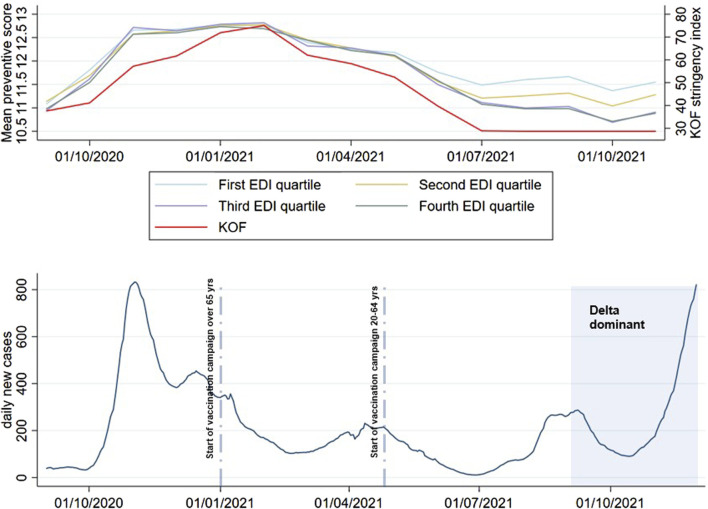 Figure 1
Peer Reviews
No public reviews on file for this paper yet. If you reviewed it on a platform where reviews are public (OpenReview, ICLR, NeurIPS, ICML), you can paste yours below so the community can read it here.
Videos
No videos yet. Explain this paper in a talk, walkthrough, or lecture? Add one.
Taxonomy
TopicsCOVID-19 and Mental Health · Health disparities and outcomes · COVID-19 epidemiological studies