Factorial invariance of the abridged version of the Explicit Discrimination Scale among adults living in southern Brazil
Fabiula Renilda Bernardo, João Luiz Bastos, Michael Eduardo Reichenheim, Fabiula Renilda Bernardo, João Luiz Bastos, Michael Eduardo Reichenheim

TL;DR
This study confirms that a shortened version of a discrimination scale works reliably across different groups in southern Brazil, with one exception for Black respondents with low education.
Contribution
The study demonstrates factorial invariance of two abridged versions of the Explicit Discrimination Scale across demographic groups in Brazil.
Findings
Both abridged versions of the EDS provide comparable discrimination estimates across skin color, sex, and socioeconomic status.
Only one parameter in the seven-item version lacked invariance among Black respondents with less than 12 years of education.
The EDS is valid and reliable for measuring discrimination across diverse population segments in southern Brazil.
Abstract
The Explicit Discrimination Scale (EDS) was developed to assess experiences with discrimination in Brazilian epidemiologic surveys. Though previous analyses have demonstrated that the EDS has good configural, metric, and scalar properties, its invariance has not yet been investigated. In this study, we examined the factorial invariance of two abridged versions of the EDS, according to skin color/ethnicity, sex, socioeconomic status, and their intersections. Data from the EpiFloripa Adult Study were used, which include a representative sample of adults residing in a state capital of southern Brazil (n=1,187). Over half of the respondents were women, and around 90% identified as white; the mean age of the participants was 39 years. Two abridged versions of the EDS were analyzed, with seven and eight items, using Multigroup Confirmatory Analysis and the Alignment method. The two versions…
Genes, proteins, chemicals, diseases, species, mutations and cell lines named across the full text — each resolved to its canonical identifier and authoritative record.
Click any figure to enlarge with its caption.
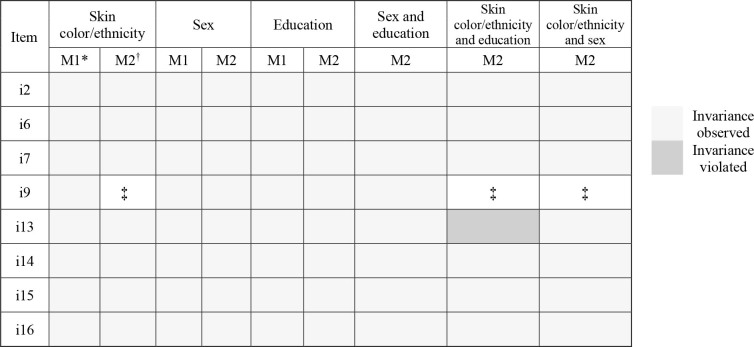 Figure 1
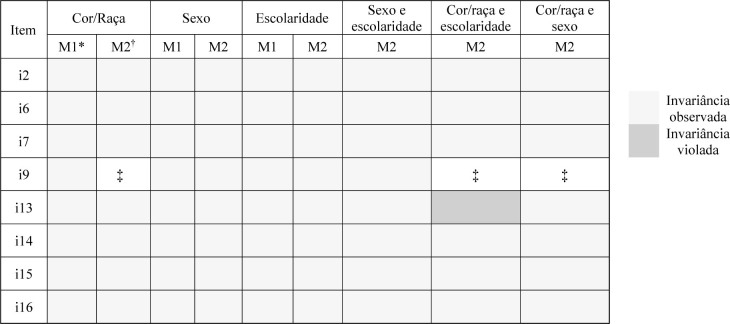 Figure 2
Peer Reviews
No public reviews on file for this paper yet. If you reviewed it on a platform where reviews are public (OpenReview, ICLR, NeurIPS, ICML), you can paste yours below so the community can read it here.
Videos
No videos yet. Explain this paper in a talk, walkthrough, or lecture? Add one.
Taxonomy
TopicsRacial and Ethnic Identity Research · Social and Intergroup Psychology · Gender Roles and Identity Studies