Case report of pharmacokinetic analysis of continuous intravenous infusion of fentanyl in a patient with severe burn: burn shock stage complicates pain management
Takafumi Nakano, Yasuhisa Oida, Shinichi Morimoto, Kentaro Muranishi, Soichiro Ushio, Takuya Yamashina, Masanobu Uchiyama, Kenichi Mishima, Kiyoyuki Kitaichi, Yoshihiko Nakamura, Koichi Matsuo

TL;DR
This case report shows that fentanyl blood levels in a burn patient were too low during the shock phase, requiring adjusted dosing for effective pain management.
Contribution
The study provides novel pharmacokinetic insights into fentanyl infusion in a severe burn patient during the acute shock phase.
Findings
Fentanyl blood concentrations in a burn patient during shock were subtherapeutic despite standard infusion rates.
Fluid resuscitation during burn shock increased fentanyl distribution volume, lowering its concentration.
Fentanyl concentrations improved after the shock phase, even with unchanged infusion rates.
Abstract
Fentanyl is widely used as an analgesic and sedative for patients with severe burn injuries in intensive care units. However, pharmacokinetic (PK) data for fentanyl, particularly for continuous intravenous infusion during the acute phase of burn injuries, are limited. Here, we report the clinical course and changes in blood fentanyl concentrations during the acute phase in a patient with severe burns treated with continuous intravenous infusion of fentanyl. A woman in her 40s, with burns caused by a gas cylinder explosion, was transported to our hospital. The patient had burn wounds on face, neck, shoulders, and all four extremities, with a total burn area of 39.0%. For pain relief, the patient received a continuous infusion of 0.01 mg/mL fentanyl (20–30 µg/h) with a target blood concentration of 1.0–1.5 ng/mL, but continued to suffer from pain due to burning during the acute phase. We…
Genes, proteins, chemicals, diseases, species, mutations and cell lines named across the full text — each resolved to its canonical identifier and authoritative record.
Click any figure to enlarge with its caption.
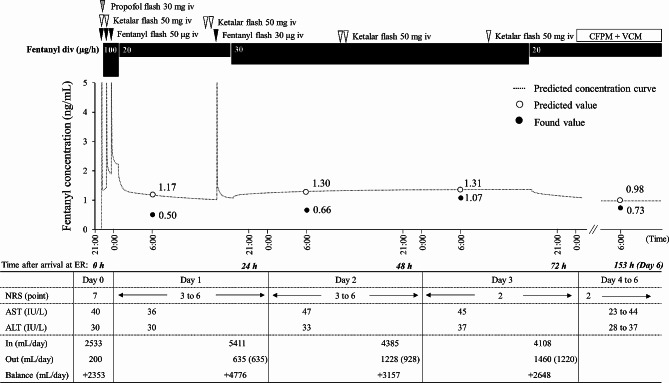 Figure 1
Peer Reviews
No public reviews on file for this paper yet. If you reviewed it on a platform where reviews are public (OpenReview, ICLR, NeurIPS, ICML), you can paste yours below so the community can read it here.
Videos
No videos yet. Explain this paper in a talk, walkthrough, or lecture? Add one.
Taxonomy
TopicsPediatric Pain Management Techniques · Burn Injury Management and Outcomes · Cardiac Arrest and Resuscitation