Clip-anchored floss traction-assisted endoscopic submucosal dissection combined with endoscopic tunneling in treatment of long circumferential early esophageal carcinoma
Wen-juan Ding, Xiang-rong Zhou, Fu-qiang Liu, Zhi-qiang Du, Wei-hui Liu

Abstract
Genes, proteins, chemicals, diseases, species, mutations and cell lines named across the full text — each resolved to its canonical identifier and authoritative record.
Click any figure to enlarge with its caption.
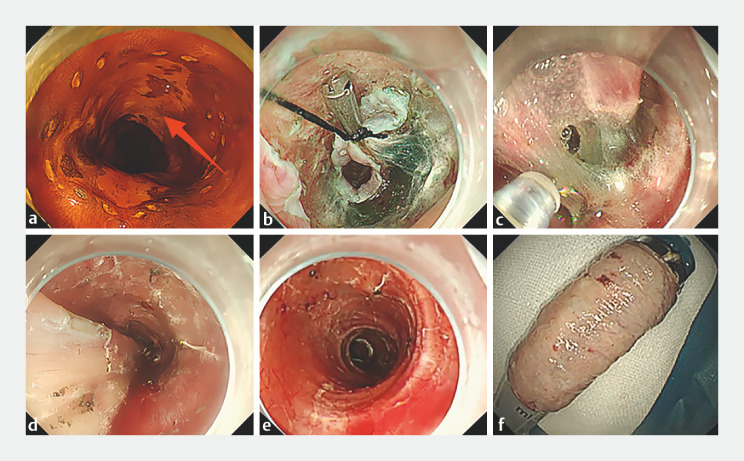 Fig. 1
Peer Reviews
No public reviews on file for this paper yet. If you reviewed it on a platform where reviews are public (OpenReview, ICLR, NeurIPS, ICML), you can paste yours below so the community can read it here.
Videos
No videos yet. Explain this paper in a talk, walkthrough, or lecture? Add one.
Taxonomy
TopicsEsophageal Cancer Research and Treatment · Gastric Cancer Management and Outcomes · Gastroesophageal reflux and treatments
During endoscopic submucosal dissection (ESD) for large esophageal lesions, problems like lumen obstruction caused by distal contraction of the detached tissue, narrow submucosal space, and poor exposure of the submucosa often occur 1 2 3 . Although tunneling techniques can reportedly treat such lesions, they have not been able to resolve the issue of the dissected tissue clogging the lumen, and dissecting the ridges between the tunnels is challenging 4 5 . In this study, we used a tunneling technique combined with floss traction to improve the long circumferential ESD of early esophageal cancer ( Video 1 ).
Clip-anchored floss traction-assisted endoscopic submucosal dissection combined with endoscopic tunneling in the treatment of long circumferential early esophageal carcinoma.Video 1
A 64-year-old woman was treated with ESD for a circular early esophageal cancer 7 cm in length. ( Fig. 1 a ). Circumferential markings and incisions were made at the anal and oral sides of the lesion. The dental floss was fixed to the mucosal flap on the oral side with a clip to apply appropriate traction ( Fig. 1 b ). The submucosal fibers were stretched gently, and the submucosal space was thoroughly exposed; then, a wide tunnel was established from the oral side to the anal edge ( Fig. 1 c ). Continuous traction was applied by pulling the floss, and the dissected tissue clogging the lumen was avoided, hence the lesion was then efficiently dissected ( Fig. 1 d ). After the lesion was fully dissected, it showed a completely circumferential 8-cm surgical wound with a smooth surface and no muscle damage ( Fig. 1 e ). The specimen was easily extracted by simply pulling the floss ( Fig. 1 f ).
a A schematic of the clip-anchored floss traction-assisted endoscopic submucosal dissection combined with endoscopic tunneling in the treatment of long circumferential early esophageal carcinoma. Chromoendoscopy revealed an unstained area measuring 7 cm in length involving the esophageal circumference. b After circumferential incision, the dental floss was fixed to the mucosal flap on the oral side with a clip to apply appropriate traction. c Under continuous traction, the submucosal space was thoroughly exposed, and a wide tunnel was established from the oral side to the anal edge. d The submucosal fibers were gently pulled to prevent contraction of the resected tissue from blocking the surgical field of view and to dissect the lesion. e A completely circumferential 8-cm postoperative wound with smooth surface and no muscle damage was observed. f The en bloc-resected circumferential specimen was retrieved.
The tunneling technique combined with floss traction not only expands the space of the tunnel cavity but also avoids the obstruction of the surgical field of view by contraction of the dissected tissue. In addition, the tension provided significantly reduces the difficulty of dissecting the ridges between the tunnels. As the technology is simple to operate, it may be an attractive option for treating long circumferential early esophageal cancer.
Endoscopy_UCTN_Code_TTT_1AQ_2AD_3AZ
The reference list from the paper itself. Each links out to its DOI / PubMed record.
- 1Aslam SP Abdelrahim M Htet H Traction-assisted circumferential endoscopic submucosal dissection of early esophageal squamous cell carcinoma, followed by metal stent insertion and fixation with a dedicated clip Endoscopy 202254 E 689E 69035180786 10.1055/a-1722-2206 · doi ↗ · pubmed ↗
- 2Ru N Linghu E Chai N Endoscopic submucosal tunnel dissection with an elastic traction device for a circumferential superficial esophageal neoplasm Endoscopy 202355 E 388E 38910.1055/a-2008-027236736357 PMC 9897940 · doi ↗ · pubmed ↗
- 3Zhang T Zhang H Zhong F Efficacy of endoscopic submucosal tunnel dissection versus endoscopic submucosal dissection for superficial esophageal neoplastic lesions: a systematic review and meta-analysis Surg Endosc 202135526210.1007/s 00464-020-07925-632856152 · doi ↗ · pubmed ↗
- 4Zhang W Zhai Y Chai N Single- and double-tunnel endoscopic submucosal tunnel dissection for large superficial esophageal squamous cell neoplasms Endoscopy 20185050551010.1055/s-0043-12238429220859 · doi ↗ · pubmed ↗
- 5Zhai YQ Li HK Linghu EQ Endoscopic submucosal tunnel dissection for large superficial esophageal squamous cell neoplasms World J Gastroentrol 20162243544510.3748/wjg.v 22.i 1.435PMC 469850626755889 · doi ↗ · pubmed ↗